

ROVs. Acronym for remotely operated vehicles – tethered
underwater vehicles under direct control of a human operator at the surface.
Introduction
Remotely operated vehicles (ROVs) and autonomous
underwater vehicles (AUVs) are increasingly used in studies of deep and shallow coral reefs. As a general rule,
AUVs are computer-controlled taxicabs for sensors, need
to continuously maintain some degree of horizontal
motion, and do not collect physical samples. ROVs are
swimming video cameras under direct human control that
can stop and hover, and bring back an object or water
sample to the surface using a manipulator arm or other
mechanical device. However, hybrid AUV/ROVs with
combined attributes now exist for military and geophysical
surveys (e.g., Saab Double Eagle Seaeye http://www.
seaeye.com/doubleeagle.html) and deep ocean oceanography (e.g., WHOI Nereus, which reached the Challenger
Deep, Marianas Trench in June 2009, http://www.whoi.
com/page.do?pid=10076). Hybrid AUV designs are particularly well-suited for the demanding navigational environment of coral reef environments because of their increased
maneuverability (Dunbabin et al., 2004).
AUVs and ROVs allow the collection of data that might
not be otherwise obtainable (Dickey et al., 2008), or at
a reduced risk, or cost, compared to other sampling
methods such as a scuba diver, towed platform, or ship
(Patterson and Relles, 2008). ROVs were initially developed by the defense and oil industries. Maturation of the
technology coupled with decreases in vehicle cost led to
their adoption as a viable research tool by marine scientists
(Stewart and Auster, 1989). In the 1990s, the US National
Oceanic and Atmospheric Administration (NOAA) began
offering ROV access to scientists funded through its
National Undersea Research Program (http://explore.
noaa.gov/). AUV technology had an intense research and
development phase during the 1990s funded largely by
national defense agencies (Curtin et al., 1993; Kunzig,
1996), with commercial vehicles not widely available
until around 2000. NOAA added AUV access beginning
in 2005 (http://uncw.edu/nurc/auv/glider/pressreleases.
htm). During the past decade, many academic and government institutions purchased commercial AUVs, or
transitioned their in-house engineering development AUVs
to working research platforms.
ROV technology
ROVs range in mass from a few kilograms to several tons,
with tethers a few hundred meters to full-ocean depth
in length. All ROVs possess a video camera or highfrequency imaging sonar to allow the surface operator to
drive the vehicle by visual feedback from the image transmitted over the tether. Maneuvering is provided by orthogonal thrusters that allow independent control of vertical
and horizontal motion, including rotation around the
ROV’s vertical axis. ROVs are usually weighted to almost
neutral buoyancy, allowing them to hover. Most ROVs are
supplied with power through the tether, although deepwater ROVs may carry battery power on the vehicle
instead, and use the tether only for image transmission
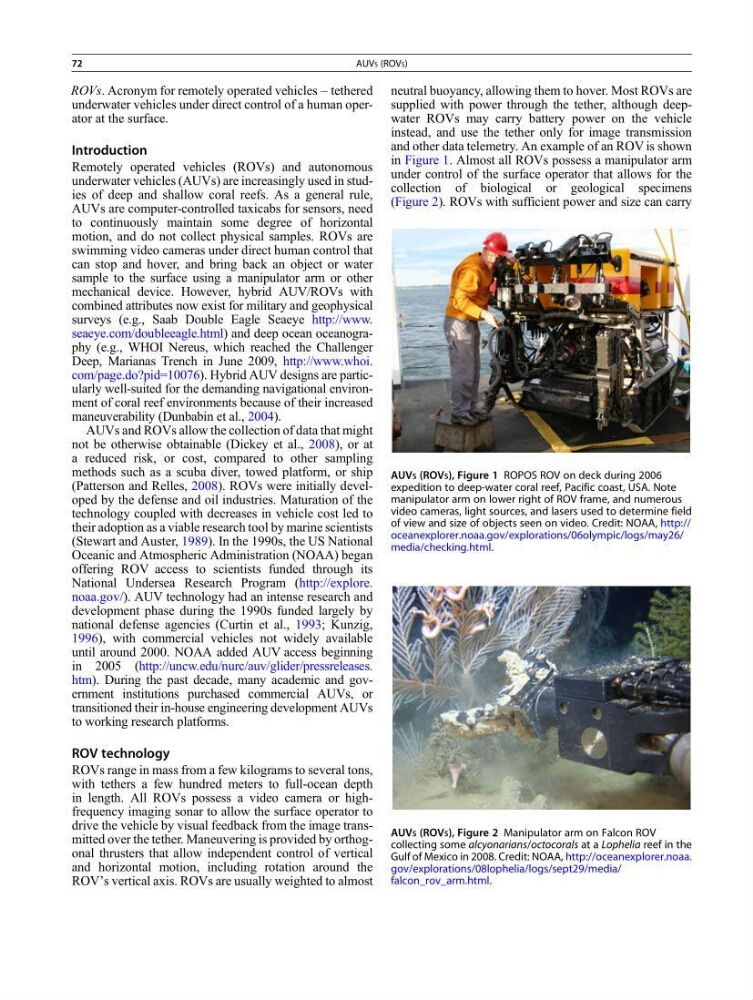
and other data telemetry. An example of an ROV is shown
in Figure 1. Almost all ROVs possess a manipulator arm
under control of the surface operator that allows for the
collection of biological or geological specimens
(Figure 2). ROVs with sufficient power and size can carry
AUVS (ROVS), Figure 1 ROPOS ROV on deck during 2006
expedition to deep-water coral reef, Pacific coast, USA. Note
manipulator arm on lower right of ROV frame, and numerous
video cameras, light sources, and lasers used to determine field
of view and size of objects seen on video. Credit: NOAA, http://
oceanexplorer.noaa.gov/explorations/06olympic/logs/may26/
media/checking.html.
AUVS (ROVS), Figure 2 Manipulator arm on Falcon ROV
collecting some alcyonarians/octocorals at a Lophelia reef in the
Gulf of Mexico in 2008. Credit: NOAA, http://oceanexplorer.noaa.
gov/explorations/08lophelia/logs/sept29/media/
falcon_rov_arm.html.
72
AUVS (ROVS)
underwater vehicles under direct control of a human operator at the surface.
Introduction
Remotely operated vehicles (ROVs) and autonomous
underwater vehicles (AUVs) are increasingly used in studies of deep and shallow coral reefs. As a general rule,
AUVs are computer-controlled taxicabs for sensors, need
to continuously maintain some degree of horizontal
motion, and do not collect physical samples. ROVs are
swimming video cameras under direct human control that
can stop and hover, and bring back an object or water
sample to the surface using a manipulator arm or other
mechanical device. However, hybrid AUV/ROVs with
combined attributes now exist for military and geophysical
surveys (e.g., Saab Double Eagle Seaeye http://www.
seaeye.com/doubleeagle.html) and deep ocean oceanography (e.g., WHOI Nereus, which reached the Challenger
Deep, Marianas Trench in June 2009, http://www.whoi.
com/page.do?pid=10076). Hybrid AUV designs are particularly well-suited for the demanding navigational environment of coral reef environments because of their increased
maneuverability (Dunbabin et al., 2004).
AUVs and ROVs allow the collection of data that might
not be otherwise obtainable (Dickey et al., 2008), or at
a reduced risk, or cost, compared to other sampling
methods such as a scuba diver, towed platform, or ship
(Patterson and Relles, 2008). ROVs were initially developed by the defense and oil industries. Maturation of the
technology coupled with decreases in vehicle cost led to
their adoption as a viable research tool by marine scientists
(Stewart and Auster, 1989). In the 1990s, the US National
Oceanic and Atmospheric Administration (NOAA) began
offering ROV access to scientists funded through its
National Undersea Research Program (http://explore.
noaa.gov/). AUV technology had an intense research and
development phase during the 1990s funded largely by
national defense agencies (Curtin et al., 1993; Kunzig,
1996), with commercial vehicles not widely available
until around 2000. NOAA added AUV access beginning
in 2005 (http://uncw.edu/nurc/auv/glider/pressreleases.
htm). During the past decade, many academic and government institutions purchased commercial AUVs, or
transitioned their in-house engineering development AUVs
to working research platforms.
ROV technology
ROVs range in mass from a few kilograms to several tons,
with tethers a few hundred meters to full-ocean depth
in length. All ROVs possess a video camera or highfrequency imaging sonar to allow the surface operator to
drive the vehicle by visual feedback from the image transmitted over the tether. Maneuvering is provided by orthogonal thrusters that allow independent control of vertical
and horizontal motion, including rotation around the
ROV’s vertical axis. ROVs are usually weighted to almost
neutral buoyancy, allowing them to hover. Most ROVs are
supplied with power through the tether, although deepwater ROVs may carry battery power on the vehicle
instead, and use the tether only for image transmission
and other data telemetry. An example of an ROV is shown
in Figure 1. Almost all ROVs possess a manipulator arm
under control of the surface operator that allows for the
collection of biological or geological specimens
(Figure 2). ROVs with sufficient power and size can carry
AUVS (ROVS), Figure 1 ROPOS ROV on deck during 2006
expedition to deep-water coral reef, Pacific coast, USA. Note
manipulator arm on lower right of ROV frame, and numerous
video cameras, light sources, and lasers used to determine field
of view and size of objects seen on video. Credit: NOAA, http://
oceanexplorer.noaa.gov/explorations/06olympic/logs/may26/
media/checking.html.
AUVS (ROVS), Figure 2 Manipulator arm on Falcon ROV
collecting some alcyonarians/octocorals at a Lophelia reef in the
Gulf of Mexico in 2008. Credit: NOAA, http://oceanexplorer.noaa.
gov/explorations/08lophelia/logs/sept29/media/
falcon_rov_arm.html.
72
AUVS (ROVS)