

30 0
N
20 0
Light and Nutrients in the Indian Ocean
61
200.~--~~~~--~--,~
6O".f--'""'f;~+--+S
70°L-~~~~-1~~~~L__L __ L_~~~~~~v
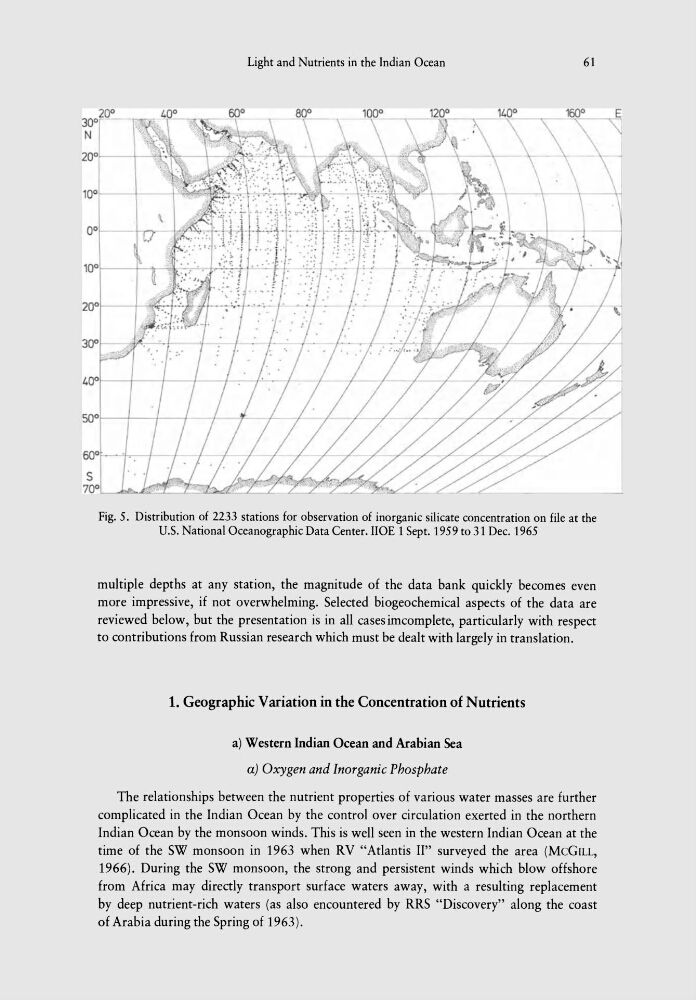
Fig. 5. Distribution of 2233 stations for observation of inorganic silicate concentration on file at the
U.S. National Oceanographic Data Center. HOE 1 Sept. 1959 to 31 Dec. 1965
multiple depths at any station, the magnitude of the data bank quickly becomes even
more impressive, if not overwhelming. Selected biogeochemical aspects of the data are
reviewed below, but the presentation is in all casesimcomplete, particularly with respect
to contributions from Russian research which must be dealt with largely in translation.
1. Geographic Variation in the Concentration of Nutrients
a) Western Indian Ocean and Arabian Sea
a) Oxygen and Inorganic Phosphate
The relationships between the nutrient properties of various water masses are further
complicated in the Indian Ocean by the control over circulation exerted in the northern
Indian Ocean by the monsoon winds. This is well seen in the western Indian Ocean at the
time of the SW monsoon in 1963 when RV "Atlantis II" surveyed the area (M CGILL,
1966). During the SW monsoon, the strong and persistent winds which blow offshore
from Africa may directly transport surface waters away, with a resulting replacement
by deep nutrient-rich waters (as also encountered by RRS "Discovery" along the coast
of Arabia during the Spring of 1963 ).
J
N
20 0
Light and Nutrients in the Indian Ocean
61
200.~--~~~~--~--,~
6O".f--'""'f;~+--+S
70°L-~~~~-1~~~~L__L __ L_~~~~~~v
Fig. 5. Distribution of 2233 stations for observation of inorganic silicate concentration on file at the
U.S. National Oceanographic Data Center. HOE 1 Sept. 1959 to 31 Dec. 1965
multiple depths at any station, the magnitude of the data bank quickly becomes even
more impressive, if not overwhelming. Selected biogeochemical aspects of the data are
reviewed below, but the presentation is in all casesimcomplete, particularly with respect
to contributions from Russian research which must be dealt with largely in translation.
1. Geographic Variation in the Concentration of Nutrients
a) Western Indian Ocean and Arabian Sea
a) Oxygen and Inorganic Phosphate
The relationships between the nutrient properties of various water masses are further
complicated in the Indian Ocean by the control over circulation exerted in the northern
Indian Ocean by the monsoon winds. This is well seen in the western Indian Ocean at the
time of the SW monsoon in 1963 when RV "Atlantis II" surveyed the area (M CGILL,
1966). During the SW monsoon, the strong and persistent winds which blow offshore
from Africa may directly transport surface waters away, with a resulting replacement
by deep nutrient-rich waters (as also encountered by RRS "Discovery" along the coast
of Arabia during the Spring of 1963 ).
J