

42
R. I. CURRIE, A. E. FISHER and P. M. HARGREAVES:
The lack of continuity identifiable between the individual transects also suggests that
much of the temporal and spatial scale of the circulation was of smaller magnitude than
could be resolved by the observations. BorrERO (1969) from a numerical analysis of
the physical data confirms that upwelling extends at least 400 km offshore and parallels
the Arabian coast for a distance of over 1000 km. It is most intense in a narrow band
adjacent to the coast.
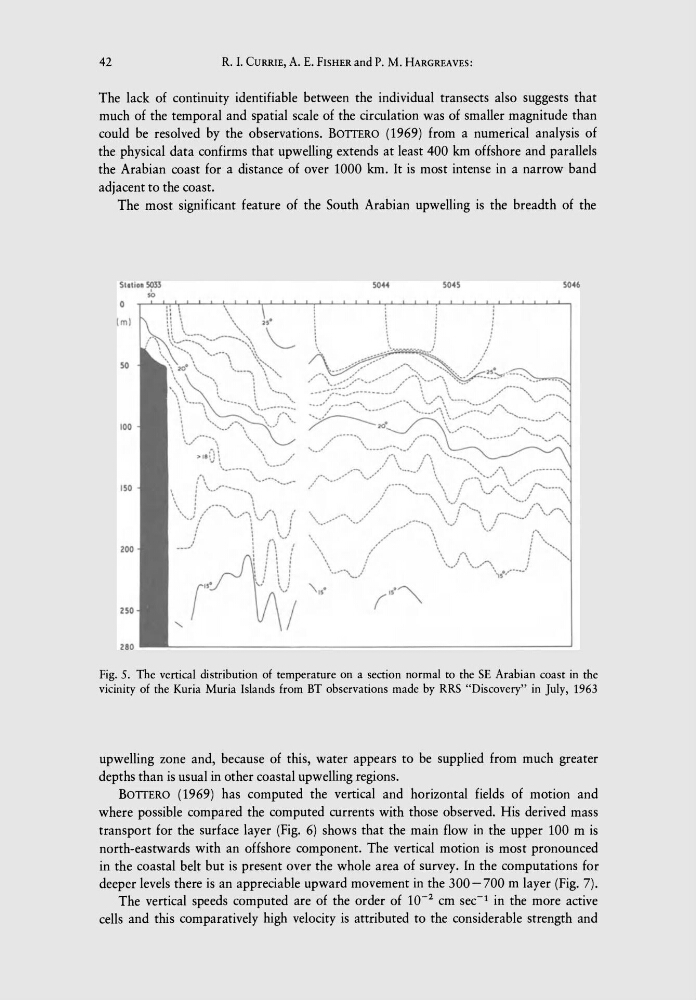
The most significant feature of the South Arabian upwelling is the breadth of the
Stotlo. son
o
Iml
50
100
150
zoo
250
Z80
.0
5044
5045
5046
Fig. 5. The vertical distribution of temperature on a section normal to the SE Arabian coast in the
vicinity of the Kuria Muria Islands from BT observations made by RRS "Discovery" in July, 1963
upwelling zone and, because of this, water appears to be supplied from much greater
depths than is usual in other coastal upwelling regions.
BorrERO (1969) has computed the vertical and horizontal fields of motion and
where possible compared the computed currents with those observed. His derived mass
transport for the surface layer (Fig. 6) shows that the main flow in the upper 100 m is
north-eastwards with an offshore component. The vertical motion is most pronounced
in the coastal belt but is present over the whole area of survey. In the computations for
deeper levels there is an appreciable upward movement in the 300-700 m layer (Fig. 7).
The vertical speeds computed are of the order of 10- 2 cm sec- 1 in the more active
cells and this comparatively high velocity is attributed to the considerable strength and
R. I. CURRIE, A. E. FISHER and P. M. HARGREAVES:
The lack of continuity identifiable between the individual transects also suggests that
much of the temporal and spatial scale of the circulation was of smaller magnitude than
could be resolved by the observations. BorrERO (1969) from a numerical analysis of
the physical data confirms that upwelling extends at least 400 km offshore and parallels
the Arabian coast for a distance of over 1000 km. It is most intense in a narrow band
adjacent to the coast.
The most significant feature of the South Arabian upwelling is the breadth of the
Stotlo. son
o
Iml
50
100
150
zoo
250
Z80
.0
5044
5045
5046
Fig. 5. The vertical distribution of temperature on a section normal to the SE Arabian coast in the
vicinity of the Kuria Muria Islands from BT observations made by RRS "Discovery" in July, 1963
upwelling zone and, because of this, water appears to be supplied from much greater
depths than is usual in other coastal upwelling regions.
BorrERO (1969) has computed the vertical and horizontal fields of motion and
where possible compared the computed currents with those observed. His derived mass
transport for the surface layer (Fig. 6) shows that the main flow in the upper 100 m is
north-eastwards with an offshore component. The vertical motion is most pronounced
in the coastal belt but is present over the whole area of survey. In the computations for
deeper levels there is an appreciable upward movement in the 300-700 m layer (Fig. 7).
The vertical speeds computed are of the order of 10- 2 cm sec- 1 in the more active
cells and this comparatively high velocity is attributed to the considerable strength and