

Seasonal Studies of a Pelagic Ecosystem (Meridian 110
0
E)
499
followed by Copelata and Thaliacea, two herbivorous groups (80%). For zooplankton
biomass, micronekton dry weight, and phytoplankton (chlorophyll a), the variation was
much the same (25%) but higher for (light-saturated) primary productivity. The seasonal
amplitude of nitrate was 4 times that of phosphate.
Table 3 shows seasonal amplitudes separately for tropical and subtropical zones,
by day and night. In general, there was a greater day-night difference in seasonal amplitude
for the tropics than for the sub tropics, particularly in the case of fish eggs and larvae
and Copepoda (day> night) and Thaliaceae (night> day). In some cases there was a
marked zonal difference in seasonal amplitude, for example for the copepod species
Rhincalanus nasutus (greater in subtropics) and Eucalanus subtenuis (greater in tropics).
Elsewhere, differences were slight.
E
x
. .
a.
'" 0
SEASONAL VARIATION r%) *
50
100
150
200
250
OT---------~~~~----~---------L----------~--------_i
1:' 1 0. ••••••••
0 ••• ··~~:;;o
500
1000
1500
~~
i III
to' ........
~
~
0-------0 CALANUS HYPERBOREUS : DEPTH PROFILE}
.--:It
: COLUMN MEAN
_5T ... T,1955
0 __ .. - __ -0 JmINCALANUS GIGAS : OE:PTH PROFILE}
1(00 .......... ·"x
: COLUMN r..tEAN
MACkINTOSH, 1937
* COEFFICIENT OF VARIATION
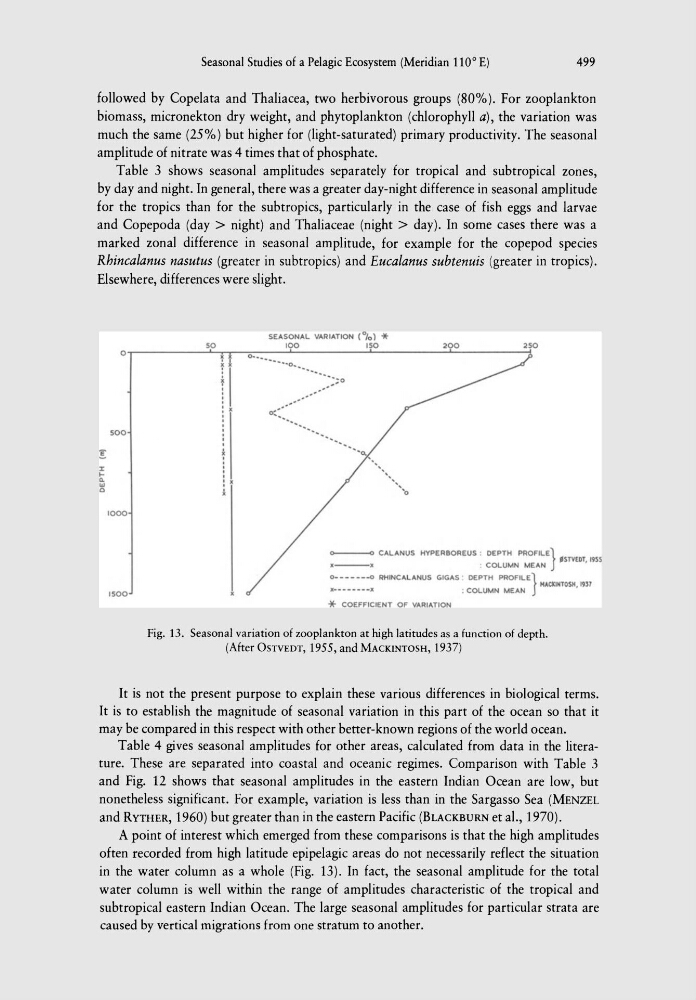
Fig. 13. Seasonal variation of zooplankton at high latitudes as a function of depth.
(After OSTVEDT, 1955, and MACKINTOSH, 1937)
It is not the present purpose to explain these various differences in biological terms.
It is to establish the magnitude of seasonal variation in this part of the ocean so that it
may be compared in this respect with other better-known regions of the world ocean.
Table 4 gives seasonal amplitudes for other areas, calculated from data in the literature. These are separated into coastal and oceanic regimes. Comparison with Table 3
and Fig. 12 shows that seasonal amplitudes in the eastern Indian Ocean are low, but
nonetheless significant. For example, variation is less than in the Sargasso Sea (MENZEL
and RYTHER, 1960) but greater than in the eastern Pacific (BLACKBURN et aI., 1970).
A point of interest which emerged from these comparisons is that the high amplitudes
often recorded from high latitude epipelagic areas do not necessarily reflect the situation
in the water column as a whole (Fig. 13). In fact, the seasonal amplitude for the total
water column is well within the range of amplitudes characteristic of the tropical and
subtropical eastern Indian Ocean. The large seasonal amplitudes for particular strata are
caused by vertical migrations from one stratum to another.
0
E)
499
followed by Copelata and Thaliacea, two herbivorous groups (80%). For zooplankton
biomass, micronekton dry weight, and phytoplankton (chlorophyll a), the variation was
much the same (25%) but higher for (light-saturated) primary productivity. The seasonal
amplitude of nitrate was 4 times that of phosphate.
Table 3 shows seasonal amplitudes separately for tropical and subtropical zones,
by day and night. In general, there was a greater day-night difference in seasonal amplitude
for the tropics than for the sub tropics, particularly in the case of fish eggs and larvae
and Copepoda (day> night) and Thaliaceae (night> day). In some cases there was a
marked zonal difference in seasonal amplitude, for example for the copepod species
Rhincalanus nasutus (greater in subtropics) and Eucalanus subtenuis (greater in tropics).
Elsewhere, differences were slight.
E
x
. .
a.
'" 0
SEASONAL VARIATION r%) *
50
100
150
200
250
OT---------~~~~----~---------L----------~--------_i
1:' 1 0. ••••••••
0 ••• ··~~:;;o
500
1000
1500
~~
i III
to' ........
~
~
0-------0 CALANUS HYPERBOREUS : DEPTH PROFILE}
.--:It
: COLUMN MEAN
_5T ... T,1955
0 __ .. - __ -0 JmINCALANUS GIGAS : OE:PTH PROFILE}
1(00 .......... ·"x
: COLUMN r..tEAN
MACkINTOSH, 1937
* COEFFICIENT OF VARIATION
Fig. 13. Seasonal variation of zooplankton at high latitudes as a function of depth.
(After OSTVEDT, 1955, and MACKINTOSH, 1937)
It is not the present purpose to explain these various differences in biological terms.
It is to establish the magnitude of seasonal variation in this part of the ocean so that it
may be compared in this respect with other better-known regions of the world ocean.
Table 4 gives seasonal amplitudes for other areas, calculated from data in the literature. These are separated into coastal and oceanic regimes. Comparison with Table 3
and Fig. 12 shows that seasonal amplitudes in the eastern Indian Ocean are low, but
nonetheless significant. For example, variation is less than in the Sargasso Sea (MENZEL
and RYTHER, 1960) but greater than in the eastern Pacific (BLACKBURN et aI., 1970).
A point of interest which emerged from these comparisons is that the high amplitudes
often recorded from high latitude epipelagic areas do not necessarily reflect the situation
in the water column as a whole (Fig. 13). In fact, the seasonal amplitude for the total
water column is well within the range of amplitudes characteristic of the tropical and
subtropical eastern Indian Ocean. The large seasonal amplitudes for particular strata are
caused by vertical migrations from one stratum to another.