

460
D. M. COHEN:
manuscripts and notes; and from NIELSEN, 1969). This order contains fishes from a wide
diversity of habitats, but the present discussion is limited to the 43 Indian Ocean species
which as adults live on or close to the bottom at depths from about 250 to 4 800 m.
Particularly notable is the high degree of endemism in the Indian Ocean, with 58% of
the species found there only. There are also distinct separations within the Indian Ocean:
western Indian Ocean, 35%; eastern Indian Ocean, 9%, common to both, 14%; eastern
Indian Ocean and to the east, 7%; and widespread species, 35%. Slope and abyssal fishes
seem to have more restricted distributions than do shore or shelf fishes.
There are no deepwater ophidioids known from the Red Sea, and MARSHALL and
BOURNE (1964) note that the deep-sea benthic fish fauna in general is very small, consisting
of but 6 species. This they attribute to the 150 m sill which serves as a barrier to the ingress
of species from the open sea, and to the warmer water at comparable depths.
4. Tropical Epipelagic
The epipelagic fish fauna, which is small and relatively well studied, has been the
subject of a scholarly treatise by PARIN (1968), who stressed the diversity of the fauna
and classified its ecological origins. He distinguished between littoral and oceanic species,
plankton and nekton, permanently epipelagic species and those that are temporarily
so, and finally between species that are only accidental visitors from the shore or deeper
water, as distinguished from obligatory visitors. I have analyzed the distributions of
2 groups of fishes that as adults are found chiefly, though not entirely, in the upper pelagic
of the littoral.
Family Belonidae, the needlefishes, is circumtropical and temperate with about
30 species. Needlefishes may average a meter in length and are active swimmers. Their
eggs have sticky filaments and attach to floating objects. The tropical Indian Ocean
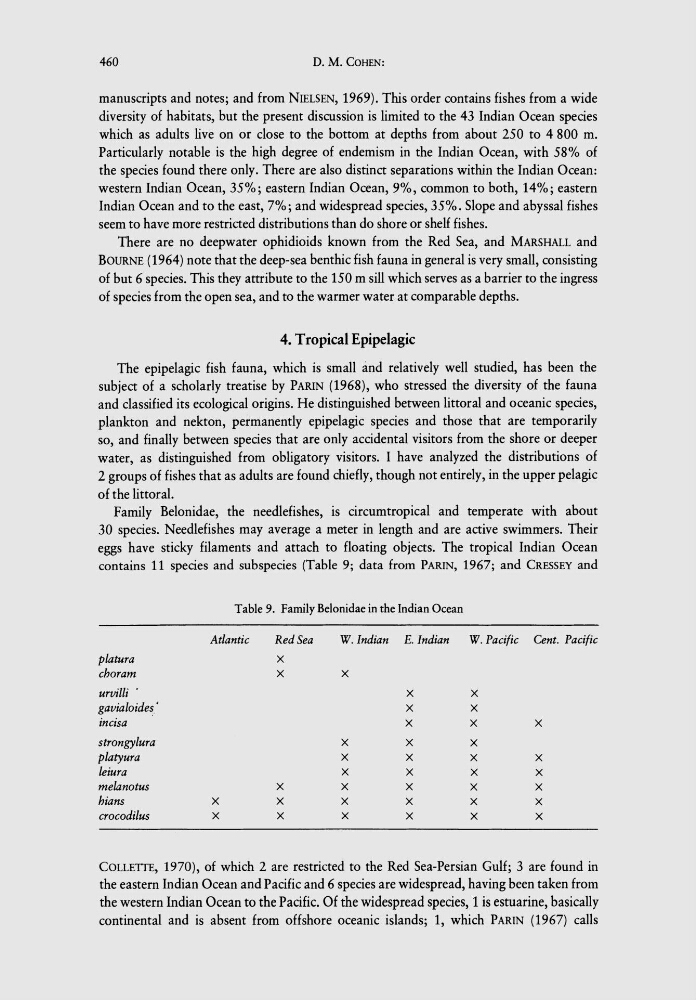
contains 11 species and subspecies (Table 9; data from PARIN, 1967; and CRESSEY and
Table 9. Family Belonidae in the Indian Ocean
Atlantic
Red Sea
W. Indian E. Indian
W. Pacific Cent. Pacific
platura
X
choram
X
X
urvilli .
X
X
gavialoides
X
X
incisa
X
X
X
strongylura
X
X
X
platyura
X
X
X
X
leiura
X
X
X
X
melanotus
X
X
X
X
X
hians
X
X
X
X
X
X
crocodilus
X
X
X
X
X
X
COLLETfE, 1970), of which 2 are restricted to the Red Sea-Persian Gulf; 3 are found in
the eastern Indian Ocean and Pacific and 6 species are widespread, having been taken from
the western Indian Ocean to the Pacific. Of the widespread species, 1 is estuarine, basically
continental and is absent from offshore oceanic islands; 1, which PARIN (1967) calls
D. M. COHEN:
manuscripts and notes; and from NIELSEN, 1969). This order contains fishes from a wide
diversity of habitats, but the present discussion is limited to the 43 Indian Ocean species
which as adults live on or close to the bottom at depths from about 250 to 4 800 m.
Particularly notable is the high degree of endemism in the Indian Ocean, with 58% of
the species found there only. There are also distinct separations within the Indian Ocean:
western Indian Ocean, 35%; eastern Indian Ocean, 9%, common to both, 14%; eastern
Indian Ocean and to the east, 7%; and widespread species, 35%. Slope and abyssal fishes
seem to have more restricted distributions than do shore or shelf fishes.
There are no deepwater ophidioids known from the Red Sea, and MARSHALL and
BOURNE (1964) note that the deep-sea benthic fish fauna in general is very small, consisting
of but 6 species. This they attribute to the 150 m sill which serves as a barrier to the ingress
of species from the open sea, and to the warmer water at comparable depths.
4. Tropical Epipelagic
The epipelagic fish fauna, which is small and relatively well studied, has been the
subject of a scholarly treatise by PARIN (1968), who stressed the diversity of the fauna
and classified its ecological origins. He distinguished between littoral and oceanic species,
plankton and nekton, permanently epipelagic species and those that are temporarily
so, and finally between species that are only accidental visitors from the shore or deeper
water, as distinguished from obligatory visitors. I have analyzed the distributions of
2 groups of fishes that as adults are found chiefly, though not entirely, in the upper pelagic
of the littoral.
Family Belonidae, the needlefishes, is circumtropical and temperate with about
30 species. Needlefishes may average a meter in length and are active swimmers. Their
eggs have sticky filaments and attach to floating objects. The tropical Indian Ocean
contains 11 species and subspecies (Table 9; data from PARIN, 1967; and CRESSEY and
Table 9. Family Belonidae in the Indian Ocean
Atlantic
Red Sea
W. Indian E. Indian
W. Pacific Cent. Pacific
platura
X
choram
X
X
urvilli .
X
X
gavialoides
X
X
incisa
X
X
X
strongylura
X
X
X
platyura
X
X
X
X
leiura
X
X
X
X
melanotus
X
X
X
X
X
hians
X
X
X
X
X
X
crocodilus
X
X
X
X
X
X
COLLETfE, 1970), of which 2 are restricted to the Red Sea-Persian Gulf; 3 are found in
the eastern Indian Ocean and Pacific and 6 species are widespread, having been taken from
the western Indian Ocean to the Pacific. Of the widespread species, 1 is estuarine, basically
continental and is absent from offshore oceanic islands; 1, which PARIN (1967) calls