

454
D.M. COHEN:
The western Indian Ocean is taken to include the Persian Gulf and the Red Sea, unless
otherwise indicated. The boundary between the western and the eastern Indian Ocean
is the longitude of Cape Comorin at the southern tip of India. Western Pacific includes the
Indo-Australian Archipelago, the Great Barrier Reef, the China Sea, the Philippines and
Japan. The dividing line between the eastern Indian Ocean and the western Pacific on
the north coasts of Western Australia is taken as Cape Talbot.
Unequal sampling is a possible source of error, as the coral reef areas (and perhaps
other habitats as well) of the western Indian Ocean probably have been better collected
than those of the eastern Indian Ocean.
III. Distributions of Fishes Living in Various Habitats
1. Tropical Shore
The Indian Ocean may contain between 3 000 and 4 000 species of tropical shore
fishes. Although many of these are named, very few have been accorded taxonomic
attention sufficient to allow their use in zoogeography. I have examined the distributional
data on 91 species in 6 taxonomic groups and find 2 reasonably coherent distribution
patterns.
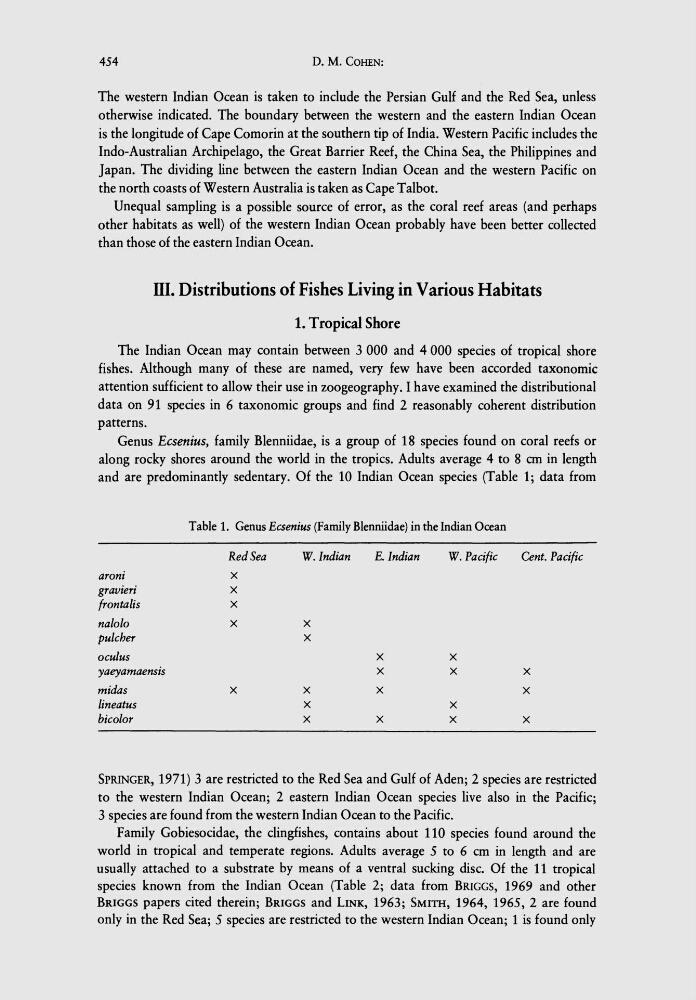
Genus Ecsenius, family Blenniidae, is a group of 18 species found on coral reefs or
along rocky shores around the world in the tropics. Adults average 4 to 8 em in length
and are predominantly sedentary. Of the 10 Indian Ocean species (Table 1; data from
aroni
gravieri
frontalis
nalolo
pulcher
oculus
yaeyamaensis
midas
lineatus
hicolor
Table 1. Genus Ecsenius (Family Blenniidae) in the Indian Ocean
Red Sea
X
X
X
X
X
W. Indian
X
X
X
X
X
E. Indian
X
X
X
X
W. Pacific
X
X
X
X
Cent. Pacific
X
X
X
SPRINGER, 1971) 3 are restricted to the Red Sea and Gulf of Aden; 2 species are restricted
to the western Indian Ocean; 2 eastern Indian Ocean species live also in the Pacific;
3 species are found from the western Indian Ocean to the Pacific.
Family Gobiesocidae, the clingfishes, contains about 110 species found around the
world in tropical and temperate regions. Adults average 5 to 6 cm in length and are
usually attached to a substrate by means of a ventral sucking disc. Of the 11 tropical
species known from the Indian Ocean (Table 2; data from BRIGGS, 1969 and other
BRIGGS papers cited therein; BRIGGS and LINK, 1963; SMITH, 1964, 1965, 2 are found
only in the Red Sea; 5 species are restricted to the western Indian Ocean; 1 is found only
D.M. COHEN:
The western Indian Ocean is taken to include the Persian Gulf and the Red Sea, unless
otherwise indicated. The boundary between the western and the eastern Indian Ocean
is the longitude of Cape Comorin at the southern tip of India. Western Pacific includes the
Indo-Australian Archipelago, the Great Barrier Reef, the China Sea, the Philippines and
Japan. The dividing line between the eastern Indian Ocean and the western Pacific on
the north coasts of Western Australia is taken as Cape Talbot.
Unequal sampling is a possible source of error, as the coral reef areas (and perhaps
other habitats as well) of the western Indian Ocean probably have been better collected
than those of the eastern Indian Ocean.
III. Distributions of Fishes Living in Various Habitats
1. Tropical Shore
The Indian Ocean may contain between 3 000 and 4 000 species of tropical shore
fishes. Although many of these are named, very few have been accorded taxonomic
attention sufficient to allow their use in zoogeography. I have examined the distributional
data on 91 species in 6 taxonomic groups and find 2 reasonably coherent distribution
patterns.
Genus Ecsenius, family Blenniidae, is a group of 18 species found on coral reefs or
along rocky shores around the world in the tropics. Adults average 4 to 8 em in length
and are predominantly sedentary. Of the 10 Indian Ocean species (Table 1; data from
aroni
gravieri
frontalis
nalolo
pulcher
oculus
yaeyamaensis
midas
lineatus
hicolor
Table 1. Genus Ecsenius (Family Blenniidae) in the Indian Ocean
Red Sea
X
X
X
X
X
W. Indian
X
X
X
X
X
E. Indian
X
X
X
X
W. Pacific
X
X
X
X
Cent. Pacific
X
X
X
SPRINGER, 1971) 3 are restricted to the Red Sea and Gulf of Aden; 2 species are restricted
to the western Indian Ocean; 2 eastern Indian Ocean species live also in the Pacific;
3 species are found from the western Indian Ocean to the Pacific.
Family Gobiesocidae, the clingfishes, contains about 110 species found around the
world in tropical and temperate regions. Adults average 5 to 6 cm in length and are
usually attached to a substrate by means of a ventral sucking disc. Of the 11 tropical
species known from the Indian Ocean (Table 2; data from BRIGGS, 1969 and other
BRIGGS papers cited therein; BRIGGS and LINK, 1963; SMITH, 1964, 1965, 2 are found
only in the Red Sea; 5 species are restricted to the western Indian Ocean; 1 is found only