

Zoogeography of the Fishes of the Indian Ocean
453
of distribution of reef building corals, and for marine organisms dwelling close to shore
is accepted as the approximate boundary between tropical and temperate regions.
EKMAN (1953) and others have divided the shallow water tropical marine faunas of the
world into 4 sections: eastern Pacific, western Atlantic, eastern Atlantic and, largest
of all, Indo-Pacific. It is the last of these with which we are here chiefly concerned, and
I can do no better than to quote from MYERS (1941). "By far the richest of the 4 tropical
shore fish faunas is the Indo-Pacific, and it contains practically all the families and a
considerable number of the genera that make up the fauna of the other 3, in addition to
many families and genera not found elsewhere ... "
"The geographical boundaries of the Indo-Pacific shore fish fauna are, in general,
the area from Natal to the head of the Red Sea and the coasts and islands eastward to the
2()oN
Central
'()Os ~ .~~t:=r~~~~1
•
Subantarctic
200
600
abo
1200E
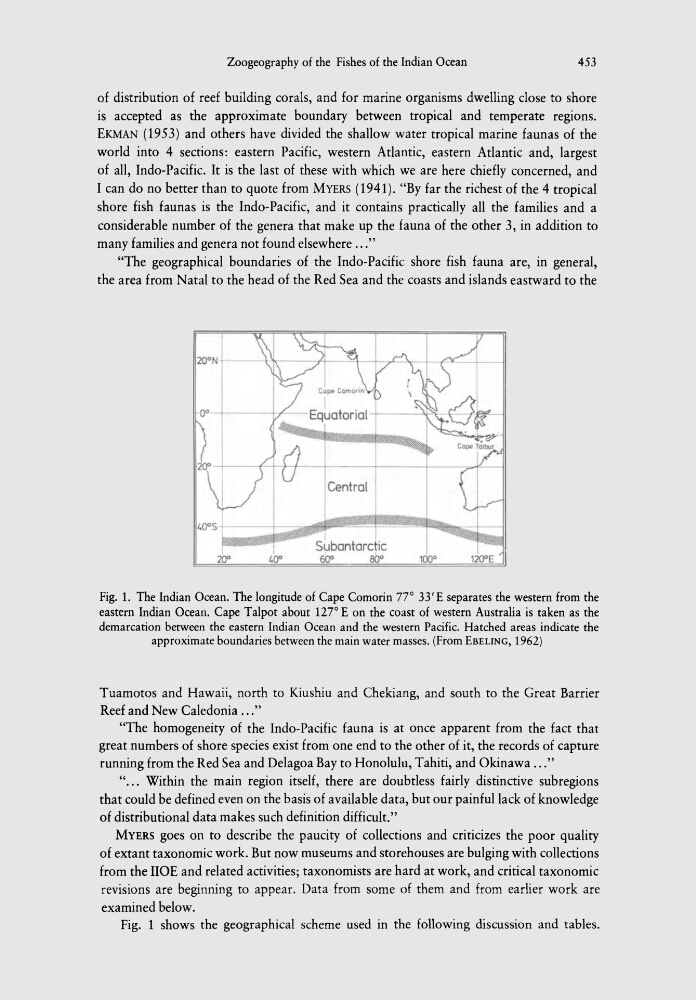
Fig. 1. The Indian Ocean. The longitude of Cape Comorin 77° 33' E separates the western from the
eastern Indian Ocean. Cape Talpot about 127° E on the coast of western Australia is taken as the
demarcation between the eastern Indian Ocean and the western Pacific. Hatched areas indicate the
approximate boundaries between the main water masses. (From EBELING, 1962)
Tuamotos and Hawaii, north to Kiushiu and Chekiang, and south to the Great Barrier
Reef and New Caledonia ... "
"The homogeneity of the Indo-Pacific fauna is at once apparent from the fact that
great numbers of shore species exist from one end to the other of it, the records of capture
running from the Red Sea and Delagoa Bay to Honolulu, Tahiti, and Okinawa ... "
" ... Within the main region itself, there are doubtless fairly distinctive subregions
that could be defined even on the basis of available data, but our painful lack of knowledge
of distributional data makes such definition difficult."
MYERS goes on to describe the paucity of collections and criticizes the poor quality
of extant taxonomic work. But now museums and storehouses are bulging with collections
from the HOE and related activities; taxonomists are hard at work, and critical taxonomic
revisions are beginning to appear. Data from some of them and from earlier work are
examined below.
Fig. 1 shows the geographical scheme used in the following discussion and tables.
453
of distribution of reef building corals, and for marine organisms dwelling close to shore
is accepted as the approximate boundary between tropical and temperate regions.
EKMAN (1953) and others have divided the shallow water tropical marine faunas of the
world into 4 sections: eastern Pacific, western Atlantic, eastern Atlantic and, largest
of all, Indo-Pacific. It is the last of these with which we are here chiefly concerned, and
I can do no better than to quote from MYERS (1941). "By far the richest of the 4 tropical
shore fish faunas is the Indo-Pacific, and it contains practically all the families and a
considerable number of the genera that make up the fauna of the other 3, in addition to
many families and genera not found elsewhere ... "
"The geographical boundaries of the Indo-Pacific shore fish fauna are, in general,
the area from Natal to the head of the Red Sea and the coasts and islands eastward to the
2()oN
Central
'()Os ~ .~~t:=r~~~~1
•
Subantarctic
200
600
abo
1200E
Fig. 1. The Indian Ocean. The longitude of Cape Comorin 77° 33' E separates the western from the
eastern Indian Ocean. Cape Talpot about 127° E on the coast of western Australia is taken as the
demarcation between the eastern Indian Ocean and the western Pacific. Hatched areas indicate the
approximate boundaries between the main water masses. (From EBELING, 1962)
Tuamotos and Hawaii, north to Kiushiu and Chekiang, and south to the Great Barrier
Reef and New Caledonia ... "
"The homogeneity of the Indo-Pacific fauna is at once apparent from the fact that
great numbers of shore species exist from one end to the other of it, the records of capture
running from the Red Sea and Delagoa Bay to Honolulu, Tahiti, and Okinawa ... "
" ... Within the main region itself, there are doubtless fairly distinctive subregions
that could be defined even on the basis of available data, but our painful lack of knowledge
of distributional data makes such definition difficult."
MYERS goes on to describe the paucity of collections and criticizes the poor quality
of extant taxonomic work. But now museums and storehouses are bulging with collections
from the HOE and related activities; taxonomists are hard at work, and critical taxonomic
revisions are beginning to appear. Data from some of them and from earlier work are
examined below.
Fig. 1 shows the geographical scheme used in the following discussion and tables.