

438
A. SUDA:
longline hooking-rate in various parts of the Ocean suggests a wide distribution of this
species over the tropical and sub-tropical waters (KASAHARA, 1968). Also the occurrence
of juvenile sklipjack from the stomach contents of longline-caught billfishes supports
the same nature of distribution (Fig. 2, MORI, unpublished).
2. Distribution at Larval Stage
The occurrence at larval stage is demonstrated for skipjack by UEYANAGI (1969),
and for little tuna and frigate mackerel by YABE, YABUTA and UEYANAGI (1963). The
distribution of their abundance shows 2 types, with skipjack spawning over a wide
oceanic area, while larvae of the little tuna and frigate mackerel are mainly found in
coastal waters. The habitats of the latter 2 species probably do not extend so far offshore
during their life cycle.
III. Contribution of Tunas to the Fisheries in the Indian Ocean
The annual catches of the 4 large-sized tunas are given in Table 2. The average
catch for these 4 species in the Indian Ocean in 1968 per 1000 km 2 is 1.78 tons. The
corresponding values for the Pacific and the Atlantic Ocean are 2.16 and 1.59 tons
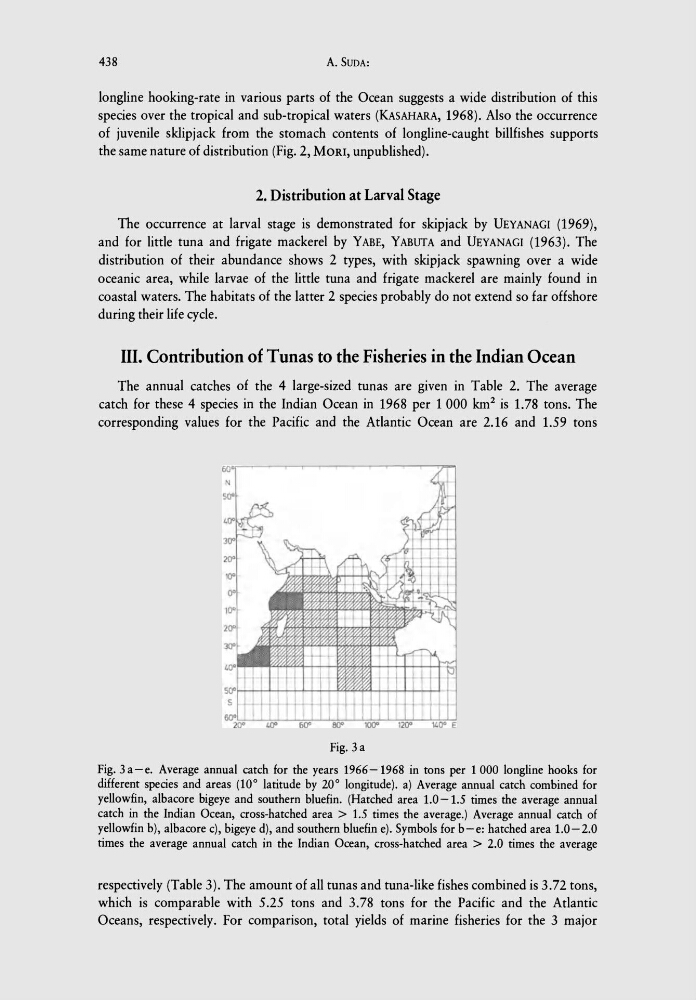
Fig.3a
Fig. 3a-e. Average annual catch for the years 1966-1968 in tons per 1000 longline hooks for
different species and areas (10° latitude by 20° longitude). a) Average annual catch combined for
yellowfin, albacore bigeye and southern blue£in. (Hatched area 1.0-1.5 times the average annual
catch in the Indian Ocean, cross-hatched area> 1.5 times the average.) Average annual catch of
yellowfin b), albacore c), bigeye d), and southern blue£in e). Symbols for b - e: hatched area 1.0 - 2.0
times the average annual catch in the Indian Ocean, cross-hatched area > 2.0 times the average
respectively (Table 3). The amount of all tunas and tuna-like fishes combined is 3.72 tons,
which is comparable with 5.25 tons and 3.78 tons for the Pacific and the Atlantic
Oceans, respectively. For comparison, total yields of marine fisheries for the 3 major
A. SUDA:
longline hooking-rate in various parts of the Ocean suggests a wide distribution of this
species over the tropical and sub-tropical waters (KASAHARA, 1968). Also the occurrence
of juvenile sklipjack from the stomach contents of longline-caught billfishes supports
the same nature of distribution (Fig. 2, MORI, unpublished).
2. Distribution at Larval Stage
The occurrence at larval stage is demonstrated for skipjack by UEYANAGI (1969),
and for little tuna and frigate mackerel by YABE, YABUTA and UEYANAGI (1963). The
distribution of their abundance shows 2 types, with skipjack spawning over a wide
oceanic area, while larvae of the little tuna and frigate mackerel are mainly found in
coastal waters. The habitats of the latter 2 species probably do not extend so far offshore
during their life cycle.
III. Contribution of Tunas to the Fisheries in the Indian Ocean
The annual catches of the 4 large-sized tunas are given in Table 2. The average
catch for these 4 species in the Indian Ocean in 1968 per 1000 km 2 is 1.78 tons. The
corresponding values for the Pacific and the Atlantic Ocean are 2.16 and 1.59 tons
Fig.3a
Fig. 3a-e. Average annual catch for the years 1966-1968 in tons per 1000 longline hooks for
different species and areas (10° latitude by 20° longitude). a) Average annual catch combined for
yellowfin, albacore bigeye and southern blue£in. (Hatched area 1.0-1.5 times the average annual
catch in the Indian Ocean, cross-hatched area> 1.5 times the average.) Average annual catch of
yellowfin b), albacore c), bigeye d), and southern blue£in e). Symbols for b - e: hatched area 1.0 - 2.0
times the average annual catch in the Indian Ocean, cross-hatched area > 2.0 times the average
respectively (Table 3). The amount of all tunas and tuna-like fishes combined is 3.72 tons,
which is comparable with 5.25 tons and 3.78 tons for the Pacific and the Atlantic
Oceans, respectively. For comparison, total yields of marine fisheries for the 3 major