

5.2
Tuna Fisheries and their Resources in the Indian Ocean
A. SUDA
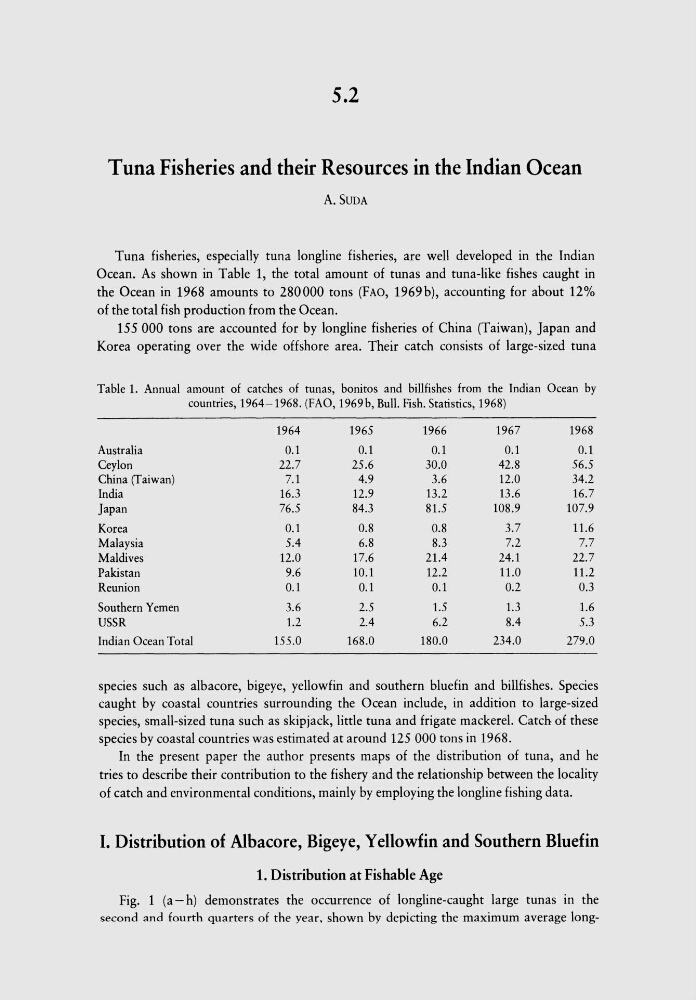
Tuna fisheries, especially tuna longline fisheries, are well developed in the Indian
Ocean. As shown in Table 1, the total amount of tunas and tuna-like fishes caught in
the Ocean in 1968 amounts to 280000 tons (FAO, 1969b), accounting for about 12%
of the total fish production from the Ocean.
155000 tons are accounted for by longline fisheries of China (Taiwan), Japan and
Korea operating over the wide offshore area. Their catch consists of large-sized tuna
Table 1. Annual amount of catches of tunas, bonitos and billfishes from the Indian Ocean by
countries, 1964-1968. (FAO, 1969b, Bull. Fish. Statistics, 1968)
1964
1965
1966
1967
1968
Australia
0.1
0.1
0.1
0.1
0.1
Ceylon
22.7
25.6
30.0
42.8
56.5
China (Taiwan)
7.1
4.9
3.6
12.0
34.2
India
16.3
12.9
13.2
13.6
16.7
Japan
76.5
84.3
81.5
108.9
107.9
Korea
0.1
0.8
0.8
3.7
11.6
Malaysia
5.4
6.8
8.3
7.2
7.7
Maldives
12.0
17.6
21.4
24.1
22.7
Pakistan
9.6
10.1
12.2
11.0
11.2
Reunion
0.1
0.1
0.1
0.2
0.3
Southern Yemen
3.6
2.5
1.5
1.3
1.6
USSR
1.2
2.4
6.2
8.4
5.3
Indian Ocean Total
155.0
168.0
180.0
234.0
279.0
species such as albacore, bigeye, yellowfin and southern bluefin and billfishes. Species
caught by coastal countries surrounding the Ocean include, in addition to large-sized
species, small-sized tuna such as skipjack, little tuna and frigate mackerel. Catch of these
species by coastal countries was estimated at around 125 000 tons in 1968.
In the present paper the author presents maps of the distribution of tuna, and he
tries to describe their contribution to the fishery and the relationship between the locality
of catch and environmental conditions, mainly by employing the longline fishing data.
I. Distribution of Albacore, Bigeye, Yellowfin and Southern Bluefin
1. Distribution at Fishable Age
Fig. 1 (a - h) demonstrates the occurrence of longline-caught large tunas in the
second and fourth quarters of the year, shown by depicting the maximum average long-
Tuna Fisheries and their Resources in the Indian Ocean
A. SUDA
Tuna fisheries, especially tuna longline fisheries, are well developed in the Indian
Ocean. As shown in Table 1, the total amount of tunas and tuna-like fishes caught in
the Ocean in 1968 amounts to 280000 tons (FAO, 1969b), accounting for about 12%
of the total fish production from the Ocean.
155000 tons are accounted for by longline fisheries of China (Taiwan), Japan and
Korea operating over the wide offshore area. Their catch consists of large-sized tuna
Table 1. Annual amount of catches of tunas, bonitos and billfishes from the Indian Ocean by
countries, 1964-1968. (FAO, 1969b, Bull. Fish. Statistics, 1968)
1964
1965
1966
1967
1968
Australia
0.1
0.1
0.1
0.1
0.1
Ceylon
22.7
25.6
30.0
42.8
56.5
China (Taiwan)
7.1
4.9
3.6
12.0
34.2
India
16.3
12.9
13.2
13.6
16.7
Japan
76.5
84.3
81.5
108.9
107.9
Korea
0.1
0.8
0.8
3.7
11.6
Malaysia
5.4
6.8
8.3
7.2
7.7
Maldives
12.0
17.6
21.4
24.1
22.7
Pakistan
9.6
10.1
12.2
11.0
11.2
Reunion
0.1
0.1
0.1
0.2
0.3
Southern Yemen
3.6
2.5
1.5
1.3
1.6
USSR
1.2
2.4
6.2
8.4
5.3
Indian Ocean Total
155.0
168.0
180.0
234.0
279.0
species such as albacore, bigeye, yellowfin and southern bluefin and billfishes. Species
caught by coastal countries surrounding the Ocean include, in addition to large-sized
species, small-sized tuna such as skipjack, little tuna and frigate mackerel. Catch of these
species by coastal countries was estimated at around 125 000 tons in 1968.
In the present paper the author presents maps of the distribution of tuna, and he
tries to describe their contribution to the fishery and the relationship between the locality
of catch and environmental conditions, mainly by employing the longline fishing data.
I. Distribution of Albacore, Bigeye, Yellowfin and Southern Bluefin
1. Distribution at Fishable Age
Fig. 1 (a - h) demonstrates the occurrence of longline-caught large tunas in the
second and fourth quarters of the year, shown by depicting the maximum average long-