

430 W. NELLEN: Kinds and Abundance of Fish Larvae in the Arabian Sea and the Persian Gulf
larvae type was as abundant, and even the frequently occurring gonostomids rank far
behind the myctophids in number per m 2 • Lantern fish seem to be a very important link
in the food chain in oceanic areas, comparable perhaps with herring-like fish and some
gadids in the neritic and boreal zones respectively.
Larval concentrations were not very high for fish which may have commercial importance. Herring-like larvae were relatively common and abundant in the Persian Gulf,
as were anchovy, which in addition appeared in considerable quantities on some stations
in the Gulf of Oman as well. Carangids, probably Decapterus spec., seemed to have
4(f'J(j'
40°
' YJ 0
6fi
70°
&l
• Katsuw
• ThulIlus albacares
J(j'
r
30°
'Kf
'Kf
10°
10°
N
N
0°
0°
CD
10°
10°
3rJ'E
4(f'
' YJ 0
6fi
70°
&f'
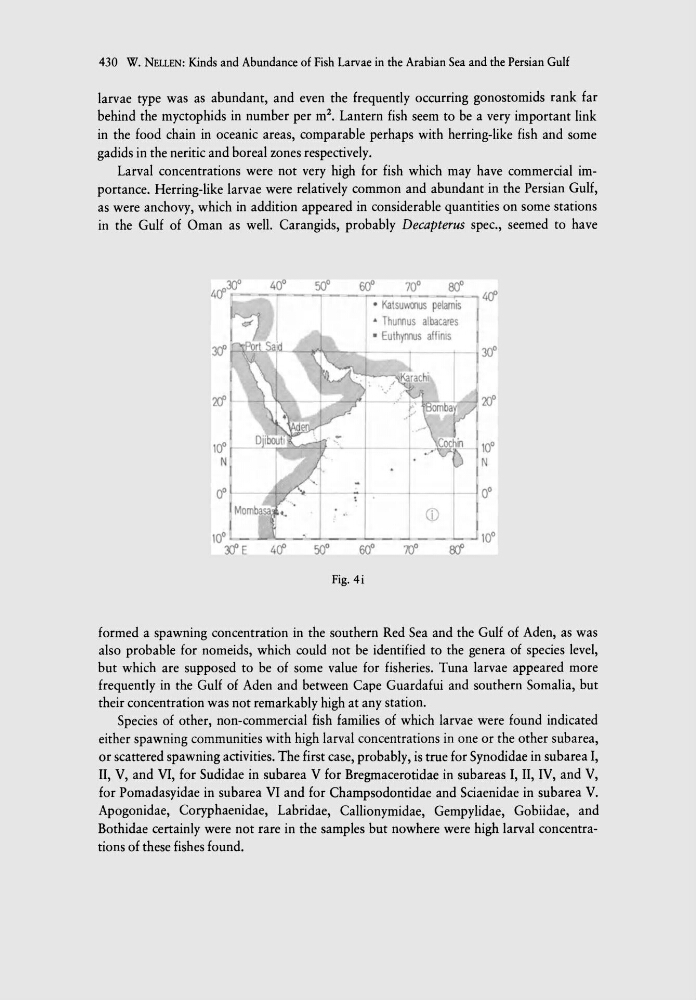
Fig.4i
formed a spawning concentration in the southern Red Sea and the Gulf of Aden, as was
also probable for nomeids, which could not be identified to the genera of species level,
but which are supposed to be of some value for fisheries. Tuna larvae appeared more
frequently in the Gulf of Aden and between Cape Guardafui and southern Somalia, but
their concentration was not remarkably high at any station.
Species of other, non-commercial fish families of which larvae were found indicated
either spawning communities with high larval concentrations in one or the other subarea,
or scattered spawning activities. The first case, probably, is true for Synodidae in subarea I,
II, V, and VI, for Sudidae in subarea V for Bregmacerotidae in subareas I, II, IV, and V,
for Pomadasyidae in subarea VI and for Champsodontidae and Sciaenidae in subarea V.
Apogonidae, Coryphaenidae, Labridae, Callionymidae, Gempylidae, Gobiidae, and
Bothidae certainly were not rare in the samples but nowhere were high larval concentrations of these fishes found.
larvae type was as abundant, and even the frequently occurring gonostomids rank far
behind the myctophids in number per m 2 • Lantern fish seem to be a very important link
in the food chain in oceanic areas, comparable perhaps with herring-like fish and some
gadids in the neritic and boreal zones respectively.
Larval concentrations were not very high for fish which may have commercial importance. Herring-like larvae were relatively common and abundant in the Persian Gulf,
as were anchovy, which in addition appeared in considerable quantities on some stations
in the Gulf of Oman as well. Carangids, probably Decapterus spec., seemed to have
4(f'J(j'
40°
' YJ 0
6fi
70°
&l
• Katsuw
• ThulIlus albacares
J(j'
r
30°
'Kf
'Kf
10°
10°
N
N
0°
0°
CD
10°
10°
3rJ'E
4(f'
' YJ 0
6fi
70°
&f'
Fig.4i
formed a spawning concentration in the southern Red Sea and the Gulf of Aden, as was
also probable for nomeids, which could not be identified to the genera of species level,
but which are supposed to be of some value for fisheries. Tuna larvae appeared more
frequently in the Gulf of Aden and between Cape Guardafui and southern Somalia, but
their concentration was not remarkably high at any station.
Species of other, non-commercial fish families of which larvae were found indicated
either spawning communities with high larval concentrations in one or the other subarea,
or scattered spawning activities. The first case, probably, is true for Synodidae in subarea I,
II, V, and VI, for Sudidae in subarea V for Bregmacerotidae in subareas I, II, IV, and V,
for Pomadasyidae in subarea VI and for Champsodontidae and Sciaenidae in subarea V.
Apogonidae, Coryphaenidae, Labridae, Callionymidae, Gempylidae, Gobiidae, and
Bothidae certainly were not rare in the samples but nowhere were high larval concentrations of these fishes found.