

Kinds and Abundance of Fish Larvae in the Arabian Sea and the Persian Gulf
419
This example demonstrates the limit of reliability of a qualitative analysis of fish
larvae distribution in a highly diverse tropical biotope. To get a relatively true idea of the
amount and kind of fish larvae occurring in a certain area, the grid of stations probably
must be quite dense, the net-opening must be wide to take at least the more common
species by filtering a large amount of water within a short time, and the tow must cover
the depth range within which the more important species are distributed.
The total of 326 samples contained about 55 000 specimens. Slightly more than
98% of these could be identified to family level. 107 different families were found in
the material. Among these, 120 genera and about 65 species could be identified, several
of the lower taxa representing juvenile or adult myctophids.
II. Results
1. Characteristics of Fish Larvae Distribution with Respect to Different
Geographical Areas
The area investigated was divided into 7 subareas; these geographic differences
reflect differences in the fish larvae fauna.
a) Subarea I: Southern Part of the Red Sea and Gulf of Aden
15 stations, 21 HLN standard hauls, 1 HLN>100- 0 m hauls, 10 RT hauls.
This subarea can be expected to be influenced highly by the Red Sea and by its
closeness to the shore. On the other hand the deep trench in the Gulf of Aden characterizes
this area as partly oceanic.
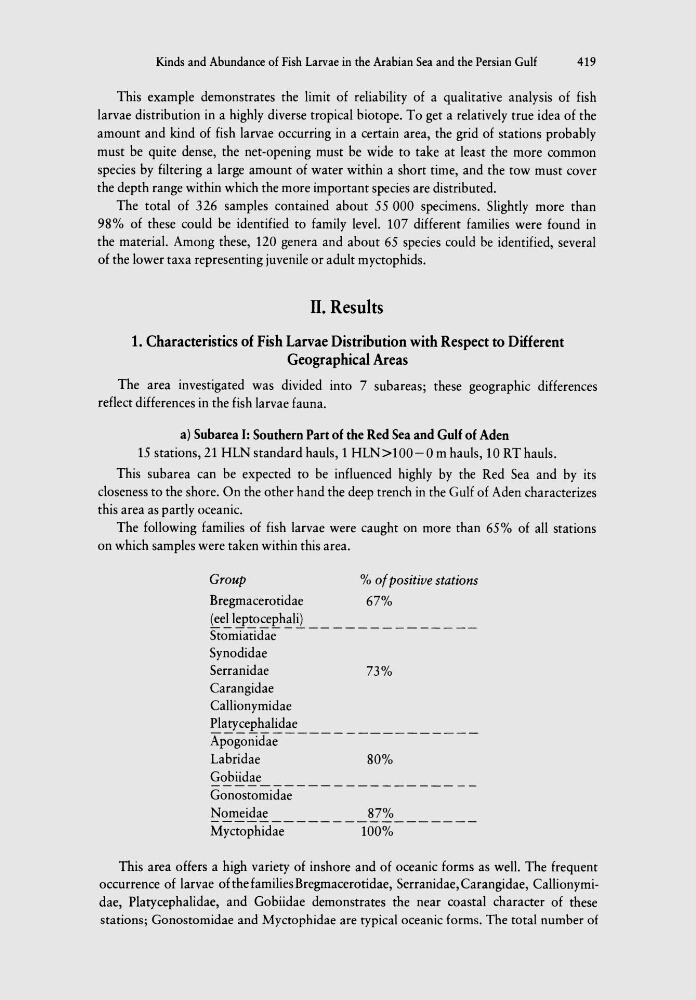
The following families of fish larvae were caught on more than 65% of all stations
on which samples were taken within this area.
Group
Bregmacerotidae
% of positive stations
67%
(eel leptocephali)
Stom~ti~e---------------Synodidae
Serranidae
73%
Carangidae
Callionymidae
Platycephalidae
A~ioru~e---------------Labridae
80%
Gobiidae
Gonostomidae
Nomeidae
87%
---------------------Myctophidae
100%
This area offers a high variety of inshore and of oceanic forms as well. The frequent
occurrence of larvae of the families Bregmacerotidae, Serranidae, Carangidae, Callionymidae, Platycephalidae, and Gobiidae demonstrates the near coastal character of these
stations; Gonostomidae and Myctophidae are typical oceanic forms. The total number of
419
This example demonstrates the limit of reliability of a qualitative analysis of fish
larvae distribution in a highly diverse tropical biotope. To get a relatively true idea of the
amount and kind of fish larvae occurring in a certain area, the grid of stations probably
must be quite dense, the net-opening must be wide to take at least the more common
species by filtering a large amount of water within a short time, and the tow must cover
the depth range within which the more important species are distributed.
The total of 326 samples contained about 55 000 specimens. Slightly more than
98% of these could be identified to family level. 107 different families were found in
the material. Among these, 120 genera and about 65 species could be identified, several
of the lower taxa representing juvenile or adult myctophids.
II. Results
1. Characteristics of Fish Larvae Distribution with Respect to Different
Geographical Areas
The area investigated was divided into 7 subareas; these geographic differences
reflect differences in the fish larvae fauna.
a) Subarea I: Southern Part of the Red Sea and Gulf of Aden
15 stations, 21 HLN standard hauls, 1 HLN>100- 0 m hauls, 10 RT hauls.
This subarea can be expected to be influenced highly by the Red Sea and by its
closeness to the shore. On the other hand the deep trench in the Gulf of Aden characterizes
this area as partly oceanic.
The following families of fish larvae were caught on more than 65% of all stations
on which samples were taken within this area.
Group
Bregmacerotidae
% of positive stations
67%
(eel leptocephali)
Stom~ti~e---------------Synodidae
Serranidae
73%
Carangidae
Callionymidae
Platycephalidae
A~ioru~e---------------Labridae
80%
Gobiidae
Gonostomidae
Nomeidae
87%
---------------------Myctophidae
100%
This area offers a high variety of inshore and of oceanic forms as well. The frequent
occurrence of larvae of the families Bregmacerotidae, Serranidae, Carangidae, Callionymidae, Platycephalidae, and Gobiidae demonstrates the near coastal character of these
stations; Gonostomidae and Myctophidae are typical oceanic forms. The total number of