

Appendicularia from the Indian Ocean, the Red Sea and the Persian Gulf
413
Table 1. Variation of the average number of appendicularians from cruise 5 of "Anton Bruun"
Area
Number
South of 42° S
40° S to 30 0 S
7
30° S to 20 0 S
16
20° S to 10° S
132
10° S to Equator
106
Equator 10 ° N
485
10°Nto 200N
611
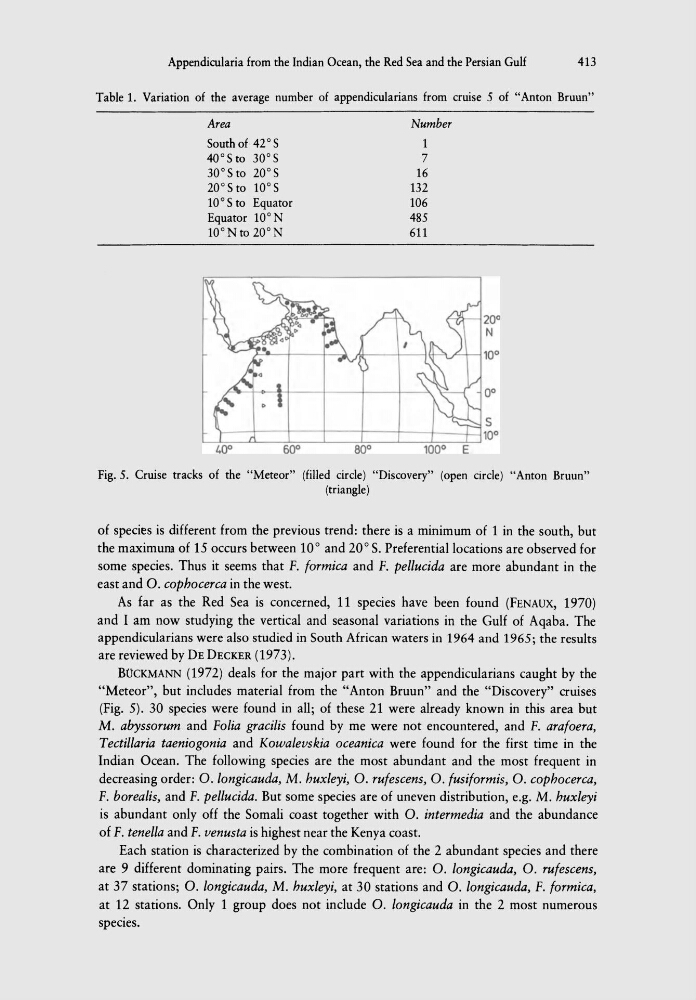
Fig. 5. Cruise tracks of the "Meteor" (filled circle) "Discovery" (open circle) "Anton Bruun"
(triangle)
of species is different from the previous trend: there is a minimum of 1 in the south, but
the maximum of 15 occurs between 10° and 20
0
S. Preferential locations are observed for
some species. Thus it seems that F. formica and F. pellucida are more abundant in the
east and O. cophocerca in the west.
As far as the Red Sea is concerned, 11 species have been found (FENAUX, 1970)
and I am now studying the vertical and seasonal variations in the Gulf of Aqaba. The
appendicularians were also studied in South African waters in 1964 and 1965; the results
are reviewed by DE DECKER (1973).
BOCKMANN (1972) deals for the major part with the appendicularians caught by the
"Meteor", but includes material from the "Anton Bruun" and the "Discovery" cruises
(Fig. 5). 30 species were found in all; of these 21 were already known in this area but
M. abyssorum and Folia gracilis found by me were not encountered, and F. arafoera,
Tectil/aria taeniogonia and Kowalevskia oceanica were found for the first time in the
Indian Ocean. The following species are the most abundant and the most frequent in
decreasing order: O. longicauda, M. huxleyi, O. rufescens, O. fusiformis, O. cophocerca,
F. borealis, and F. pellucida. But some species are of uneven distribution, e.g. M. huxleyi
is abundant only off the Somali coast together with O. intermedia and the abundance
of F. ten ella and F. venusta is highest near the Kenya coast.
Each station is characterized by the combination of the 2 abundant species and there
are 9 different dominating pairs. The more frequent are: O. longicauda, O. rufescens,
at 37 stations; O. longicauda, M. huxleyi, at 30 stations and O. longicauda, F. formica,
at 12 stations. Only 1 group does not include O. longicauda in the 2 most numerous
species.
413
Table 1. Variation of the average number of appendicularians from cruise 5 of "Anton Bruun"
Area
Number
South of 42° S
40° S to 30 0 S
7
30° S to 20 0 S
16
20° S to 10° S
132
10° S to Equator
106
Equator 10 ° N
485
10°Nto 200N
611
Fig. 5. Cruise tracks of the "Meteor" (filled circle) "Discovery" (open circle) "Anton Bruun"
(triangle)
of species is different from the previous trend: there is a minimum of 1 in the south, but
the maximum of 15 occurs between 10° and 20
0
S. Preferential locations are observed for
some species. Thus it seems that F. formica and F. pellucida are more abundant in the
east and O. cophocerca in the west.
As far as the Red Sea is concerned, 11 species have been found (FENAUX, 1970)
and I am now studying the vertical and seasonal variations in the Gulf of Aqaba. The
appendicularians were also studied in South African waters in 1964 and 1965; the results
are reviewed by DE DECKER (1973).
BOCKMANN (1972) deals for the major part with the appendicularians caught by the
"Meteor", but includes material from the "Anton Bruun" and the "Discovery" cruises
(Fig. 5). 30 species were found in all; of these 21 were already known in this area but
M. abyssorum and Folia gracilis found by me were not encountered, and F. arafoera,
Tectil/aria taeniogonia and Kowalevskia oceanica were found for the first time in the
Indian Ocean. The following species are the most abundant and the most frequent in
decreasing order: O. longicauda, M. huxleyi, O. rufescens, O. fusiformis, O. cophocerca,
F. borealis, and F. pellucida. But some species are of uneven distribution, e.g. M. huxleyi
is abundant only off the Somali coast together with O. intermedia and the abundance
of F. ten ella and F. venusta is highest near the Kenya coast.
Each station is characterized by the combination of the 2 abundant species and there
are 9 different dominating pairs. The more frequent are: O. longicauda, O. rufescens,
at 37 stations; O. longicauda, M. huxleyi, at 30 stations and O. longicauda, F. formica,
at 12 stations. Only 1 group does not include O. longicauda in the 2 most numerous
species.