

376
E. BRINTON and K. GOPALAKRISHNAN:
This corresponds to the southern part of the region dominated by coastal forms
Pseudeuphausia latifrons (Fig. la, b) and Euphausia distinguenda (Fig. 2a, b). This
region consists of the Arabian Sea and Bay of Bengal- the tropical, paired semi-enclosed
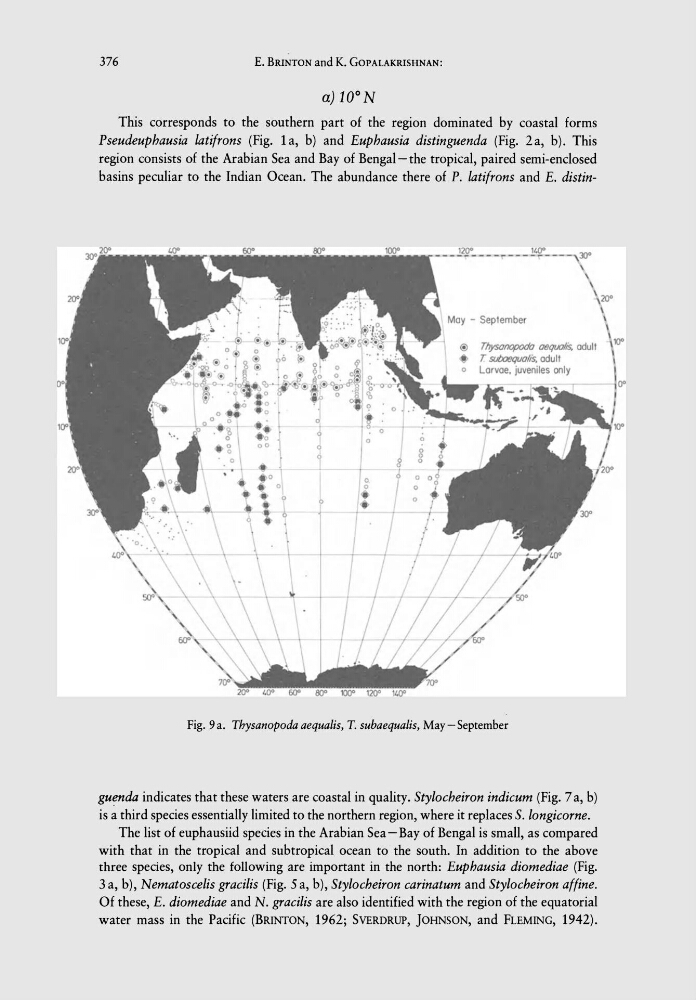
basins peculiar to the Indian Ocean. The abundance there of P. latifrons and E. dis tinFig. 9 a. Thysanopoda aequalis, T. subaequalis, May - September
guenda indicates that these waters are coastal in quality. Stylocheiron indicum (Fig. 7 a, b)
is a third species essentially limited to the northern region, where it replaces S. longicorne.
The list of euphausiid species in the Arabian Sea - Bay of Bengal is small, as compared
with that in the tropical and subtropical ocean to the south. In addition to the above
three species, only the following are important in the north: Euphausia diomediae (Fig.
3 a, b), Nematoscelis gracilis (Fig. 5 a, b), Stylocheiron carinatum and Stylocheiron affine.
Of these, E. diomediae and N. gracilis are also identified with the region of the equatorial
water mass in the Pacific (BRINTON, 1962; SVERDRUP, JOHNSON, and FLEMING, 1942).
E. BRINTON and K. GOPALAKRISHNAN:
This corresponds to the southern part of the region dominated by coastal forms
Pseudeuphausia latifrons (Fig. la, b) and Euphausia distinguenda (Fig. 2a, b). This
region consists of the Arabian Sea and Bay of Bengal- the tropical, paired semi-enclosed
basins peculiar to the Indian Ocean. The abundance there of P. latifrons and E. dis tinFig. 9 a. Thysanopoda aequalis, T. subaequalis, May - September
guenda indicates that these waters are coastal in quality. Stylocheiron indicum (Fig. 7 a, b)
is a third species essentially limited to the northern region, where it replaces S. longicorne.
The list of euphausiid species in the Arabian Sea - Bay of Bengal is small, as compared
with that in the tropical and subtropical ocean to the south. In addition to the above
three species, only the following are important in the north: Euphausia diomediae (Fig.
3 a, b), Nematoscelis gracilis (Fig. 5 a, b), Stylocheiron carinatum and Stylocheiron affine.
Of these, E. diomediae and N. gracilis are also identified with the region of the equatorial
water mass in the Pacific (BRINTON, 1962; SVERDRUP, JOHNSON, and FLEMING, 1942).