

The Distribution of Indian Ocean Euphausiids
365
Ranges of species of the genus Nematoscelis are comparable to the ranges of Euphausia
species, just discussed. Nematoscelis gracilis (Fig. 5 a, b), like E. diomediae, is a northern
species in this ocean. However, as in the Pacific (BRINTON, 1962), N. gracilis has a
relatively broader range than E. diomediae, extending southward to 20° S in midocean
and to 30° S along the eastern margin. It is the predominant Nematoscelis species in the
Arabian Sea and Bay of Bengal.
1200
140"
---------r-----~~
November - Morch
Euphausia diamediae 3
• I -499 Rer 1000 m
• 500 - 4999
.>5000
fU1~a411§~ mufica
<> 500 - 4999
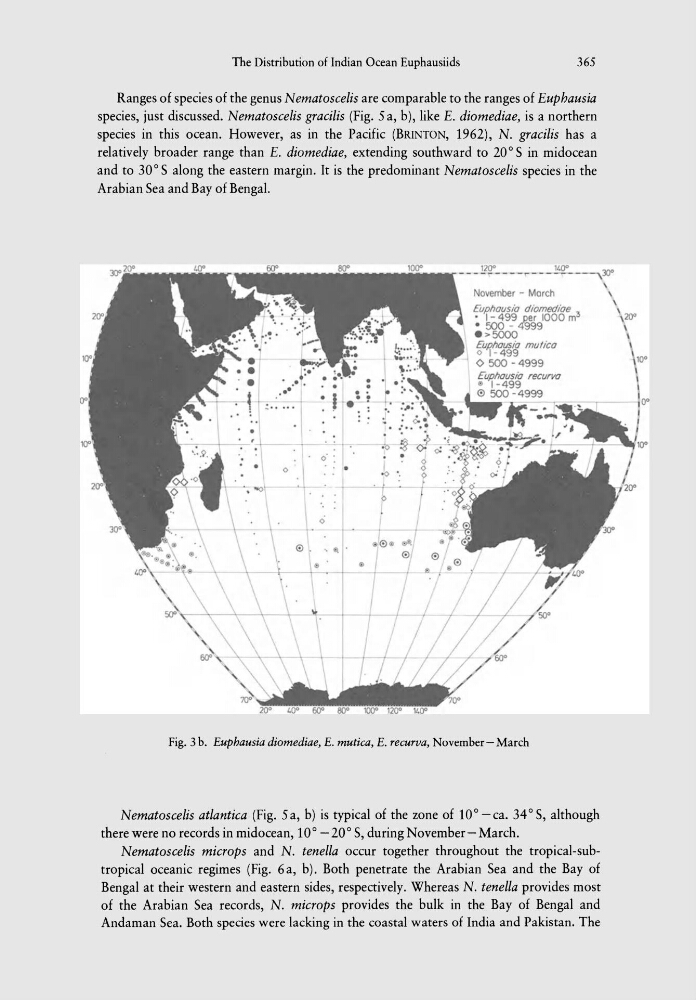
Fig. 3 b. Euphausia diomediae, E. mutica, E. recurva, November- March
Nematoscelis atlantica (Fig. 5 a, b) is typical of the zone of 10 ° - ca. 34 ° S, although
there were no records in midocean, 10° - 20° S, during November- March.
Nematoscelis microps and N. ten ella occur together throughout the tropical-subtropical oceanic regimes (Fig. 6a, b). Both penetrate the Arabian Sea and the Bay of
Bengal at their western and eastern sides, respectively. Whereas N. tenella provides most
of the Arabian Sea records, N. microps provides the bulk in the Bay of Bengal and
Andaman Sea. Both species were lacking in the coastal waters of India and Pakistan. The
365
Ranges of species of the genus Nematoscelis are comparable to the ranges of Euphausia
species, just discussed. Nematoscelis gracilis (Fig. 5 a, b), like E. diomediae, is a northern
species in this ocean. However, as in the Pacific (BRINTON, 1962), N. gracilis has a
relatively broader range than E. diomediae, extending southward to 20° S in midocean
and to 30° S along the eastern margin. It is the predominant Nematoscelis species in the
Arabian Sea and Bay of Bengal.
1200
140"
---------r-----~~
November - Morch
Euphausia diamediae 3
• I -499 Rer 1000 m
• 500 - 4999
.>5000
fU1~a411§~ mufica
<> 500 - 4999
Fig. 3 b. Euphausia diomediae, E. mutica, E. recurva, November- March
Nematoscelis atlantica (Fig. 5 a, b) is typical of the zone of 10 ° - ca. 34 ° S, although
there were no records in midocean, 10° - 20° S, during November- March.
Nematoscelis microps and N. ten ella occur together throughout the tropical-subtropical oceanic regimes (Fig. 6a, b). Both penetrate the Arabian Sea and the Bay of
Bengal at their western and eastern sides, respectively. Whereas N. tenella provides most
of the Arabian Sea records, N. microps provides the bulk in the Bay of Bengal and
Andaman Sea. Both species were lacking in the coastal waters of India and Pakistan. The