

360
E. BRINTON and K. GOPALAKRISHNAN:
data collected up until April 8 are included in the November- March chart. The several
instances in which we have used samples from inter-monsoon periods are designated by
indices in Tables 1 and 2.
A number of non-standard samples were included for the same reason - to fill
geographical gaps. In cases where depth-of-haul was standard but a different net was
used, useful estimates of abundance may still be made. Where sampling was by means of
surface tow only (i.e., "Patanela"), useful qualitative information has been deduced.
The following non-standard material, not part of the international collections, has
also been used: "Argo" Monsoon Expedition, stations 7 - 24 (SNYDER and FLEMINGER,
1965) (Station 7: 9° 12' N, 127° 34' E, and station 8: 7° 47' N, 121 ° 17' E in the Timor
and Banda Seas are included together with the Indian Ocean stations); BAKER'S 1965 data
for Euphausia species caught along 90° E by "Discovery II", 1950 - 51 (a region not well
sampled by HOE); "Anton Bruun" Isaacs-Kidd midwater trawl samples from all stations,
cruises 3 and 6. The latter samples, processed at the Smithsonian Institution's Oceanographic Sorting Center (SOSC), proved of use in determining presence or absence of
species at a number of relatively barren localities where the standard samples were
particularly sparse in euphausiids. In our continuing study, fuller use is being made of
these samples and of the rest of the large "Anton Bruun" collection processed at SOSC,
particularly in the study of bathymetric distribution.
- - - 2. 2 9"_ - - -- - - - ~- - ,JOO
\
\
\ \20"
May - September
\
,
\~
. ' .
,. " III"'; .... . ... .
. ' .
I
- t -
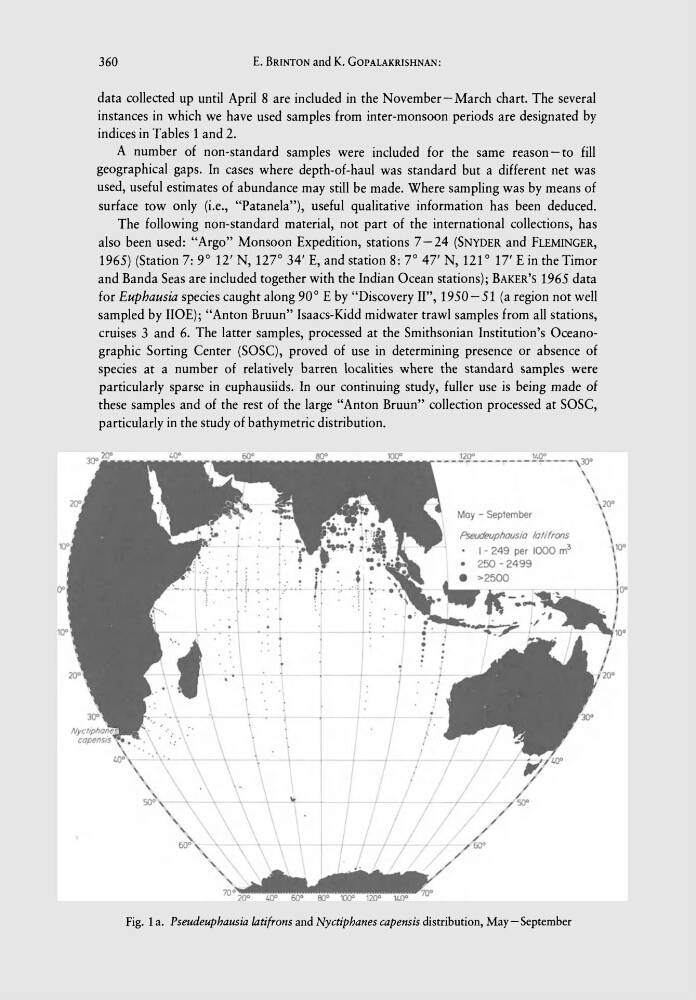
Fig. 1 a. Pseudeuphausia latifrons and Nyctiphanes capensis distribution, May - September
E. BRINTON and K. GOPALAKRISHNAN:
data collected up until April 8 are included in the November- March chart. The several
instances in which we have used samples from inter-monsoon periods are designated by
indices in Tables 1 and 2.
A number of non-standard samples were included for the same reason - to fill
geographical gaps. In cases where depth-of-haul was standard but a different net was
used, useful estimates of abundance may still be made. Where sampling was by means of
surface tow only (i.e., "Patanela"), useful qualitative information has been deduced.
The following non-standard material, not part of the international collections, has
also been used: "Argo" Monsoon Expedition, stations 7 - 24 (SNYDER and FLEMINGER,
1965) (Station 7: 9° 12' N, 127° 34' E, and station 8: 7° 47' N, 121 ° 17' E in the Timor
and Banda Seas are included together with the Indian Ocean stations); BAKER'S 1965 data
for Euphausia species caught along 90° E by "Discovery II", 1950 - 51 (a region not well
sampled by HOE); "Anton Bruun" Isaacs-Kidd midwater trawl samples from all stations,
cruises 3 and 6. The latter samples, processed at the Smithsonian Institution's Oceanographic Sorting Center (SOSC), proved of use in determining presence or absence of
species at a number of relatively barren localities where the standard samples were
particularly sparse in euphausiids. In our continuing study, fuller use is being made of
these samples and of the rest of the large "Anton Bruun" collection processed at SOSC,
particularly in the study of bathymetric distribution.
- - - 2. 2 9"_ - - -- - - - ~- - ,JOO
\
\
\ \20"
May - September
\
,
\~
. ' .
,. " III"'; .... . ... .
. ' .
I
- t -
Fig. 1 a. Pseudeuphausia latifrons and Nyctiphanes capensis distribution, May - September