

350
K. K. C. NAIR, P. G. JACOB, and S. KUMARAN:
II. Results
Amphipods were few in the southern central Indian Ocean and central Arabian Sea
(Fig. 5). Fair numbers were noted in the east and west of the southern Indian Ocean, which
can be compared with the equatorial area. The Somali and Arabian coasts showed average
to good density, comparable to that of the Bay of Bengal where a high concentration was
noted towards the northern part of the Bay. The highest concentration was recorded in
the northern part of the Arabian Sea.
In order to study the seasonal fluctuation and vertical migration of these animals, we
made a seasonal analysis of the data.
1. April 16 to October 15
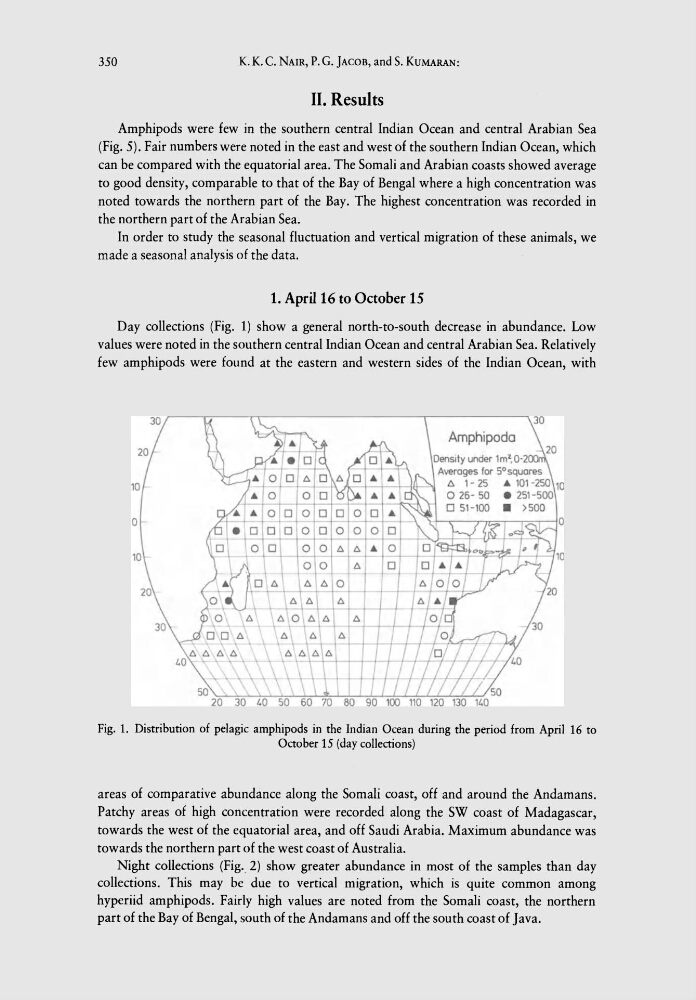
Day collections (Fig. 1) show a general north-to-south decrease in abundance. Low
values were noted in the southern central Indian Ocean and central Arabian Sea. Relatively
few amphipods were found at the eastern and western sides of the Indian Ocean, with
Amphipoda
10
0
0 0 0 0 0
0 0 t:J. t:J. ....
0 0
t:J.
t:J. t:J. 0
t:J.
Fig. 1. Distribution of pelagic amphipods in the Indian Ocean during the period from April 16 to
October 15 (day collections)
areas of comparative abundance along the Somali coast, off and around the Andamans.
Patchy areas of high concentration were recorded along the SW coast of Madagascar,
towards the west of the equatorial area, and off Saudi Arabia. Maximum abundance was
towards the northern part of the west coast of Australia.
Night collections (Fig. 2) show greater abundance in most of the samples than day
collections. This may be due to vertical migration, which is quite common among
hyperiid amphipods. Fairly high values are noted from the Somali coast, the northern
part of the Bay of Bengal, south of the Andamans and off the south coast of Java.
K. K. C. NAIR, P. G. JACOB, and S. KUMARAN:
II. Results
Amphipods were few in the southern central Indian Ocean and central Arabian Sea
(Fig. 5). Fair numbers were noted in the east and west of the southern Indian Ocean, which
can be compared with the equatorial area. The Somali and Arabian coasts showed average
to good density, comparable to that of the Bay of Bengal where a high concentration was
noted towards the northern part of the Bay. The highest concentration was recorded in
the northern part of the Arabian Sea.
In order to study the seasonal fluctuation and vertical migration of these animals, we
made a seasonal analysis of the data.
1. April 16 to October 15
Day collections (Fig. 1) show a general north-to-south decrease in abundance. Low
values were noted in the southern central Indian Ocean and central Arabian Sea. Relatively
few amphipods were found at the eastern and western sides of the Indian Ocean, with
Amphipoda
10
0
0 0 0 0 0
0 0 t:J. t:J. ....
0 0
t:J.
t:J. t:J. 0
t:J.
Fig. 1. Distribution of pelagic amphipods in the Indian Ocean during the period from April 16 to
October 15 (day collections)
areas of comparative abundance along the Somali coast, off and around the Andamans.
Patchy areas of high concentration were recorded along the SW coast of Madagascar,
towards the west of the equatorial area, and off Saudi Arabia. Maximum abundance was
towards the northern part of the west coast of Australia.
Night collections (Fig. 2) show greater abundance in most of the samples than day
collections. This may be due to vertical migration, which is quite common among
hyperiid amphipods. Fairly high values are noted from the Somali coast, the northern
part of the Bay of Bengal, south of the Andamans and off the south coast of Java.