

Chaetognaths from the Laccadives with the New Record of Spadella angulata
325
the stations with similar and small numbers (26, 37; 31, 42; 32,43) are all located at
the northern end of the atoll, presumably in waters that have been partly washed through
the reefs. All the other stations were outside the atoll. The main stream of the current
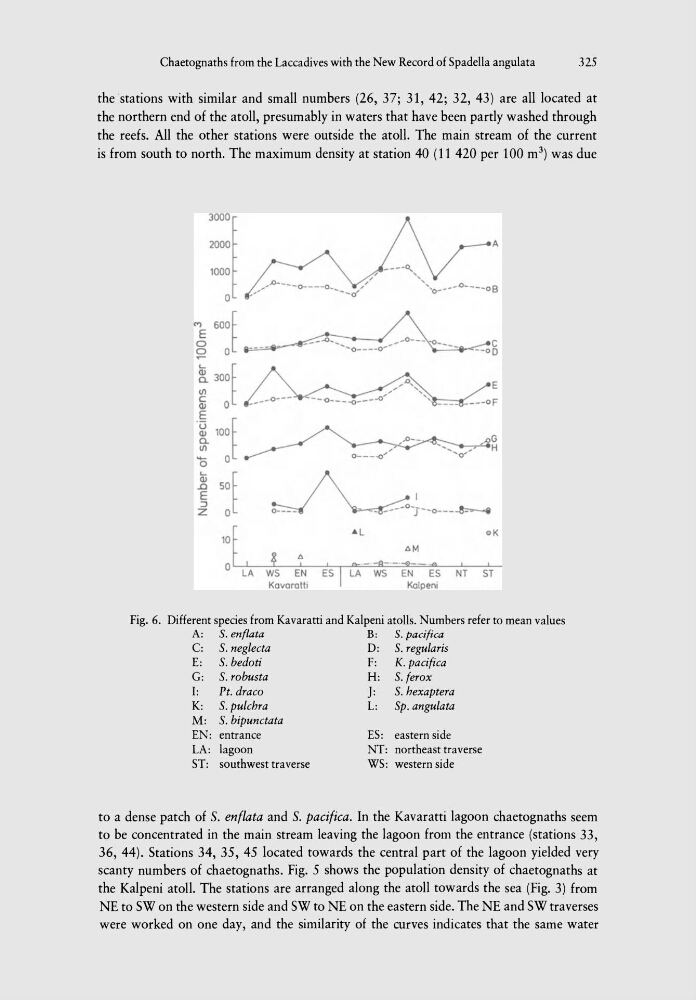
is from south to north. The maximum density at station 40 (11 420 per 100 m 3 ) was due
3000
2000
1000
0
<")
6°:f
E
0
0
~
~ 300~
5i °
E
.~ 100~
'0 °
Qj
.D
E
/ '
0- - - -0 ...
.00
, H
~~
:J
Z
~ I
_0 ... _
(). --- --J --o---~
10
oK
0
LA WS
EN
ES
NT
ST
Kalpeni
Fig. 6. Different species from Kavaratti and Kalpeni atolls. Numbers refer to mean values
A: S. enflata
B:
S. pacifica
C: S. neglecta
D: S. regularis
E: S. bedoti
F:
K. pacifica
G: S. robusta
H: S. ferox
I:
Pt. draco
J: S. hexaptera
K: S. pulchra
L:
Sp. angulata
M: S. bipunctata
EN: entrance
LA: lagoon
ST: southwest traverse
ES: eastern side
NT: northeasttraverse
WS: western side
to a dense patch of S. enflata and S. pacifica. In the Kavaratti lagoon chaetognaths seem
to be concentrated in the main stream leaving the lagoon from the entrance (stations 33,
36, 44). Stations 34, 35, 45 located towards the central part of the lagoon yielded very
scanty numbers of chaetognaths. Fig. 5 shows the population density of chaetognaths at
the Kalpeni atoll. The stations are arranged along the atoll towards the sea (Fig. 3) from
NE to SW on the western side and SW to NE on the eastern side. The NE and SW traverses
were worked on one day, and the similarity of the curves indicates that the same water
325
the stations with similar and small numbers (26, 37; 31, 42; 32,43) are all located at
the northern end of the atoll, presumably in waters that have been partly washed through
the reefs. All the other stations were outside the atoll. The main stream of the current
is from south to north. The maximum density at station 40 (11 420 per 100 m 3 ) was due
3000
2000
1000
0
<")
6°:f
E
0
0
~
~ 300~
5i °
E
.~ 100~
'0 °
Qj
.D
E
/ '
0- - - -0 ...
.00
, H
~~
:J
Z
~ I
_0 ... _
(). --- --J --o---~
10
oK
0
LA WS
EN
ES
NT
ST
Kalpeni
Fig. 6. Different species from Kavaratti and Kalpeni atolls. Numbers refer to mean values
A: S. enflata
B:
S. pacifica
C: S. neglecta
D: S. regularis
E: S. bedoti
F:
K. pacifica
G: S. robusta
H: S. ferox
I:
Pt. draco
J: S. hexaptera
K: S. pulchra
L:
Sp. angulata
M: S. bipunctata
EN: entrance
LA: lagoon
ST: southwest traverse
ES: eastern side
NT: northeasttraverse
WS: western side
to a dense patch of S. enflata and S. pacifica. In the Kavaratti lagoon chaetognaths seem
to be concentrated in the main stream leaving the lagoon from the entrance (stations 33,
36, 44). Stations 34, 35, 45 located towards the central part of the lagoon yielded very
scanty numbers of chaetognaths. Fig. 5 shows the population density of chaetognaths at
the Kalpeni atoll. The stations are arranged along the atoll towards the sea (Fig. 3) from
NE to SW on the western side and SW to NE on the eastern side. The NE and SW traverses
were worked on one day, and the similarity of the curves indicates that the same water