

Chaetognaths of the Arabian Sea
311
4 are known to inhabit greater depths. They are; Eukrohnia fowleri described as a
bathyplanktonic form and 3 other species-Sagitta decipiens, S. lyra and S. zetesiosreported as mesoplanktonic chaetognaths. All of them are cosmopolitan forms in temperate and warm oceanic regions (ALVARINO, 1965). Tables 3 and 4 show the data for these
species.
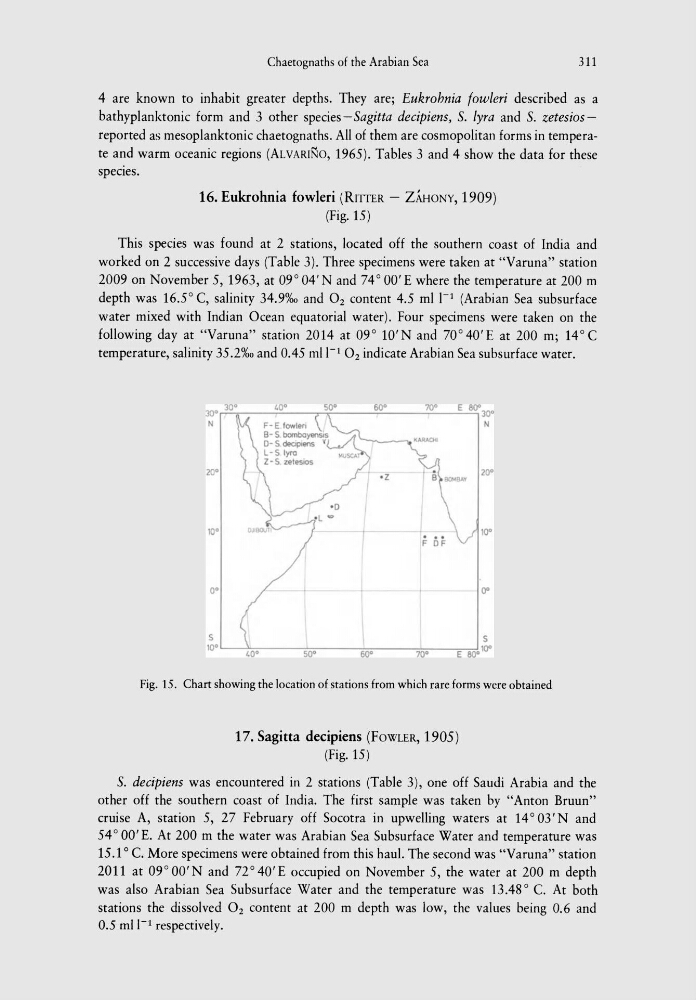
16. Eukrohnia fowleri (RITTER - ZAHONY, 1909)
(Fig. 15)
This species was found at 2 stations, located off the southern coast of India and
worked on 2 successive days (Table 3). Three specimens were taken at "Varuna" station
2009 on November 5, 1963, at 09 ° 04' Nand 74 ° 00' E where the temperature at 200 m
depth was 16.5° C, salinity 34.9%() and O2 content 4.5 ml 1-1 (Arabian Sea subsurface
water mixed with Indian Ocean equatorial water). Four specimens were taken on the
following day at "Varuna" station 2014 at 09° 10'N and 70040'E at 200 m; 14°C
temperature, salinity 35.2%0 and 0.45 mll- 1 O2 indicate Arabian Sea subsurface water.
30. 30·
N
70·
E 80" JOO
N
20·
200
...... ,
10·
o·
5
5
10· L-~L'=0.;:-----;5""0.:-----;:6O"=---"""""' 70:;:". ----;E,....,d8O" 100
Fig. 15. Chart showing the location of stations from which rare forms were obtained
17. Sagitta decipiens (FOWLER, 1905)
(Fig. 15)
S. decipiens was encountered in 2 stations (Table 3), one off Saudi Arabia and the
other off the southern coast of India. The first sample was taken by "Anton Bruun"
cruise A, station 5, 27 February off Socotra in upwelling waters at 14° 03' Nand
54°00'E. At 200 m the water was Arabian Sea Subsurface Water and temperature was
15.1 ° C. More specimens were obtained from this haul. The second was "Varuna" station
2011 at 09°00'N and 72°40'E occupied on November 5, the water at 200 m depth
was also Arabian Sea Subsurface Water and the temperature was 13.48° C. At both
stations the dissolved O2 content at 200 m depth was low, the values being 0.6 and
0.5 mll- 1 respectively.
311
4 are known to inhabit greater depths. They are; Eukrohnia fowleri described as a
bathyplanktonic form and 3 other species-Sagitta decipiens, S. lyra and S. zetesiosreported as mesoplanktonic chaetognaths. All of them are cosmopolitan forms in temperate and warm oceanic regions (ALVARINO, 1965). Tables 3 and 4 show the data for these
species.
16. Eukrohnia fowleri (RITTER - ZAHONY, 1909)
(Fig. 15)
This species was found at 2 stations, located off the southern coast of India and
worked on 2 successive days (Table 3). Three specimens were taken at "Varuna" station
2009 on November 5, 1963, at 09 ° 04' Nand 74 ° 00' E where the temperature at 200 m
depth was 16.5° C, salinity 34.9%() and O2 content 4.5 ml 1-1 (Arabian Sea subsurface
water mixed with Indian Ocean equatorial water). Four specimens were taken on the
following day at "Varuna" station 2014 at 09° 10'N and 70040'E at 200 m; 14°C
temperature, salinity 35.2%0 and 0.45 mll- 1 O2 indicate Arabian Sea subsurface water.
30. 30·
N
70·
E 80" JOO
N
20·
200
...... ,
10·
o·
5
5
10· L-~L'=0.;:-----;5""0.:-----;:6O"=---"""""' 70:;:". ----;E,....,d8O" 100
Fig. 15. Chart showing the location of stations from which rare forms were obtained
17. Sagitta decipiens (FOWLER, 1905)
(Fig. 15)
S. decipiens was encountered in 2 stations (Table 3), one off Saudi Arabia and the
other off the southern coast of India. The first sample was taken by "Anton Bruun"
cruise A, station 5, 27 February off Socotra in upwelling waters at 14° 03' Nand
54°00'E. At 200 m the water was Arabian Sea Subsurface Water and temperature was
15.1 ° C. More specimens were obtained from this haul. The second was "Varuna" station
2011 at 09°00'N and 72°40'E occupied on November 5, the water at 200 m depth
was also Arabian Sea Subsurface Water and the temperature was 13.48° C. At both
stations the dissolved O2 content at 200 m depth was low, the values being 0.6 and
0.5 mll- 1 respectively.