

212
A. DE DECKER:
Admittedly, CLEVE'S hauls over the Bank were taken in much shallower depths than
those on either side of it, but this aspect must not be overstressed. A recent survey with
vertical nets operated between 100 m and the surface at 9 stations spread over the whole
width of the Bank and visited 4 times in one year, yielded 55 species of copepods, as
against 71 species found in 7 horizontal surface hauls of 10 minutes made between East
London and Durban in July 1965. The coastal belt where CLEVE obtained his material
was sampled again 60 years later by means of a plankton pump which allows continuous
sampling while the ship is underway (DE DECKER, 1962). The succession of species in E-W
direction along the ship's route agreed surprisingly well with that found by CLEVE.
In July 1967, during a similar survey with the continuous pump along the same route,
this agreement was found once more. This time, however, the ship also worked 36
oceanographic and plankton stations on the way up and back, the upward leg between
Port Elizabeth and Durban fo~lowing a route at a distance of 60 to 80 miles from the coast
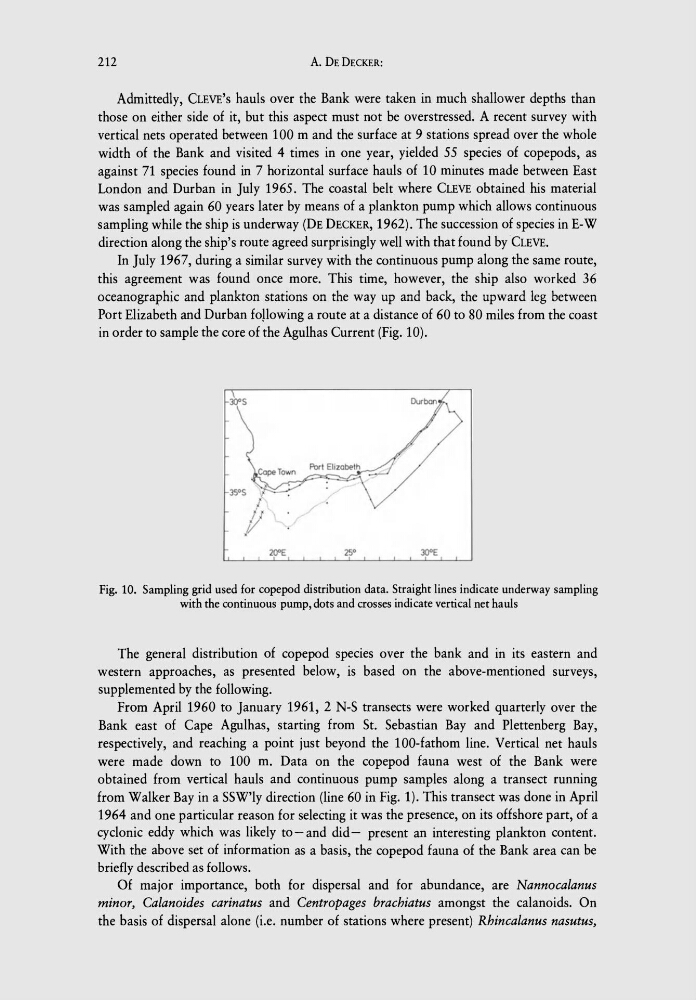
in order to sample the core of the Agulhas Current (Fig. 10).
Fig. 10. Sampling grid used for copepod distribution data. Straight lines indicate underway sampling
with the continuous pump, dots and crosses indicate vertical net hauls
The general distribution of copepod species over the bank and in its eastern and
western approaches, as presented below, is based on the above-mentioned surveys,
supplemented by the following.
From April 1960 to January 1961, 2 N-S transects were worked quarterly over the
Bank east of Cape Agulhas, starting from St. Sebastian Bay and Plettenberg Bay,
respectively, and reaching a point just beyond the 100-fathom line. Vertical net hauls
were made down to 100 m. Data on the copepod fauna west of the Bank were
obtained from vertical hauls and continuous pump samples along a transect running
from Walker Bay in a SSW'ly direction (line 60 in Fig. 1). This transect was done in April
1964 and one particular reason for selecting it was the presence, on its offshore part, of a
cyclonic eddy which was likely to - and did - present an interesting plankton content.
With the above set of information as a basis, the copepod fauna of the Bank area can be
briefly described as follows.
Of major importance, both for dispersal and for abundance, are Nannocalanus
minor, Calanoides carinatus and Centropages brachiatus amongst the calanoids. On
the basis of dispersal alone (i.e. number of stations where present) Rhincalanus nasutus,
A. DE DECKER:
Admittedly, CLEVE'S hauls over the Bank were taken in much shallower depths than
those on either side of it, but this aspect must not be overstressed. A recent survey with
vertical nets operated between 100 m and the surface at 9 stations spread over the whole
width of the Bank and visited 4 times in one year, yielded 55 species of copepods, as
against 71 species found in 7 horizontal surface hauls of 10 minutes made between East
London and Durban in July 1965. The coastal belt where CLEVE obtained his material
was sampled again 60 years later by means of a plankton pump which allows continuous
sampling while the ship is underway (DE DECKER, 1962). The succession of species in E-W
direction along the ship's route agreed surprisingly well with that found by CLEVE.
In July 1967, during a similar survey with the continuous pump along the same route,
this agreement was found once more. This time, however, the ship also worked 36
oceanographic and plankton stations on the way up and back, the upward leg between
Port Elizabeth and Durban fo~lowing a route at a distance of 60 to 80 miles from the coast
in order to sample the core of the Agulhas Current (Fig. 10).
Fig. 10. Sampling grid used for copepod distribution data. Straight lines indicate underway sampling
with the continuous pump, dots and crosses indicate vertical net hauls
The general distribution of copepod species over the bank and in its eastern and
western approaches, as presented below, is based on the above-mentioned surveys,
supplemented by the following.
From April 1960 to January 1961, 2 N-S transects were worked quarterly over the
Bank east of Cape Agulhas, starting from St. Sebastian Bay and Plettenberg Bay,
respectively, and reaching a point just beyond the 100-fathom line. Vertical net hauls
were made down to 100 m. Data on the copepod fauna west of the Bank were
obtained from vertical hauls and continuous pump samples along a transect running
from Walker Bay in a SSW'ly direction (line 60 in Fig. 1). This transect was done in April
1964 and one particular reason for selecting it was the presence, on its offshore part, of a
cyclonic eddy which was likely to - and did - present an interesting plankton content.
With the above set of information as a basis, the copepod fauna of the Bank area can be
briefly described as follows.
Of major importance, both for dispersal and for abundance, are Nannocalanus
minor, Calanoides carinatus and Centropages brachiatus amongst the calanoids. On
the basis of dispersal alone (i.e. number of stations where present) Rhincalanus nasutus,