

Agulhas Bank Plankton
199
maximum in winter, when all other species are absent or at a low ebb (except Ihlea
magalhanica in 1965). In certain periods, its distribution shows a clear preference for
areas of upwelling, both in- and offshore. Six other species were found over the Bank
for short periods and in small numbers: Salpa fusiformis each year mainly in October,
but also in June and December- Cyci()salpa pinnata, Pegea confoederata and Dolioletta
gegenbauri in March and April- Do/io/ettrJ tritonis at 5 stations in October 1965 - Salpa
cylindrica at 6 stations in December 1965.
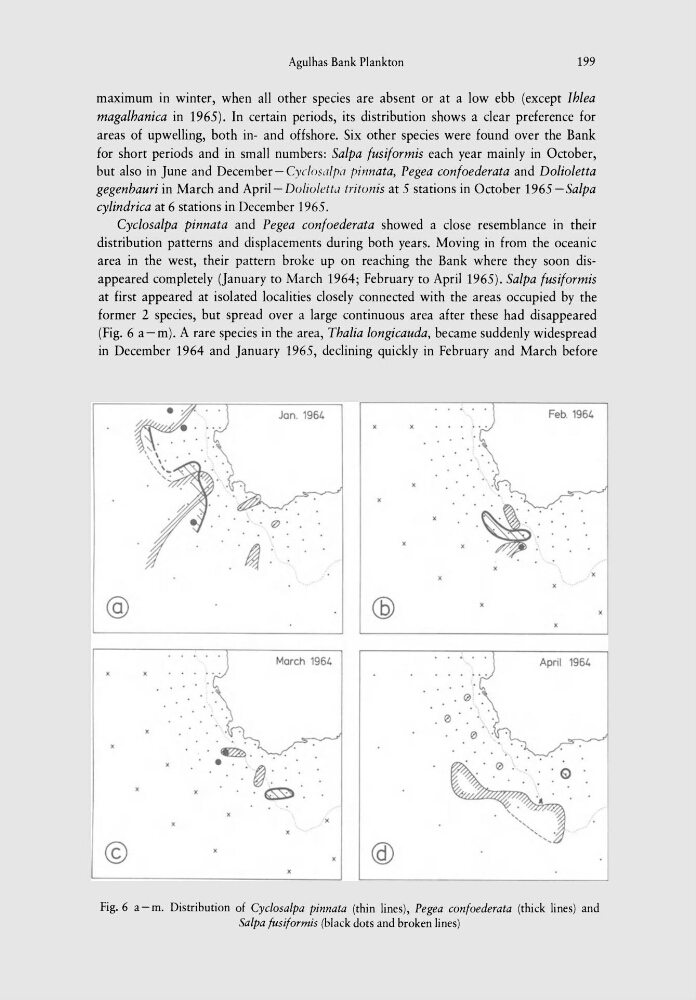
Cyclosalpa pinnata and Pegea confoederata showed a close resemblance in their
distribution patterns and displacements during both years. Moving in from the oceanic
area in the west, their pattern broke up on reaching the Bank where they soon disappeared completely (January to March 1964; February to April 1965). Salpa fusiformis
at first appeared at isolated localities closely connected with the areas occupied by the
former 2 species, but spread over a large continuous area after these had disappeared
(Fig. 6 a - m). A rare species in the area, Thalia longicauda, became suddenly widespread
in December 1964 and January 1965, declining quickly in February and March before
Feb. 1964
.~
. ..
.
.
@
March 1961.
April 1964
. . . .
©
@
Fig. 6 a - m. Distribution of Cyclosalpa pinnata (thin lines), Pegea confoederata (thick lines) and
Salpa fusiformis (black dots and broken lines)
199
maximum in winter, when all other species are absent or at a low ebb (except Ihlea
magalhanica in 1965). In certain periods, its distribution shows a clear preference for
areas of upwelling, both in- and offshore. Six other species were found over the Bank
for short periods and in small numbers: Salpa fusiformis each year mainly in October,
but also in June and December- Cyci()salpa pinnata, Pegea confoederata and Dolioletta
gegenbauri in March and April- Do/io/ettrJ tritonis at 5 stations in October 1965 - Salpa
cylindrica at 6 stations in December 1965.
Cyclosalpa pinnata and Pegea confoederata showed a close resemblance in their
distribution patterns and displacements during both years. Moving in from the oceanic
area in the west, their pattern broke up on reaching the Bank where they soon disappeared completely (January to March 1964; February to April 1965). Salpa fusiformis
at first appeared at isolated localities closely connected with the areas occupied by the
former 2 species, but spread over a large continuous area after these had disappeared
(Fig. 6 a - m). A rare species in the area, Thalia longicauda, became suddenly widespread
in December 1964 and January 1965, declining quickly in February and March before
Feb. 1964
.~
. ..
.
.
@
March 1961.
April 1964
. . . .
©
@
Fig. 6 a - m. Distribution of Cyclosalpa pinnata (thin lines), Pegea confoederata (thick lines) and
Salpa fusiformis (black dots and broken lines)