

196
A. DE DECKER:
Thaliacea in variable sizes and quantities over the Bank. This makes any comparison of
settled volumes with those in other areas meaningless, unless the catches are broken
down into taxonomic groups. These Thaliacea, at the time of their annual peak, can
occur in incredible numbers over the central and southern parts of the Bank, their uninterrupted swarms extending over thousands of square miles.
Their maxima closely follow those of the phytoplankton, and their grazing potential
probably constitutes an important limiting factor in the development of other consumers
within the Bank community. The overwhelming majority among the species present .in
these swarms belongs to the 2 species Thalia dernacratica and Daliolurn denticulaturn
which also predominated in the seas south of Madagascar during the first lIOE cruise
"African a II" in June and July 1961, but in far fewer numbers. Advection by the Agulhas
Current and eddy dispersal over the highly productive Bank may initiate their dense
swarming. Data from ZOUfENDYK (1970) on the zooplankton settled volumes in the
SW Indian Ocean show high concentrations over the eastern part of the Bank as well.
Average volumes in excess of 128 ml per 100 m 3 were recorded throughout the year,
except in winter, when they still kept within the range of 65 to 128 ml per 100 m 3 •
Apart from the Thaliacea, the Bank at times also harbours impressive local concentrations of Copepoda, Cladocera or Chaetognatha.
1. Thaliacea
V AN ZIJL (1959) identified 11 species of salps and doliolids in material taken monthly
over a period of 2 years (1954-56) off the South African west coast. His work was
continued by DOWLER (unpublished), who examined monthly catches taken over the
whole routine survey area from October 1963 to December 1965. The list of species
was correspondingly extended to 23, two af which could not be identified beyond the
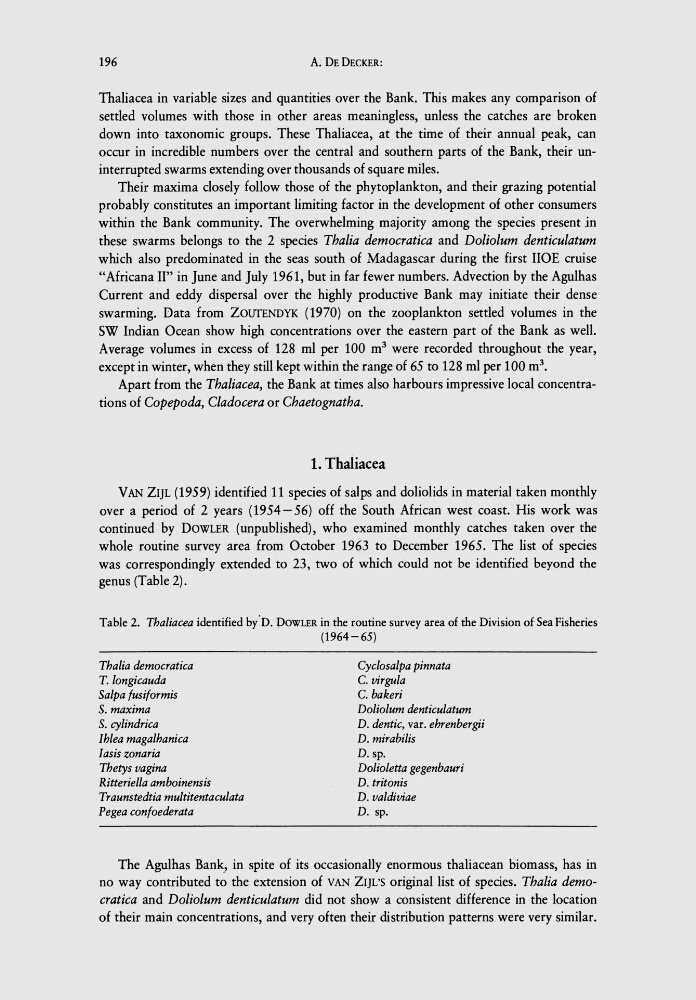
genus (Table 2).
Table 2. Thaliacea identified by 'D. DOWLER in the routine survey area of the Division of Sea Fisheries
(1964-65)
Thalia democratica
T, longicauda
Salpa fusiformis
S. maxima
S. cylindrica
Ihlea magalhanica
Iasis zonaria
Thetys vagina
Ritteriella amboinensis
Traunstedtia multitentaculata
Pegea confoederata
Cyclosalpa pinnata
C. virgula
C. bakeri
Doliolum denticulatum
D, dentic, var. ehrenbergii
D. mirabilis
D. sp.
Dolioletta gegenbauri
D. tritonis
D. valdiviae
D. sp.
The Agulhas Bank, in spite of its occasionally enormous thaliacean biomass, has in
no way contributed to the extension of VAN ZIJL'S original list of species. Thalia dernacratica and Doliolurn denticulaturn did not show a consistent difference in the location
of their main concentrations, and very often their distribution patterns were very similar.
A. DE DECKER:
Thaliacea in variable sizes and quantities over the Bank. This makes any comparison of
settled volumes with those in other areas meaningless, unless the catches are broken
down into taxonomic groups. These Thaliacea, at the time of their annual peak, can
occur in incredible numbers over the central and southern parts of the Bank, their uninterrupted swarms extending over thousands of square miles.
Their maxima closely follow those of the phytoplankton, and their grazing potential
probably constitutes an important limiting factor in the development of other consumers
within the Bank community. The overwhelming majority among the species present .in
these swarms belongs to the 2 species Thalia dernacratica and Daliolurn denticulaturn
which also predominated in the seas south of Madagascar during the first lIOE cruise
"African a II" in June and July 1961, but in far fewer numbers. Advection by the Agulhas
Current and eddy dispersal over the highly productive Bank may initiate their dense
swarming. Data from ZOUfENDYK (1970) on the zooplankton settled volumes in the
SW Indian Ocean show high concentrations over the eastern part of the Bank as well.
Average volumes in excess of 128 ml per 100 m 3 were recorded throughout the year,
except in winter, when they still kept within the range of 65 to 128 ml per 100 m 3 •
Apart from the Thaliacea, the Bank at times also harbours impressive local concentrations of Copepoda, Cladocera or Chaetognatha.
1. Thaliacea
V AN ZIJL (1959) identified 11 species of salps and doliolids in material taken monthly
over a period of 2 years (1954-56) off the South African west coast. His work was
continued by DOWLER (unpublished), who examined monthly catches taken over the
whole routine survey area from October 1963 to December 1965. The list of species
was correspondingly extended to 23, two af which could not be identified beyond the
genus (Table 2).
Table 2. Thaliacea identified by 'D. DOWLER in the routine survey area of the Division of Sea Fisheries
(1964-65)
Thalia democratica
T, longicauda
Salpa fusiformis
S. maxima
S. cylindrica
Ihlea magalhanica
Iasis zonaria
Thetys vagina
Ritteriella amboinensis
Traunstedtia multitentaculata
Pegea confoederata
Cyclosalpa pinnata
C. virgula
C. bakeri
Doliolum denticulatum
D, dentic, var. ehrenbergii
D. mirabilis
D. sp.
Dolioletta gegenbauri
D. tritonis
D. valdiviae
D. sp.
The Agulhas Bank, in spite of its occasionally enormous thaliacean biomass, has in
no way contributed to the extension of VAN ZIJL'S original list of species. Thalia dernacratica and Doliolurn denticulaturn did not show a consistent difference in the location
of their main concentrations, and very often their distribution patterns were very similar.