

The Formation of the Chlorophyll Maximum in the Indian Ocean
173
in causing the high concentration of chlorophyll pigments in deeper parts of the euphotic
layer.
III. Chemical Composition of Particulate Organic Matter
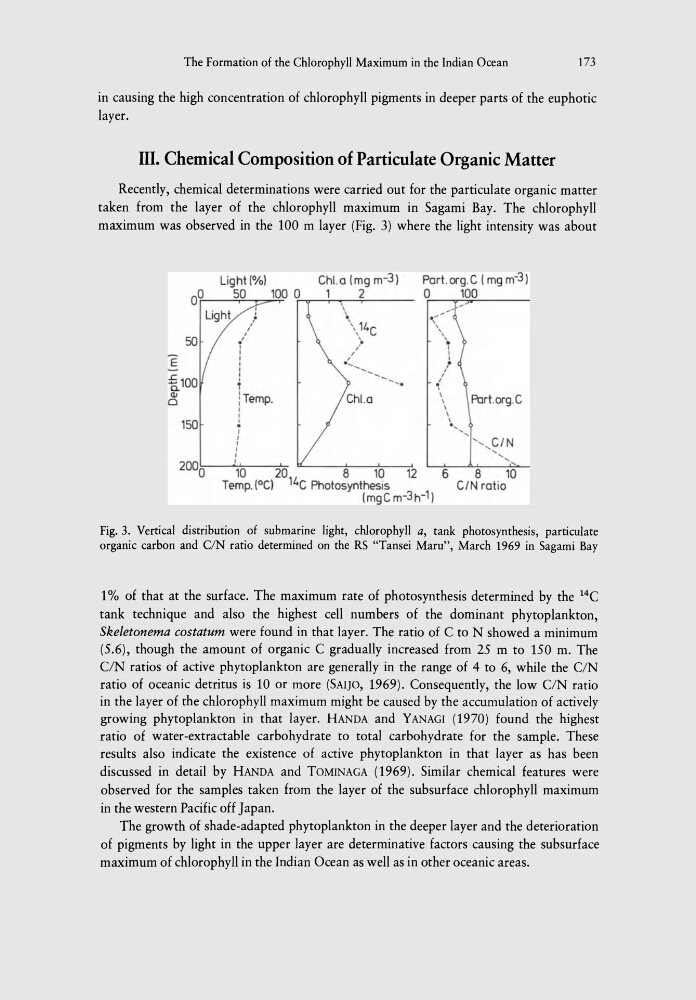
Recently, chemical determinations were carried out for the particulate organic matter
taken from the layer of the chlorophyll maximum in Sagami Bay. The chlorophyll
maximum was observed in the 100 m layer (Fig. 3) where the light intensity was about
E
£100 a.
150
Light 1%)
ChI. a (mg m-3)
50
100 0r-v----r1--",...---'2'r-_ _
, ,
.
,
I
/
i
I
I
I
:
,
; Temp.
I
I
,
. I
'.
·\~t.c
,/
0 , " .......... _-. . ..
ChI. a
Port. arg. C I mg m-3)
o 100
~.
\ \
I
I
,
l
I
I
~
\
Pcrt.org.C
\
\
\
. ............
!
",~!~,
2oo 0 ,=------o, '1-' =-0 --'2"'""0
8
10
12
6
8
10
Temp. 1°C) It.C Photosynthesis
C/N ratio
ImgC m-3h-1)
Fig. 3. Vertical distribution of submarine light, chlorophyll a, tank photosynthesis, particulate
organic carbon and CIN ratio determined on the RS "Tansei Maru", March 1969 in Sagami Bay
1 % of that at the surface. The maximum rate of photosynthesis determined by the 14C
tank technique and also the highest cell numbers of the dominant phytoplankton,
Skeletonema costatum were found in that layer. The ratio of C to N showed a minimum
(5.6), though the amount of organic C gradually increased from 25 m to 150 m. The
CIN ratios of active phytoplankton are generally in the range of 4 to 6, while the CIN
ratio of oceanic detritus is 10 or more (SAIJO, 1969) . Consequently, the low C/N ratio
in the layer of the chlorophyll maximum might be caused by the accumulation of actively
growing phytoplankton in that layer. HANDA and YANAGI (1970) found the highest
ratio of water-extractable carbohydrate to total carbohydrate for the sample. These
results also indicate the existence of active phytoplankton in that layer as has been
discussed in detail by HANDA and TOMINAGA (1969). Similar chemical features were
observed for the samples taken from the layer of the subsurface chlorophyll maximum
in the western Pacific off Japan.
The growth of shade-adapted phytoplankton in the deeper layer and the deterioration
of pigments by light in the upper layer are determinative factors causing the subsurface
maximum of chlorophyll in the Indian Ocean as well as in other oceanic areas.
173
in causing the high concentration of chlorophyll pigments in deeper parts of the euphotic
layer.
III. Chemical Composition of Particulate Organic Matter
Recently, chemical determinations were carried out for the particulate organic matter
taken from the layer of the chlorophyll maximum in Sagami Bay. The chlorophyll
maximum was observed in the 100 m layer (Fig. 3) where the light intensity was about
E
£100 a.
150
Light 1%)
ChI. a (mg m-3)
50
100 0r-v----r1--",...---'2'r-_ _
, ,
.
,
I
/
i
I
I
I
:
,
; Temp.
I
I
,
. I
'.
·\~t.c
,/
0 , " .......... _-. . ..
ChI. a
Port. arg. C I mg m-3)
o 100
~.
\ \
I
I
,
l
I
I
~
\
Pcrt.org.C
\
\
\
. ............
!
",~!~,
2oo 0 ,=------o, '1-' =-0 --'2"'""0
8
10
12
6
8
10
Temp. 1°C) It.C Photosynthesis
C/N ratio
ImgC m-3h-1)
Fig. 3. Vertical distribution of submarine light, chlorophyll a, tank photosynthesis, particulate
organic carbon and CIN ratio determined on the RS "Tansei Maru", March 1969 in Sagami Bay
1 % of that at the surface. The maximum rate of photosynthesis determined by the 14C
tank technique and also the highest cell numbers of the dominant phytoplankton,
Skeletonema costatum were found in that layer. The ratio of C to N showed a minimum
(5.6), though the amount of organic C gradually increased from 25 m to 150 m. The
CIN ratios of active phytoplankton are generally in the range of 4 to 6, while the CIN
ratio of oceanic detritus is 10 or more (SAIJO, 1969) . Consequently, the low C/N ratio
in the layer of the chlorophyll maximum might be caused by the accumulation of actively
growing phytoplankton in that layer. HANDA and YANAGI (1970) found the highest
ratio of water-extractable carbohydrate to total carbohydrate for the sample. These
results also indicate the existence of active phytoplankton in that layer as has been
discussed in detail by HANDA and TOMINAGA (1969). Similar chemical features were
observed for the samples taken from the layer of the subsurface chlorophyll maximum
in the western Pacific off Japan.
The growth of shade-adapted phytoplankton in the deeper layer and the deterioration
of pigments by light in the upper layer are determinative factors causing the subsurface
maximum of chlorophyll in the Indian Ocean as well as in other oceanic areas.