

172
o 0.1 0.2 0.3
Ch I. a I mg m-3)
Y.SAI]O:
I
, ----------------~
20
25
30
Temp. 1°C)
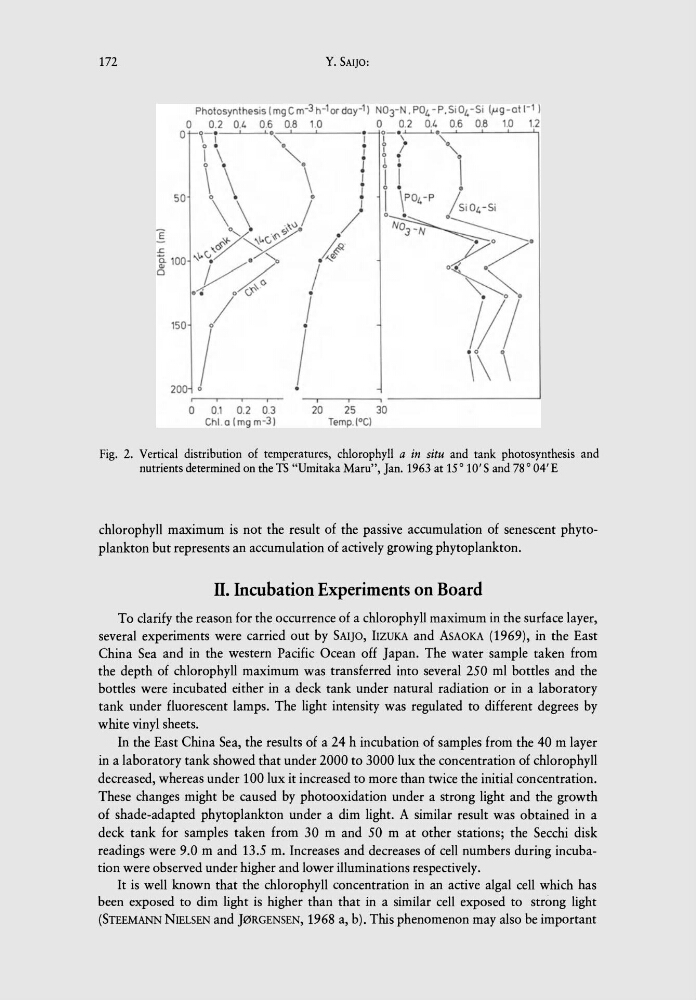
Fig. 2. Vertical distribution of temperatures, chlorophyll a in situ and tank photosynthesis and
nutrients determined on the TS "Umitaka Maru", Jan. 1963 at 15 0 10' 5 and 78 0 04' E
chlorophyll maximum is not the result of the passive accumulation of senescent phytoplankton but represents an accumulation of actively growing phytoplankton.
II. Incubation Experiments on Board
To clarify the reason for the occurrence of a chlorophyll maximum in the surface layer,
several experiments were carried out by SAI]O, IIZUKA and ASAOKA (1969), in the East
China Sea and in the western Pacific Ocean off Japan. The water sample taken from
the depth of chlorophyll maximum was transferred into several 250 ml bottles and the
bottles were incubated either in a deck tank under natural radiation or in a laboratory
tank under fluorescent lamps. The light intensity was regulated to different degrees by
white vinyl sheets.
In the East China Sea, the results of a 24 h incubation of samples from the 40 m layer
in a laboratory tank showed that under 2000 to 3000 lux the concentration of chlorophyll
decreased, whereas under 100 lux it increased to more than twice the initial concentration.
These changes might be caused by photooxidation under a strong light and the growth
of shade-adapted phytoplankton under a dim light. A similar result was obtained in a
deck tank for samples taken from 30 m and 50 m at other stations; the Secchi disk
readings were 9.0 m and 13.5 m. Increases and decreases of cell numbers during incubation were observed under higher and lower illuminations respectively.
It is well known that the chlorophyll concentration in an active algal cell which has
been exposed to dim light is higher than that in a similar cell exposed to strong light
(STEEMANN NIELSEN and J0RGENSEN, 1968 a, b). This phenomenon may also be important
o 0.1 0.2 0.3
Ch I. a I mg m-3)
Y.SAI]O:
I
, ----------------~
20
25
30
Temp. 1°C)
Fig. 2. Vertical distribution of temperatures, chlorophyll a in situ and tank photosynthesis and
nutrients determined on the TS "Umitaka Maru", Jan. 1963 at 15 0 10' 5 and 78 0 04' E
chlorophyll maximum is not the result of the passive accumulation of senescent phytoplankton but represents an accumulation of actively growing phytoplankton.
II. Incubation Experiments on Board
To clarify the reason for the occurrence of a chlorophyll maximum in the surface layer,
several experiments were carried out by SAI]O, IIZUKA and ASAOKA (1969), in the East
China Sea and in the western Pacific Ocean off Japan. The water sample taken from
the depth of chlorophyll maximum was transferred into several 250 ml bottles and the
bottles were incubated either in a deck tank under natural radiation or in a laboratory
tank under fluorescent lamps. The light intensity was regulated to different degrees by
white vinyl sheets.
In the East China Sea, the results of a 24 h incubation of samples from the 40 m layer
in a laboratory tank showed that under 2000 to 3000 lux the concentration of chlorophyll
decreased, whereas under 100 lux it increased to more than twice the initial concentration.
These changes might be caused by photooxidation under a strong light and the growth
of shade-adapted phytoplankton under a dim light. A similar result was obtained in a
deck tank for samples taken from 30 m and 50 m at other stations; the Secchi disk
readings were 9.0 m and 13.5 m. Increases and decreases of cell numbers during incubation were observed under higher and lower illuminations respectively.
It is well known that the chlorophyll concentration in an active algal cell which has
been exposed to dim light is higher than that in a similar cell exposed to strong light
(STEEMANN NIELSEN and J0RGENSEN, 1968 a, b). This phenomenon may also be important