

158
F.]. R. TAYLOR:
studies. In a few samples, even despite inadequate preservation, it could be seen that nonthecate dino£lagellates were abundant. These were from stations 289, 327 and 374, all
in coastal regions. Further, SUBRAHMANYAN and SARMA (1965) in a study off the SW
N 30·
f
20
!
(
10
A
0
10
, .....
20
~;
,: .
~;:
j,'
. '.
... -'~
20
----+------rN 2o
.. ,.
-f-------'''f'''''-----'i'''''''---...,---r:\-;;;----'''''-''-----Q - '33 ---+----+--111- 30
• • >0
' .I)I~
.4t' _ _ .... .:t .• 132 0;~::~:.d1m
~-L---+---~----r-----t_--~-~-~ W~·-r---t---~~40·S
20· E
30
40
50
60
70
80
90
100" E
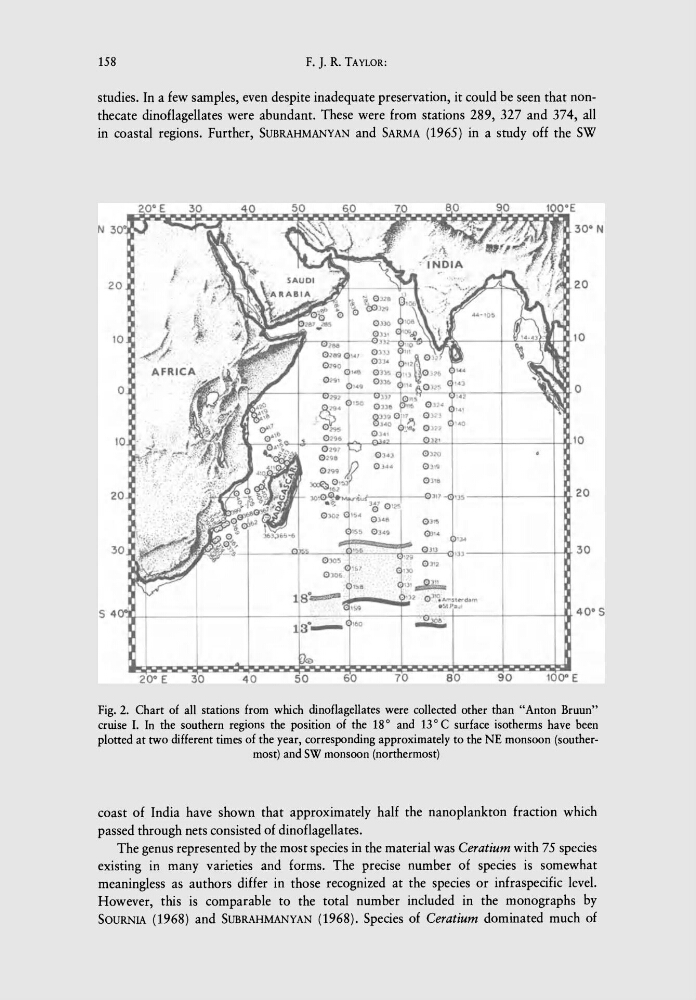
Fig. 2. Chart of all stations from which dinoflagellates were collected other than "Anton Bruun"
cruise 1. In the southern regions the position of the 18° and 13 0 C surface isotherms have been
plotted at two different times of the year, corresponding approximately to the NE monsoon (southermost) and SW monsoon (northermost)
coast of India have shown that approximately half the nanoplankton fraction which
passed through nets consisted of dino£lagellates.
The genus represented by the most species in the material was Ceratium with 75 species
existing in many varieties and forms. The precise number of species is somewhat
meaningless as authors differ in those recognized at the species or infraspecific level.
However, this is comparable to the total number included in the monographs by
SOURNIA (1968) and SUBRAHMANYAN (1968). Species of Ceratium dominated much of
F.]. R. TAYLOR:
studies. In a few samples, even despite inadequate preservation, it could be seen that nonthecate dino£lagellates were abundant. These were from stations 289, 327 and 374, all
in coastal regions. Further, SUBRAHMANYAN and SARMA (1965) in a study off the SW
N 30·
f
20
!
(
10
A
0
10
, .....
20
~;
,: .
~;:
j,'
. '.
... -'~
20
----+------rN 2o
.. ,.
-f-------'''f'''''-----'i'''''''---...,---r:\-;;;----'''''-''-----Q - '33 ---+----+--111- 30
• • >0
' .I)I~
.4t' _ _ .... .:t .• 132 0;~::~:.d1m
~-L---+---~----r-----t_--~-~-~ W~·-r---t---~~40·S
20· E
30
40
50
60
70
80
90
100" E
Fig. 2. Chart of all stations from which dinoflagellates were collected other than "Anton Bruun"
cruise 1. In the southern regions the position of the 18° and 13 0 C surface isotherms have been
plotted at two different times of the year, corresponding approximately to the NE monsoon (southermost) and SW monsoon (northermost)
coast of India have shown that approximately half the nanoplankton fraction which
passed through nets consisted of dino£lagellates.
The genus represented by the most species in the material was Ceratium with 75 species
existing in many varieties and forms. The precise number of species is somewhat
meaningless as authors differ in those recognized at the species or infraspecific level.
However, this is comparable to the total number included in the monographs by
SOURNIA (1968) and SUBRAHMANYAN (1968). Species of Ceratium dominated much of