

Productivity of Backwaters and Estuaries
145
February- May (premonsoon), June-September (monsoon) and October-January
(postmonsoon). For convenience, the 2 monsoons (SW and NE) have been referred to as
monsoon and postmonsoon seasons. During the monsoon season, as a result of
considerable inflow of freshwater, the turbidity in the backwater increases and the light
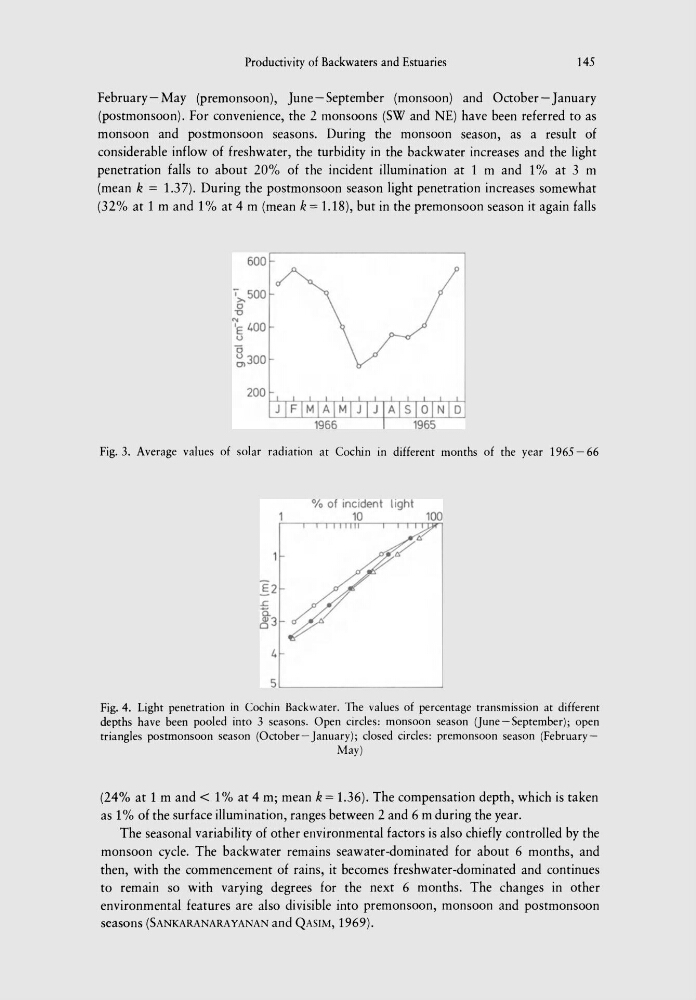
penetration falls to about 20% of the incident illumination at 1 m and 1 % at 3 m
(mean k = 1.37). During the postmonsoon season light penetration increases somewhat
(32% at 1 m and 1 % at 4 m (mean k = 1.18), but in the premonsoon season it again falls
600
' >. 500
o
"0
~ 400
u
a
~300
200
D
Fig. 3. Average values of solar radiation at Cochin m different months of the year 1965 - 66
% of incident light
10
SL-________________ ~
Fig. 4. Light penetration in Cochin Backwater. The values of percentage transmission at different
depths have been pooled into 3 seasons. Open circles: monsoon season (June-September); open
triangles postmonsoon season (October-January); closed circles: premonsoon season (FebruaryMay)
(24% at 1 m and < 1 % at 4 m; mean k = 1.36). The compensation depth, which is taken
as 1 % of the surface illumination, ranges between 2 and 6 m during the year.
The seasonal variability of other environmental factors is also chiefly controlled by the
monsoon cycle. The backwater remains seawater-dominated for about 6 months, and
then, with the commencement of rains, it becomes freshwater-dominated and continues
to remain so with varying degrees for the next 6 months. The changes in other
environmental features are also divisible into premonsoon, monsoon and postmonsoon
seasons (SANKARANARAYANAN and QASIM, 1969).
145
February- May (premonsoon), June-September (monsoon) and October-January
(postmonsoon). For convenience, the 2 monsoons (SW and NE) have been referred to as
monsoon and postmonsoon seasons. During the monsoon season, as a result of
considerable inflow of freshwater, the turbidity in the backwater increases and the light
penetration falls to about 20% of the incident illumination at 1 m and 1 % at 3 m
(mean k = 1.37). During the postmonsoon season light penetration increases somewhat
(32% at 1 m and 1 % at 4 m (mean k = 1.18), but in the premonsoon season it again falls
600
' >. 500
o
"0
~ 400
u
a
~300
200
D
Fig. 3. Average values of solar radiation at Cochin m different months of the year 1965 - 66
% of incident light
10
SL-________________ ~
Fig. 4. Light penetration in Cochin Backwater. The values of percentage transmission at different
depths have been pooled into 3 seasons. Open circles: monsoon season (June-September); open
triangles postmonsoon season (October-January); closed circles: premonsoon season (FebruaryMay)
(24% at 1 m and < 1 % at 4 m; mean k = 1.36). The compensation depth, which is taken
as 1 % of the surface illumination, ranges between 2 and 6 m during the year.
The seasonal variability of other environmental factors is also chiefly controlled by the
monsoon cycle. The backwater remains seawater-dominated for about 6 months, and
then, with the commencement of rains, it becomes freshwater-dominated and continues
to remain so with varying degrees for the next 6 months. The changes in other
environmental features are also divisible into premonsoon, monsoon and postmonsoon
seasons (SANKARANARAYANAN and QASIM, 1969).