

144
S. Z. QASIM:
tained by a channel, about 450 m wide, which forms an entrance to Cochin harbour.
Several rivers, irrigation channels and sewers open into this backwater which terminates
in a large lake called Vembanad Lake. The area is accessible to all types of craft, including
ocean-going vessels (to the harbour). The backwater is intensely polluted and most
of the area is less than 3 m deep, except for the shipping channels which are dredged
to a depth of 10 to 12 m.
I. Environmental Features
The hydrography of the backwater is largely influenced by two main factors: the
short-term changes induced by the tides and the seasonal changes brought about by the
monsoon system. The magnitude of variation within the backwater largely depends upon
the place of observation (nearness to the sea or freshwater source). In this communication,
therefore, descriptions are provided of the environmental features at a site where conditions remain typically estuarine (Fig. 1). The changes in the different parameters can
be summarized as follows:
1. Tides
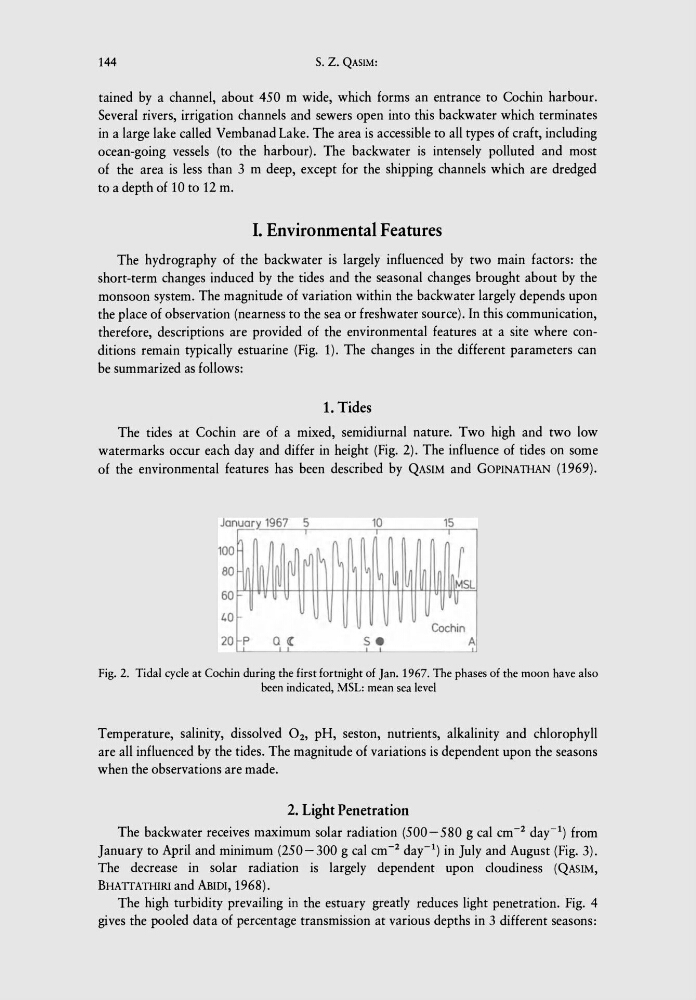
The tides at Cochin are of a mixed, semidiurnal nature. Two high and two low
watermarks occur each day and differ in height (Fig. 2). The influence of tides on some
of the environmental features has been described by QASIM and GOPINATHAN (1969).
JQnuar~ 1967 5
r==.
100
80
60
40
20 p
l~1 , U
~,~ J ~
U
a
15
l Il ~
r
I~ InMSL
'~ ' U
Cochin
se
A
Fig. 2. Tidal cycle at Cochin during the first fortnight of Jan. 1967. The phases of the moon have also
been indicated, MSL: mean sea level
Temperature, salinity, dissolved 02, pH, seston, nutrients, alkalinity and chlorophyll
are all influenced by the tides. The magnitude of variations is dependent upon the seasons
when the observations are made.
2. Light Penetration
The backwater receives maximum solar radiation (500-580 g cal cm- 2 day-I) from
January to April and minimum (250-300 g cal cm- 2 day-I) in July and August (Fig. 3).
The decrease in solar radiation is largely dependent upon cloudiness (QASIM,
BHATTATHIRI and ABIDI, 1968).
The high turbidity prevailing in the estuary greatly reduces light penetration. Fig. 4
gives the pooled data of percentage transmission at various depths in 3 different seasons:
S. Z. QASIM:
tained by a channel, about 450 m wide, which forms an entrance to Cochin harbour.
Several rivers, irrigation channels and sewers open into this backwater which terminates
in a large lake called Vembanad Lake. The area is accessible to all types of craft, including
ocean-going vessels (to the harbour). The backwater is intensely polluted and most
of the area is less than 3 m deep, except for the shipping channels which are dredged
to a depth of 10 to 12 m.
I. Environmental Features
The hydrography of the backwater is largely influenced by two main factors: the
short-term changes induced by the tides and the seasonal changes brought about by the
monsoon system. The magnitude of variation within the backwater largely depends upon
the place of observation (nearness to the sea or freshwater source). In this communication,
therefore, descriptions are provided of the environmental features at a site where conditions remain typically estuarine (Fig. 1). The changes in the different parameters can
be summarized as follows:
1. Tides
The tides at Cochin are of a mixed, semidiurnal nature. Two high and two low
watermarks occur each day and differ in height (Fig. 2). The influence of tides on some
of the environmental features has been described by QASIM and GOPINATHAN (1969).
JQnuar~ 1967 5
r==.
100
80
60
40
20 p
l~1 , U
~,~ J ~
U
a
15
l Il ~
r
I~ InMSL
'~ ' U
Cochin
se
A
Fig. 2. Tidal cycle at Cochin during the first fortnight of Jan. 1967. The phases of the moon have also
been indicated, MSL: mean sea level
Temperature, salinity, dissolved 02, pH, seston, nutrients, alkalinity and chlorophyll
are all influenced by the tides. The magnitude of variations is dependent upon the seasons
when the observations are made.
2. Light Penetration
The backwater receives maximum solar radiation (500-580 g cal cm- 2 day-I) from
January to April and minimum (250-300 g cal cm- 2 day-I) in July and August (Fig. 3).
The decrease in solar radiation is largely dependent upon cloudiness (QASIM,
BHATTATHIRI and ABIDI, 1968).
The high turbidity prevailing in the estuary greatly reduces light penetration. Fig. 4
gives the pooled data of percentage transmission at various depths in 3 different seasons: