

Phytoplankton Production in the Southeastern Indian Ocean
141
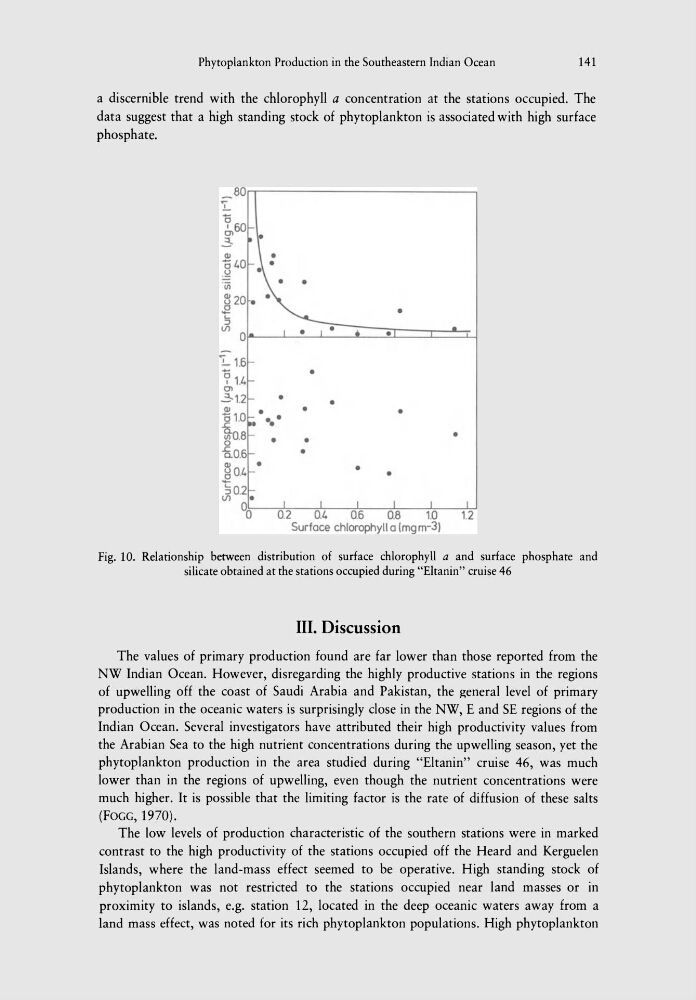
a discernible trend with the chlorophyll a concentration at the stations occupied. The
data suggest that a high standing stock of phytoplankton is associated with high surface
phosphate.
80.
L
0
~60
3•
•
• •
•
0
!:... 1.6
'9 1.4
•
Ol
3-1.2
•
•
OJ
•
•
•
0 1.0
• •
.c
• •
5ro.8
•
0
•
•
-a0.6
•
OJ
•
•
g 0.4
•
~0.2
VI
•
00
Fig. 10. Relationship between distribution of surface chlorophyll a and surface phosphate and
silicate obtained at the stations occupied during "Eltanin" cruise 46
III. Discussion
The values of primary production found are far lower than those reported from the
NW Indian Ocean. However, disregarding the highly productive stations in the regions
of upwelling off the coast of Saudi Arabia and Pakistan, the general level of primary
production in the oceanic waters is surprisingly close in the NW, E and SE regions of the
Indian Ocean. Several investigators have attributed their high productivity values from
the Arabian Sea to the high nutrient concentrations during the upwelling season, yet the
phytoplankton production in the area studied during "Eltanin" cruise 46, was much
lower than in the regions of upwelling, even though the nutrient concentrations were
much higher. It is possible that the limiting factor is the rate of diffusion of these salts
(FoGG,1970).
The low levels of production characteristic of the southern stations were in marked
contrast to the high productivity of the stations occupied off the Heard and Kerguelen
Islands, where the land-mass effect seemed to be operative. High standing stock of
phytoplankton was not restricted to the stations occupied near land masses or in
proximity to islands, e.g. station 12, located in the deep oceanic waters away from a
land mass effect, was noted for its rich phytoplankton populations. High phytoplankton
141
a discernible trend with the chlorophyll a concentration at the stations occupied. The
data suggest that a high standing stock of phytoplankton is associated with high surface
phosphate.
80.
L
0
~60
3•
•
• •
•
0
!:... 1.6
'9 1.4
•
Ol
3-1.2
•
•
OJ
•
•
•
0 1.0
• •
.c
• •
5ro.8
•
0
•
•
-a0.6
•
OJ
•
•
g 0.4
•
~0.2
VI
•
00
Fig. 10. Relationship between distribution of surface chlorophyll a and surface phosphate and
silicate obtained at the stations occupied during "Eltanin" cruise 46
III. Discussion
The values of primary production found are far lower than those reported from the
NW Indian Ocean. However, disregarding the highly productive stations in the regions
of upwelling off the coast of Saudi Arabia and Pakistan, the general level of primary
production in the oceanic waters is surprisingly close in the NW, E and SE regions of the
Indian Ocean. Several investigators have attributed their high productivity values from
the Arabian Sea to the high nutrient concentrations during the upwelling season, yet the
phytoplankton production in the area studied during "Eltanin" cruise 46, was much
lower than in the regions of upwelling, even though the nutrient concentrations were
much higher. It is possible that the limiting factor is the rate of diffusion of these salts
(FoGG,1970).
The low levels of production characteristic of the southern stations were in marked
contrast to the high productivity of the stations occupied off the Heard and Kerguelen
Islands, where the land-mass effect seemed to be operative. High standing stock of
phytoplankton was not restricted to the stations occupied near land masses or in
proximity to islands, e.g. station 12, located in the deep oceanic waters away from a
land mass effect, was noted for its rich phytoplankton populations. High phytoplankton