

116
J. KREY:
relation with the different ecological entities which were constructed on the basis of
spatial current charts. In principle, it should be possible to extrapolate such a pattern of
plankton distribution for the Indian Ocean region, provided the other relevant
environmental factors remain constant.
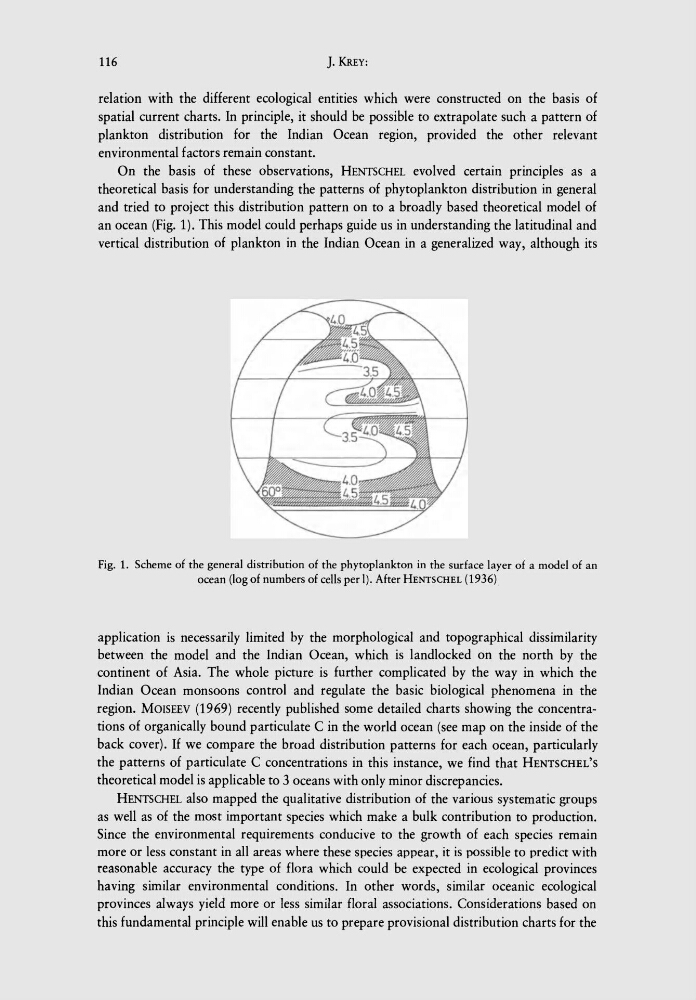
On the basis of these observations, HENTSCHEL evolved certain principles as a
theoretical basis for understanding the patterns of phytoplankton distribution in general
and tried to project this distribution pattern on to a broadly based theoretical model of
an ocean (Fig. 1). This model could perhaps guide us in understanding the latitudinal and
vertical distribution of plankton in the Indian Ocean in a generalized way, although its
Fig. 1. Scheme of the general distribution of the phytoplankton in the surface layer of a model of an
ocean (log of numbers of cells per I). After HENTSCHEL (1936)
application is necessarily limited by the morphological and topographical dissimilarity
between the model and the Indian Ocean, which is landlocked on the north by the
continent of Asia. The whole picture is further complicated by the way in which the
Indian Ocean monsoons control and regulate the basic biological phenomena in the
region. MOISEEV (1969) recently published some detailed charts showing the concentrations of organically bound particulate C in the world ocean (see map on the inside of the
back cover). If we compare the broad distribution patterns for each ocean, particularly
the patterns of particulate C concentrations in this instance, we find that HENTSCHEL'S
theoretical model is applicable to 3 oceans with only minor discrepancies.
HENTSCHEL also mapped the qualitative distribution of the various systematic groups
as well as of the most important species which make a bulk contribution to production.
Since the environmental requirements conducive to the growth of each species remain
more or less constant in all areas where these species appear, it is possible to predict with
reasonable accuracy the type of flora which could be expected in ecological provinces
having similar environmental conditions. In other words, similar oceanic ecological
provinces always yield more or less similar floral associations. Considerations based on
this fundamental principle will enable us to prepare provisional distribution charts for the
J. KREY:
relation with the different ecological entities which were constructed on the basis of
spatial current charts. In principle, it should be possible to extrapolate such a pattern of
plankton distribution for the Indian Ocean region, provided the other relevant
environmental factors remain constant.
On the basis of these observations, HENTSCHEL evolved certain principles as a
theoretical basis for understanding the patterns of phytoplankton distribution in general
and tried to project this distribution pattern on to a broadly based theoretical model of
an ocean (Fig. 1). This model could perhaps guide us in understanding the latitudinal and
vertical distribution of plankton in the Indian Ocean in a generalized way, although its
Fig. 1. Scheme of the general distribution of the phytoplankton in the surface layer of a model of an
ocean (log of numbers of cells per I). After HENTSCHEL (1936)
application is necessarily limited by the morphological and topographical dissimilarity
between the model and the Indian Ocean, which is landlocked on the north by the
continent of Asia. The whole picture is further complicated by the way in which the
Indian Ocean monsoons control and regulate the basic biological phenomena in the
region. MOISEEV (1969) recently published some detailed charts showing the concentrations of organically bound particulate C in the world ocean (see map on the inside of the
back cover). If we compare the broad distribution patterns for each ocean, particularly
the patterns of particulate C concentrations in this instance, we find that HENTSCHEL'S
theoretical model is applicable to 3 oceans with only minor discrepancies.
HENTSCHEL also mapped the qualitative distribution of the various systematic groups
as well as of the most important species which make a bulk contribution to production.
Since the environmental requirements conducive to the growth of each species remain
more or less constant in all areas where these species appear, it is possible to predict with
reasonable accuracy the type of flora which could be expected in ecological provinces
having similar environmental conditions. In other words, similar oceanic ecological
provinces always yield more or less similar floral associations. Considerations based on
this fundamental principle will enable us to prepare provisional distribution charts for the