

Biogenic Sedimentation of the Persian Gulf
111
matter and the resultant reduction in light, the lack of plant life, the frequent predatory
ophiuroids or the different soil-mechanical properties. In areas where low sedimentation
rates prevail, molluscs increase in frequency in comparison to high sedimentation areas.
Molluscs generate a type of hard bottom with their own shell remains. Fine sand bottoms
where sediment is being moved, as in near-shore, shallow-water areas, have only been
investigated at one locality by the RV "Meteor". No epi-benthic organisms were
encountered (sediment type 3).
Shott
Central Swell
o~----------------------------------------/: : : I
~
50
100
m
@ Q schlumberged (WIESNER)
I: ~ .. 'J
(j~
50
100
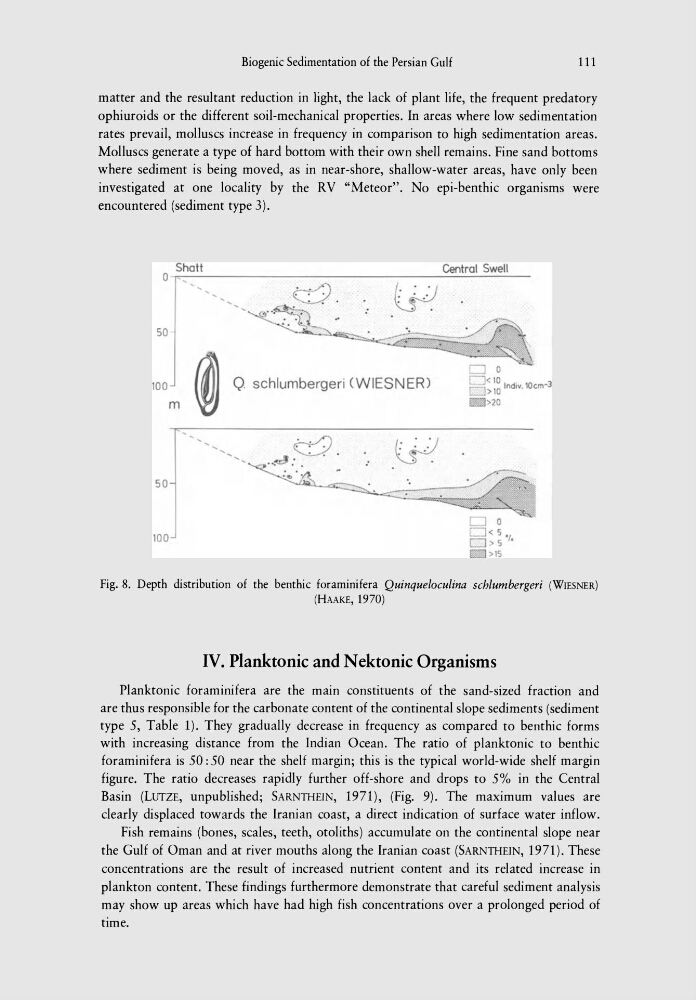
Fig. 8. Depth distribution of the benthic foraminifera Quinqueloculina schlumbergeri (WIESNER)
(HAAKE, 1970)
IV. Planktonic and Nektonic Organisms
Planktonic foraminifera are the main constituents of the sand-sized fraction and
are thus responsible for the carbonate content of the continental slope sediments (sediment
type 5, Table 1). They gradually decrease in frequency as compared to benthic forms
with increasing distance from the Indian Ocean. The ratio of planktonic to benthic
foraminifera is 50: 50 near the shelf margin; this is the typical world-wide shelf margin
figure. The ratio decreases rapidly further off-shore and drops to 5% in the Central
Basin (LUTZE, unpublished; SARNTHEIN, 1971), (Fig. 9). The maximum values are
clearly displaced towards the Iranian coast, a direct indication of surface water inflow.
Fish remains (bones, scales, teeth, otoliths) accumulate on the continental slope near
the Gulf of Oman and at river mouths along the Iranian coast (SARNTHEIN, 1971). These
concentrations are the result of increased nutrient content and its related increase in
plankton content. These findings furthermore demonstrate that careful sediment analysis
may show up areas which have had high fish concentrations over a prolonged period of
time.
111
matter and the resultant reduction in light, the lack of plant life, the frequent predatory
ophiuroids or the different soil-mechanical properties. In areas where low sedimentation
rates prevail, molluscs increase in frequency in comparison to high sedimentation areas.
Molluscs generate a type of hard bottom with their own shell remains. Fine sand bottoms
where sediment is being moved, as in near-shore, shallow-water areas, have only been
investigated at one locality by the RV "Meteor". No epi-benthic organisms were
encountered (sediment type 3).
Shott
Central Swell
o~----------------------------------------/: : : I
~
50
100
m
@ Q schlumberged (WIESNER)
I: ~ .. 'J
(j~
50
100
Fig. 8. Depth distribution of the benthic foraminifera Quinqueloculina schlumbergeri (WIESNER)
(HAAKE, 1970)
IV. Planktonic and Nektonic Organisms
Planktonic foraminifera are the main constituents of the sand-sized fraction and
are thus responsible for the carbonate content of the continental slope sediments (sediment
type 5, Table 1). They gradually decrease in frequency as compared to benthic forms
with increasing distance from the Indian Ocean. The ratio of planktonic to benthic
foraminifera is 50: 50 near the shelf margin; this is the typical world-wide shelf margin
figure. The ratio decreases rapidly further off-shore and drops to 5% in the Central
Basin (LUTZE, unpublished; SARNTHEIN, 1971), (Fig. 9). The maximum values are
clearly displaced towards the Iranian coast, a direct indication of surface water inflow.
Fish remains (bones, scales, teeth, otoliths) accumulate on the continental slope near
the Gulf of Oman and at river mouths along the Iranian coast (SARNTHEIN, 1971). These
concentrations are the result of increased nutrient content and its related increase in
plankton content. These findings furthermore demonstrate that careful sediment analysis
may show up areas which have had high fish concentrations over a prolonged period of
time.