

110
E. SEIBOLD:
The wave base, the lower limit of frequently and strongly agitated waters, seems to
be reflected in a maximum concentration of echinoderm fragments within the sediment
(15 - 50 m depending on fetch; SARNTHEIN, 1970). As yet unexplained is the fact that
of the echinoderms, the echinoids dominate in the Western Basin and on the central
swell while the ophiuroids dominate in the Central Basin. This difference appears unrelated to sediment character (SARTNHEIN, 1971).
The relationships between fauna and bottom type are numerous (SARTNHEIN, 1971).
Even the rocky bottoms of the shallows and island slopes (sediment type 4 of Table 1)
Shalt
0
~
,
50
@
100
m
0
50
100
~ . : . . . : .
&>
Q. crassicarinata COLLINS
Central Swell
~ .
0
0
t j <20 Indi v. l0cm-3
>20
';-'1 >50
o 0
C
[§J>1 0
.
>30
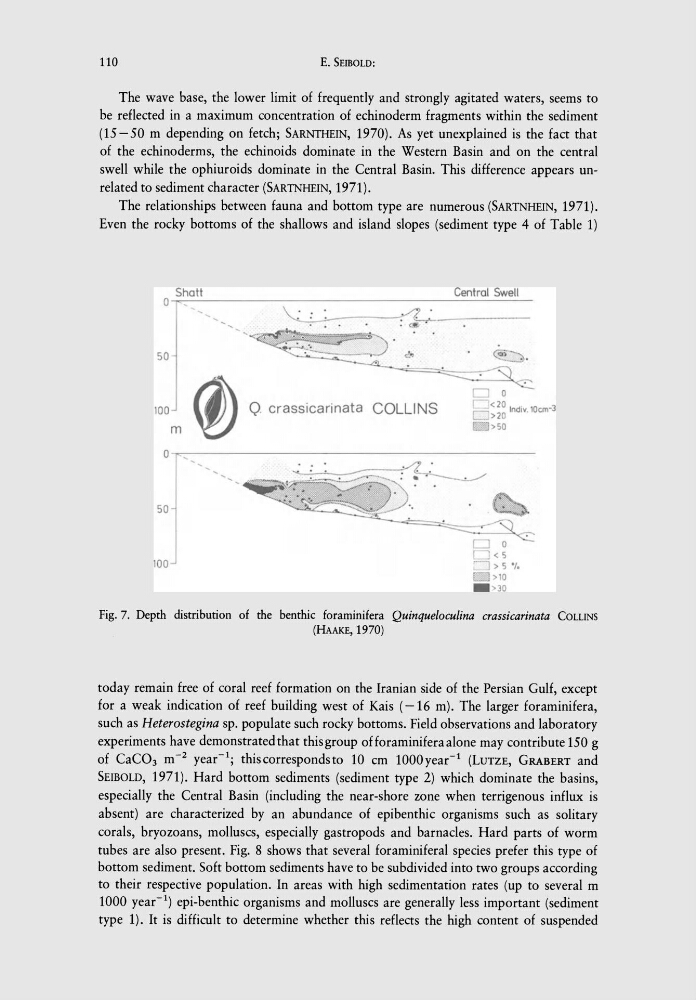
Fig. 7. Depth distribution of the benthic foraminifera Quinqueloculina crassicarinata COLLINS
(HAAKE, 1970)
today remain free of coral reef formation on the Iranian side of the Persian Gulf, except
for a weak indication of reef building west of Kais (-16 m). The larger foraminifera,
such as Heterostegina sp. populate such rocky bottoms. Field observations and laboratory
experiments have demonstrated that this group offoraminiferaalone may contribute 150 g
of CaC03 m- 2 year-l; thiscorrespondsto 10 cm 1000year- l (LUTZE, GRABERT and
SEIBOLD, 1971). Hard bottom sediments (sediment type 2) which dominate the basins,
especially the Central Basin (including the near-shore zone when terrigenous influx is
absent) are characterized by an abundance of epibenthic organisms such as solitary
corals, bryozoans, molluscs, especially gastropods and barnacles. Hard parts of worm
tubes are also present. Fig. 8 shows that several foraminiferal species prefer this type of
bottom sediment. Soft bottom sediments have to be subdivided into two groups according
to their respective population. In areas with high sedimentation rates (up to several m
1000 year-l) epi-benthic organisms and molluscs are generally less important (sediment
type 1). It is difficult to determine whether this reflects the high content of suspended
E. SEIBOLD:
The wave base, the lower limit of frequently and strongly agitated waters, seems to
be reflected in a maximum concentration of echinoderm fragments within the sediment
(15 - 50 m depending on fetch; SARNTHEIN, 1970). As yet unexplained is the fact that
of the echinoderms, the echinoids dominate in the Western Basin and on the central
swell while the ophiuroids dominate in the Central Basin. This difference appears unrelated to sediment character (SARTNHEIN, 1971).
The relationships between fauna and bottom type are numerous (SARTNHEIN, 1971).
Even the rocky bottoms of the shallows and island slopes (sediment type 4 of Table 1)
Shalt
0
~
,
50
@
100
m
0
50
100
~ . : . . . : .
&>
Q. crassicarinata COLLINS
Central Swell
~ .
0
0
t j <20 Indi v. l0cm-3
>20
';-'1 >50
o 0
C
[§J>1 0
.
>30
Fig. 7. Depth distribution of the benthic foraminifera Quinqueloculina crassicarinata COLLINS
(HAAKE, 1970)
today remain free of coral reef formation on the Iranian side of the Persian Gulf, except
for a weak indication of reef building west of Kais (-16 m). The larger foraminifera,
such as Heterostegina sp. populate such rocky bottoms. Field observations and laboratory
experiments have demonstrated that this group offoraminiferaalone may contribute 150 g
of CaC03 m- 2 year-l; thiscorrespondsto 10 cm 1000year- l (LUTZE, GRABERT and
SEIBOLD, 1971). Hard bottom sediments (sediment type 2) which dominate the basins,
especially the Central Basin (including the near-shore zone when terrigenous influx is
absent) are characterized by an abundance of epibenthic organisms such as solitary
corals, bryozoans, molluscs, especially gastropods and barnacles. Hard parts of worm
tubes are also present. Fig. 8 shows that several foraminiferal species prefer this type of
bottom sediment. Soft bottom sediments have to be subdivided into two groups according
to their respective population. In areas with high sedimentation rates (up to several m
1000 year-l) epi-benthic organisms and molluscs are generally less important (sediment
type 1). It is difficult to determine whether this reflects the high content of suspended