

104
E. SEIBOLD:
an arid climate region. The high loss of water through evaporation (annual mean 144 em)
is not compensated for by precipitation and river inflow. As a result, surface water from
the Indian Ocean enters the Gulf along the Iranian coast. During the summer, surface
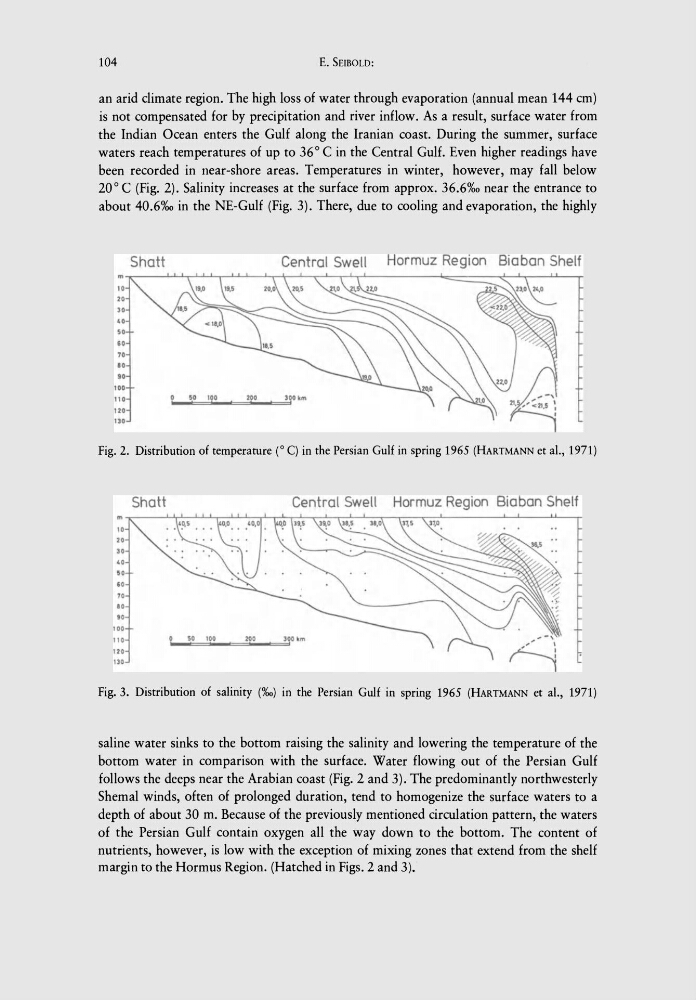
waters reach temperatures of up to 36° C in the Central Gulf. Even higher readings have
been recorded in near-shore areas. Temperatures in winter, however, may fall below
20° C (Fig. 2). Salinity increases at the surface from approx. 36.60/00 near the entrance to
about 40.60/00 in the NE-Gulf (Fig. 3). There, due to cooling and evaporation, the highly
Shott
Central Swell Hormuz Region Sioban Shelf
Fig. 2. Distribution of temperature (O C) in the Persian Gulf in spring 1965 (HARTMANN et aI., 1971)
Shott
Central Swell Hormuz Region Siaban Shelf
Fig. 3. Distribution of salinity (o/oo) in the Persian Gulf in spring 1965 (HARTMANN et ai., 1971)
saline water sinks to the bottom raising the salinity and lowering the temperature of the
bottom water in comparison with the surface. Water £lowing out of the Persian Gulf
follows the deeps near the Arabian coast (Fig. 2 and 3). The predominantly northwesterly
Shemal winds, often of prolonged duration, tend to homogenize the surface waters to a
depth of about 30 m. Because of the previously mentioned circulation pattern, the waters
of the Persian Gulf contain oxygen all the way down to the bottom. The content of
nutrients, however, is low with the exception of mixing zones that extend from the shelf
margin to the Hormus Region. (Hatched in Figs. 2 and 3).
E. SEIBOLD:
an arid climate region. The high loss of water through evaporation (annual mean 144 em)
is not compensated for by precipitation and river inflow. As a result, surface water from
the Indian Ocean enters the Gulf along the Iranian coast. During the summer, surface
waters reach temperatures of up to 36° C in the Central Gulf. Even higher readings have
been recorded in near-shore areas. Temperatures in winter, however, may fall below
20° C (Fig. 2). Salinity increases at the surface from approx. 36.60/00 near the entrance to
about 40.60/00 in the NE-Gulf (Fig. 3). There, due to cooling and evaporation, the highly
Shott
Central Swell Hormuz Region Sioban Shelf
Fig. 2. Distribution of temperature (O C) in the Persian Gulf in spring 1965 (HARTMANN et aI., 1971)
Shott
Central Swell Hormuz Region Siaban Shelf
Fig. 3. Distribution of salinity (o/oo) in the Persian Gulf in spring 1965 (HARTMANN et ai., 1971)
saline water sinks to the bottom raising the salinity and lowering the temperature of the
bottom water in comparison with the surface. Water £lowing out of the Persian Gulf
follows the deeps near the Arabian coast (Fig. 2 and 3). The predominantly northwesterly
Shemal winds, often of prolonged duration, tend to homogenize the surface waters to a
depth of about 30 m. Because of the previously mentioned circulation pattern, the waters
of the Persian Gulf contain oxygen all the way down to the bottom. The content of
nutrients, however, is low with the exception of mixing zones that extend from the shelf
margin to the Hormus Region. (Hatched in Figs. 2 and 3).