

48
– Desmostylia (an extinct order of marine mammals) (Reinhart 1953 , 1982 ),
– Pinnipedia (seals, sea lions, walrus) (Ronald et al. 1991 ),
– Ursus maritimus (polar bear),
– Enhydra lutris (sea otter),
– and Thalassocnus spp. (aquatic sloths)
“Some of these lineages have retained most of their terrestrial form while spending
a great deal of time in the water, whereas others have changed their morphology
dramatically and spend almost all, if not all, of their time in the water” (Uhen 2007 ;
additionally see for review Rice 1998 ).
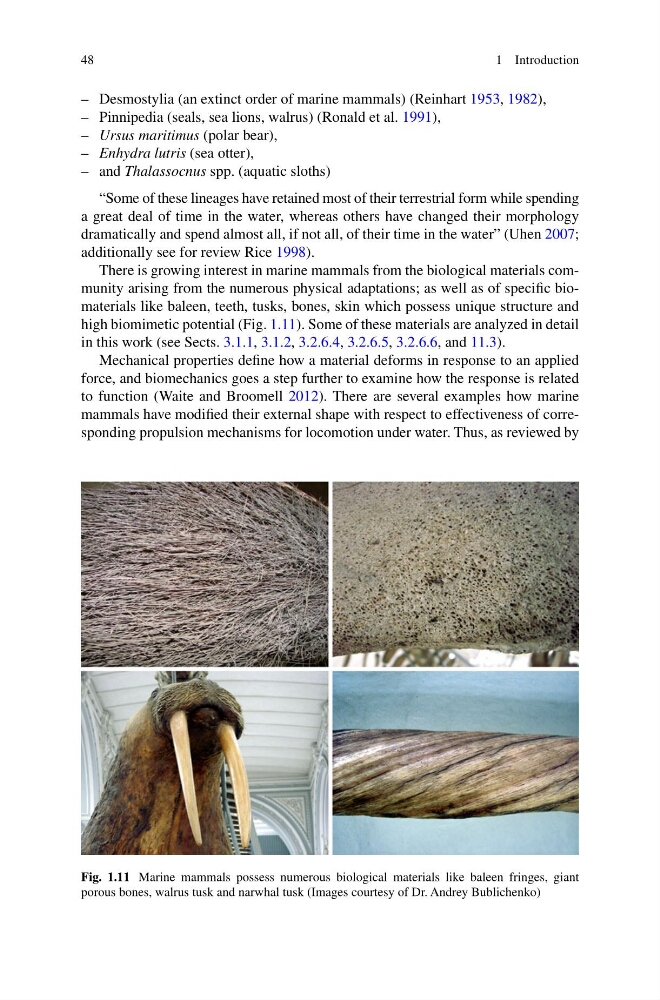
There is growing interest in marine mammals from the biological materials community arising from the numerous physical adaptations; as well as of specifi c biomaterials like baleen, teeth, tusks, bones, skin which possess unique structure and
high biomimetic potential (Fig. 1.11 ). Some of these materials are analyzed in detail
in this work (see Sects. 3.1.1 , 3.1.2 , 3.2.6.4 , 3.2.6.5 , 3.2.6.6 , and 11.3 ).
Mechanical properties defi ne how a material deforms in response to an applied
force, and biomechanics goes a step further to examine how the response is related
to function (Waite and Broomell 2012 ). There are several examples how marine
mammals have modifi ed their external shape with respect to effectiveness of corresponding propulsion mechanisms for locomotion under water. Thus, as reviewed by
Fig. 1.11 Marine mammals possess numerous biological materials like baleen fringes, giant
porous bones, walrus tusk and narwhal tusk (Images courtesy of Dr. Andrey Bublichenko)
1 Introduction
– Desmostylia (an extinct order of marine mammals) (Reinhart 1953 , 1982 ),
– Pinnipedia (seals, sea lions, walrus) (Ronald et al. 1991 ),
– Ursus maritimus (polar bear),
– Enhydra lutris (sea otter),
– and Thalassocnus spp. (aquatic sloths)
“Some of these lineages have retained most of their terrestrial form while spending
a great deal of time in the water, whereas others have changed their morphology
dramatically and spend almost all, if not all, of their time in the water” (Uhen 2007 ;
additionally see for review Rice 1998 ).
There is growing interest in marine mammals from the biological materials community arising from the numerous physical adaptations; as well as of specifi c biomaterials like baleen, teeth, tusks, bones, skin which possess unique structure and
high biomimetic potential (Fig. 1.11 ). Some of these materials are analyzed in detail
in this work (see Sects. 3.1.1 , 3.1.2 , 3.2.6.4 , 3.2.6.5 , 3.2.6.6 , and 11.3 ).
Mechanical properties defi ne how a material deforms in response to an applied
force, and biomechanics goes a step further to examine how the response is related
to function (Waite and Broomell 2012 ). There are several examples how marine
mammals have modifi ed their external shape with respect to effectiveness of corresponding propulsion mechanisms for locomotion under water. Thus, as reviewed by
Fig. 1.11 Marine mammals possess numerous biological materials like baleen fringes, giant
porous bones, walrus tusk and narwhal tusk (Images courtesy of Dr. Andrey Bublichenko)
1 Introduction