

47
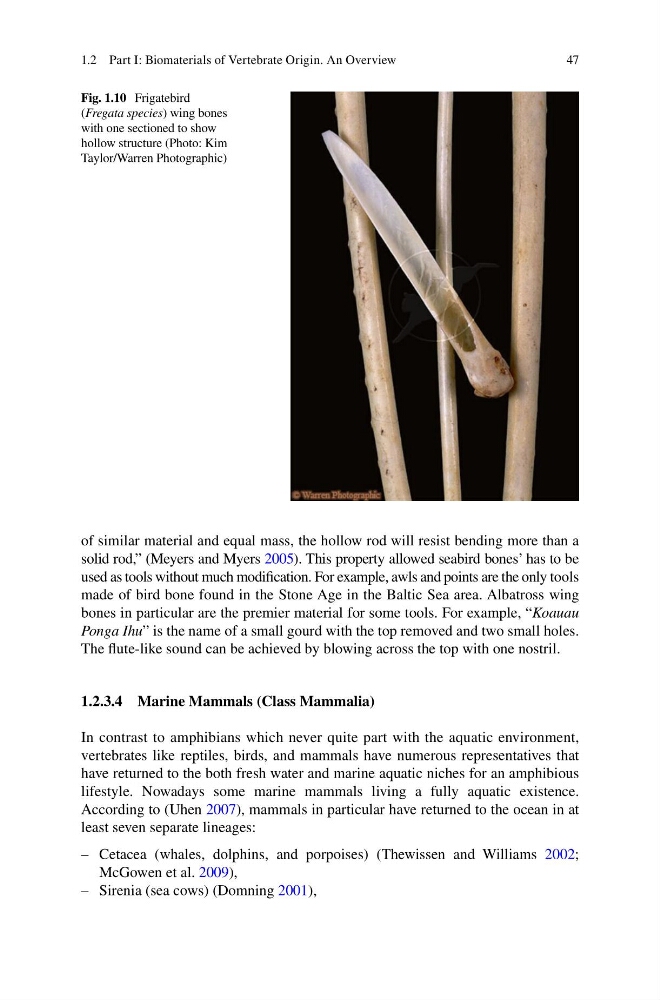
of similar material and equal mass, the hollow rod will resist bending more than a
solid rod,” (Meyers and Myers 2005 ). This property allowed seabird bones’ has to be
used as tools without much modifi cation. For example, awls and points are the only tools
made of bird bone found in the Stone Age in the Baltic Sea area. Albatross wing
bones in particular are the premier material for some tools. For example, “ Koauau
Ponga Ihu ” is the name of a small gourd with the top removed and two small holes.
The fl ute-like sound can be achieved by blowing across the top with one nostril.
1.2.3.4 Marine Mammals (Class Mammalia)
In contrast to amphibians which never quite part with the aquatic environment,
vertebrates like reptiles, birds, and mammals have numerous representatives that
have returned to the both fresh water and marine aquatic niches for an amphibious
lifestyle. Nowadays some marine mammals living a fully aquatic existence.
According to (Uhen 2007 ), mammals in particular have returned to the ocean in at
least seven separate lineages:
– Cetacea (whales, dolphins, and porpoises) (Thewissen and Williams 2002 ;
McGowen et al. 2009 ),
– Sirenia (sea cows) (Domning 2001 ),
Fig. 1.10 Frigatebird
( Fregata species ) wing bones
with one sectioned to show
hollow structure (Photo: Kim
Taylor/Warren Photographic)
1.2 Part I: Biomaterials of Vertebrate Origin. An Overview
of similar material and equal mass, the hollow rod will resist bending more than a
solid rod,” (Meyers and Myers 2005 ). This property allowed seabird bones’ has to be
used as tools without much modifi cation. For example, awls and points are the only tools
made of bird bone found in the Stone Age in the Baltic Sea area. Albatross wing
bones in particular are the premier material for some tools. For example, “ Koauau
Ponga Ihu ” is the name of a small gourd with the top removed and two small holes.
The fl ute-like sound can be achieved by blowing across the top with one nostril.
1.2.3.4 Marine Mammals (Class Mammalia)
In contrast to amphibians which never quite part with the aquatic environment,
vertebrates like reptiles, birds, and mammals have numerous representatives that
have returned to the both fresh water and marine aquatic niches for an amphibious
lifestyle. Nowadays some marine mammals living a fully aquatic existence.
According to (Uhen 2007 ), mammals in particular have returned to the ocean in at
least seven separate lineages:
– Cetacea (whales, dolphins, and porpoises) (Thewissen and Williams 2002 ;
McGowen et al. 2009 ),
– Sirenia (sea cows) (Domning 2001 ),
Fig. 1.10 Frigatebird
( Fregata species ) wing bones
with one sectioned to show
hollow structure (Photo: Kim
Taylor/Warren Photographic)
1.2 Part I: Biomaterials of Vertebrate Origin. An Overview