

425
plasma membranes composed of pillar cells. The function of these endothelial cells
is to isolate columns from the circulation (see for details Hughes and Grimstone
1965 ; Wright 1973 ; Olson 2002 ; Wilson and Laurent 2002 ; Evans et al. 2005 ). Thus
two parallel sheets of respiratory epithelium are connected due to pillar cells with
spool-shaped, cylindrical morphology. “Usually fi ve to eight collagen columns are
enfolded by the plasma membrane of a pillar cell. In the peripheral cytoplasm, pillar
cells have numerous myofi laments that run parallel to the collagen columns,” (Kato
et al. 2007 ; see also Bettex-Galland and Hughes 1973 ).
Thus, in the case of fi sh gills we can observe very a unusual role for collagen in
the form of columns that must be defi nitively investigated in the future.
Recently, visiting the Zoological Museum at Christian-Albrecht University in
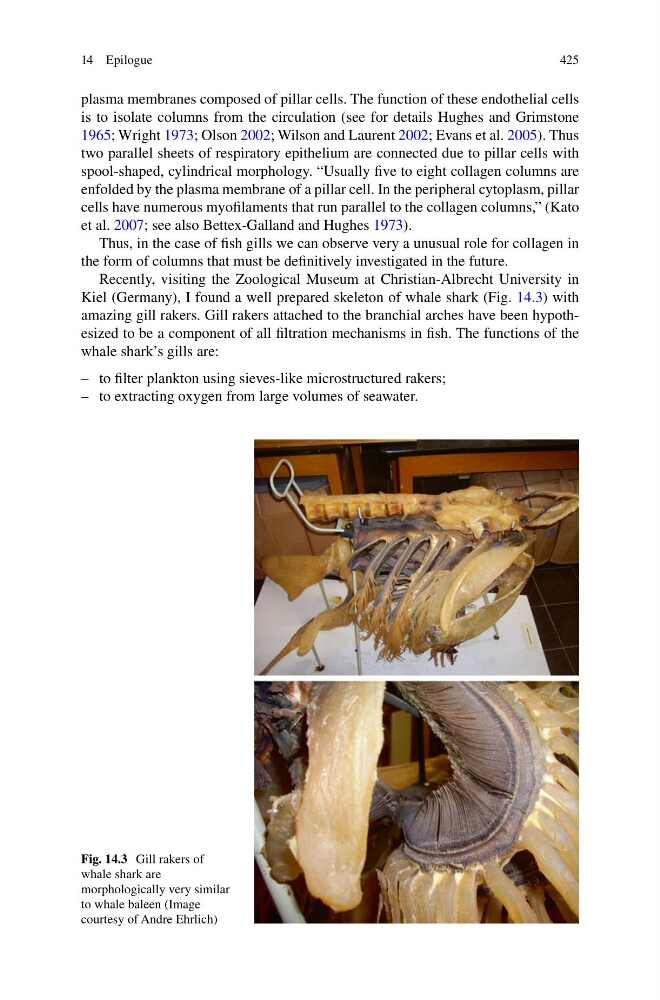
Kiel (Germany), I found a well prepared skeleton of whale shark (Fig. 14.3 ) with
amazing gill rakers. Gill rakers attached to the branchial arches have been hypothesized to be a component of all fi ltration mechanisms in fi sh. The functions of the
whale shark’s gills are:
– to fi lter plankton using sieves-like microstructured rakers;
– to extracting oxygen from large volumes of seawater.
Fig. 14.3 Gill rakers of
whale shark are
morphologically very similar
to whale baleen (Image
courtesy of Andre Ehrlich)
14 Epilogue
plasma membranes composed of pillar cells. The function of these endothelial cells
is to isolate columns from the circulation (see for details Hughes and Grimstone
1965 ; Wright 1973 ; Olson 2002 ; Wilson and Laurent 2002 ; Evans et al. 2005 ). Thus
two parallel sheets of respiratory epithelium are connected due to pillar cells with
spool-shaped, cylindrical morphology. “Usually fi ve to eight collagen columns are
enfolded by the plasma membrane of a pillar cell. In the peripheral cytoplasm, pillar
cells have numerous myofi laments that run parallel to the collagen columns,” (Kato
et al. 2007 ; see also Bettex-Galland and Hughes 1973 ).
Thus, in the case of fi sh gills we can observe very a unusual role for collagen in
the form of columns that must be defi nitively investigated in the future.
Recently, visiting the Zoological Museum at Christian-Albrecht University in
Kiel (Germany), I found a well prepared skeleton of whale shark (Fig. 14.3 ) with
amazing gill rakers. Gill rakers attached to the branchial arches have been hypothesized to be a component of all fi ltration mechanisms in fi sh. The functions of the
whale shark’s gills are:
– to fi lter plankton using sieves-like microstructured rakers;
– to extracting oxygen from large volumes of seawater.
Fig. 14.3 Gill rakers of
whale shark are
morphologically very similar
to whale baleen (Image
courtesy of Andre Ehrlich)
14 Epilogue