

408
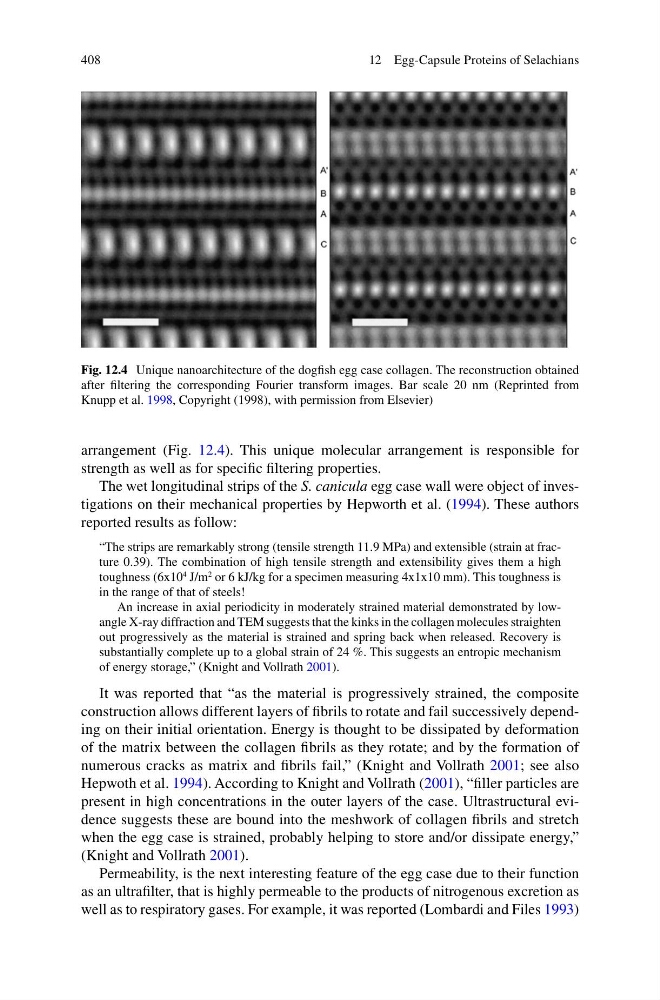
arrangement (Fig. 12.4 ). This unique molecular arrangement is responsible for
strength as well as for specifi c fi ltering properties.
The wet longitudinal strips of the S. canicula egg case wall were object of investigations on their mechanical properties by Hepworth et al. ( 1994 ). These authors
reported results as follow:
“The strips are remarkably strong (tensile strength 11.9 MPa) and extensible (strain at fracture 0.39). The combination of high tensile strength and extensibility gives them a high
toughness (6x10
4 J/m
2 or 6 kJ/kg for a specimen measuring 4x1x10 mm). This toughness is
in the range of that of steels!
An increase in axial periodicity in moderately strained material demonstrated by lowangle X-ray diffraction and TEM suggests that the kinks in the collagen molecules straighten
out progressively as the material is strained and spring back when released. Recovery is
substantially complete up to a global strain of 24 %. This suggests an entropic mechanism
of energy storage,” (Knight and Vollrath 2001 ).
It was reported that “as the material is progressively strained, the composite
construction allows different layers of fi brils to rotate and fail successively depending on their initial orientation. Energy is thought to be dissipated by deformation
of the matrix between the collagen fi brils as they rotate; and by the formation of
numerous cracks as matrix and fi brils fail,” (Knight and Vollrath 2001 ; see also
Hepwoth et al. 1994 ). According to Knight and Vollrath ( 2001 ), “fi ller particles are
present in high concentrations in the outer layers of the case. Ultrastructural evidence suggests these are bound into the meshwork of collagen fi brils and stretch
when the egg case is strained, probably helping to store and/or dissipate energy,”
(Knight and Vollrath 2001 ).
Permeability, is the next interesting feature of the egg case due to their function
as an ultrafi lter, that is highly permeable to the products of nitrogenous excretion as
well as to respiratory gases. For example, it was reported (Lombardi and Files 1993 )
Fig. 12.4 Unique nanoarchitecture of the dogfi sh egg case collagen. The reconstruction obtained
after fi ltering the corresponding Fourier transform images. Bar scale 20 nm (Reprinted from
Knupp et al. 1998 , Copyright (1998), with permission from Elsevier)
12 Egg-Capsule Proteins of Selachians
arrangement (Fig. 12.4 ). This unique molecular arrangement is responsible for
strength as well as for specifi c fi ltering properties.
The wet longitudinal strips of the S. canicula egg case wall were object of investigations on their mechanical properties by Hepworth et al. ( 1994 ). These authors
reported results as follow:
“The strips are remarkably strong (tensile strength 11.9 MPa) and extensible (strain at fracture 0.39). The combination of high tensile strength and extensibility gives them a high
toughness (6x10
4 J/m
2 or 6 kJ/kg for a specimen measuring 4x1x10 mm). This toughness is
in the range of that of steels!
An increase in axial periodicity in moderately strained material demonstrated by lowangle X-ray diffraction and TEM suggests that the kinks in the collagen molecules straighten
out progressively as the material is strained and spring back when released. Recovery is
substantially complete up to a global strain of 24 %. This suggests an entropic mechanism
of energy storage,” (Knight and Vollrath 2001 ).
It was reported that “as the material is progressively strained, the composite
construction allows different layers of fi brils to rotate and fail successively depending on their initial orientation. Energy is thought to be dissipated by deformation
of the matrix between the collagen fi brils as they rotate; and by the formation of
numerous cracks as matrix and fi brils fail,” (Knight and Vollrath 2001 ; see also
Hepwoth et al. 1994 ). According to Knight and Vollrath ( 2001 ), “fi ller particles are
present in high concentrations in the outer layers of the case. Ultrastructural evidence suggests these are bound into the meshwork of collagen fi brils and stretch
when the egg case is strained, probably helping to store and/or dissipate energy,”
(Knight and Vollrath 2001 ).
Permeability, is the next interesting feature of the egg case due to their function
as an ultrafi lter, that is highly permeable to the products of nitrogenous excretion as
well as to respiratory gases. For example, it was reported (Lombardi and Files 1993 )
Fig. 12.4 Unique nanoarchitecture of the dogfi sh egg case collagen. The reconstruction obtained
after fi ltering the corresponding Fourier transform images. Bar scale 20 nm (Reprinted from
Knupp et al. 1998 , Copyright (1998), with permission from Elsevier)
12 Egg-Capsule Proteins of Selachians