

392
which can exceed 700 in number (Matthews 1968 ). The color of baleen can be,
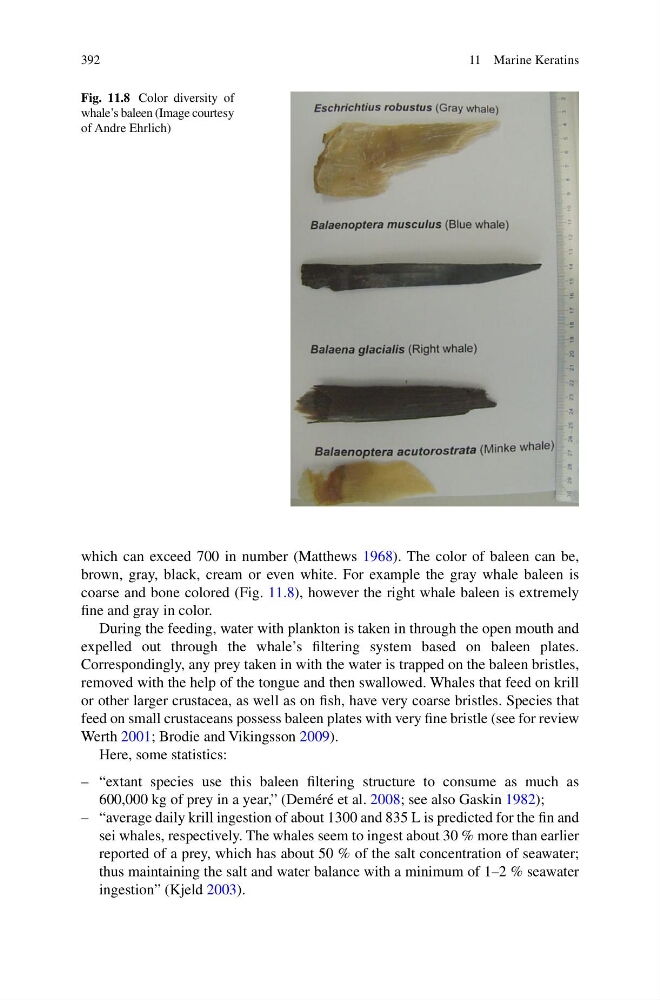
brown, gray, black, cream or even white. For example the gray whale baleen is
coarse and bone colored (Fig. 11.8 ), however the right whale baleen is extremely
fi ne and gray in color.
During the feeding, water with plankton is taken in through the open mouth and
expelled out through the whale’s fi ltering system based on baleen plates.
Correspondingly, any prey taken in with the water is trapped on the baleen bristles,
removed with the help of the tongue and then swallowed. Whales that feed on krill
or other larger crustacea, as well as on fi sh, have very coarse bristles. Species that
feed on small crustaceans possess baleen plates with very fi ne bristle (see for review
Werth 2001 ; Brodie and Vikingsson 2009 ).
Here, some statistics:
– “extant species use this baleen fi ltering structure to consume as much as
600,000 kg of prey in a year,” (Deméré et al. 2008 ; see also Gaskin 1982 );
– “average daily krill ingestion of about 1300 and 835 L is predicted for the fi n and
sei whales, respectively. The whales seem to ingest about 30 % more than earlier
reported of a prey, which has about 50 % of the salt concentration of seawater;
thus maintaining the salt and water balance with a minimum of 1–2 % seawater
ingestion” (Kjeld 2003 ).
Fig. 11.8 Color diversity of
whale’s baleen (Image courtesy
of Andre Ehrlich)
11 Marine Keratins
which can exceed 700 in number (Matthews 1968 ). The color of baleen can be,
brown, gray, black, cream or even white. For example the gray whale baleen is
coarse and bone colored (Fig. 11.8 ), however the right whale baleen is extremely
fi ne and gray in color.
During the feeding, water with plankton is taken in through the open mouth and
expelled out through the whale’s fi ltering system based on baleen plates.
Correspondingly, any prey taken in with the water is trapped on the baleen bristles,
removed with the help of the tongue and then swallowed. Whales that feed on krill
or other larger crustacea, as well as on fi sh, have very coarse bristles. Species that
feed on small crustaceans possess baleen plates with very fi ne bristle (see for review
Werth 2001 ; Brodie and Vikingsson 2009 ).
Here, some statistics:
– “extant species use this baleen fi ltering structure to consume as much as
600,000 kg of prey in a year,” (Deméré et al. 2008 ; see also Gaskin 1982 );
– “average daily krill ingestion of about 1300 and 835 L is predicted for the fi n and
sei whales, respectively. The whales seem to ingest about 30 % more than earlier
reported of a prey, which has about 50 % of the salt concentration of seawater;
thus maintaining the salt and water balance with a minimum of 1–2 % seawater
ingestion” (Kjeld 2003 ).
Fig. 11.8 Color diversity of
whale’s baleen (Image courtesy
of Andre Ehrlich)
11 Marine Keratins