

391
( Meredith et al. 2010 ). “Molecular sequences of three enamel-specifi c genes,
ameloblastin (AMBN), enamelin (ENAM) and amelogenin (AMEL) contain stop codons
and/or frameshift mutations in various mysticete species,” (Meredith et al. 2010 ).
The upper jaw of the Mysticeti possess horn-like baleen that grows in the form
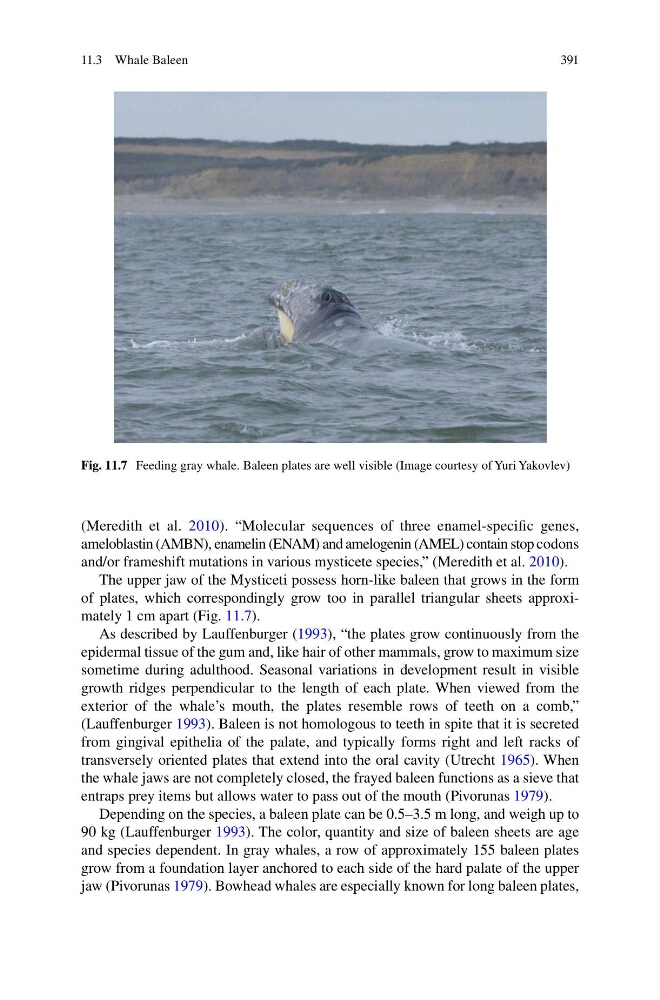
of plates, which correspondingly grow too in parallel triangular sheets approximately 1 cm apart (Fig. 11.7 ).
As described by Lauffenburger ( 1993 ), “the plates grow continuously from the
epidermal tissue of the gum and, like hair of other mammals, grow to maximum size
sometime during adulthood. Seasonal variations in development result in visible
growth ridges perpendicular to the length of each plate. When viewed from the
exterior of the whale’s mouth, the plates resemble rows of teeth on a comb,”
(Lauffenburger 1993 ). Baleen is not homologous to teeth in spite that it is secreted
from gingival epithelia of the palate, and typically forms right and left racks of
transversely oriented plates that extend into the oral cavity (Utrecht 1965 ). When
the whale jaws are not completely closed, the frayed baleen functions as a sieve that
entraps prey items but allows water to pass out of the mouth (Pivorunas 1979 ).
Depending on the species, a baleen plate can be 0.5–3.5 m long, and weigh up to
90 kg (Lauffenburger 1993 ). The color, quantity and size of baleen sheets are age
and species dependent. In gray whales, a row of approximately 155 baleen plates
grow from a foundation layer anchored to each side of the hard palate of the upper
jaw (Pivorunas 1979 ). Bowhead whales are especially known for long baleen plates,
Fig. 11.7 Feeding gray whale. Baleen plates are well visible (Image courtesy of Yuri Yakovlev)
11.3 Whale Baleen
( Meredith et al. 2010 ). “Molecular sequences of three enamel-specifi c genes,
ameloblastin (AMBN), enamelin (ENAM) and amelogenin (AMEL) contain stop codons
and/or frameshift mutations in various mysticete species,” (Meredith et al. 2010 ).
The upper jaw of the Mysticeti possess horn-like baleen that grows in the form
of plates, which correspondingly grow too in parallel triangular sheets approximately 1 cm apart (Fig. 11.7 ).
As described by Lauffenburger ( 1993 ), “the plates grow continuously from the
epidermal tissue of the gum and, like hair of other mammals, grow to maximum size
sometime during adulthood. Seasonal variations in development result in visible
growth ridges perpendicular to the length of each plate. When viewed from the
exterior of the whale’s mouth, the plates resemble rows of teeth on a comb,”
(Lauffenburger 1993 ). Baleen is not homologous to teeth in spite that it is secreted
from gingival epithelia of the palate, and typically forms right and left racks of
transversely oriented plates that extend into the oral cavity (Utrecht 1965 ). When
the whale jaws are not completely closed, the frayed baleen functions as a sieve that
entraps prey items but allows water to pass out of the mouth (Pivorunas 1979 ).
Depending on the species, a baleen plate can be 0.5–3.5 m long, and weigh up to
90 kg (Lauffenburger 1993 ). The color, quantity and size of baleen sheets are age
and species dependent. In gray whales, a row of approximately 155 baleen plates
grow from a foundation layer anchored to each side of the hard palate of the upper
jaw (Pivorunas 1979 ). Bowhead whales are especially known for long baleen plates,
Fig. 11.7 Feeding gray whale. Baleen plates are well visible (Image courtesy of Yuri Yakovlev)
11.3 Whale Baleen