

304
one body length per second. The elastic fi n ray is made of Polypropylene. Its
Young’s modulus is 1,350 MPa and density is 946 kg•m
−3
. As the allowable
payload capacity of the developed robot is 4 kg, the vehicle is able to carry various
sensors or underwater communication equipment. The power unit can also be
accommodated in the fl at fi sh body. The electrical power is provided by six cell
3,300 mAh battery. The manta ray robot can perform the forward/backward
swimming, pivot turning, and gliding with the control function. The initial testing
showed that the operation time can last about 6 h for swimming in still water
and 90 h for pure gliding (Zhou and Low 2010 ).
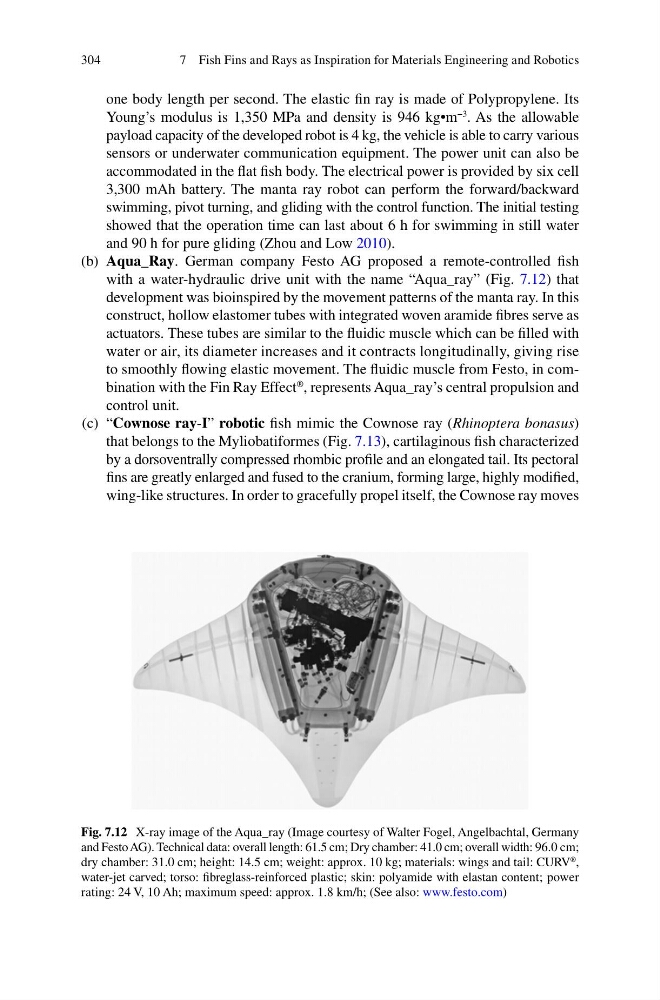
(b) Aqua _ Ray . German company Festo AG proposed a remote-controlled fi sh
with a water-hydraulic drive unit with the name “Aqua_ray” (Fig. 7.12 ) that
development was bioinspired by the movement patterns of the manta ray. In this
construct, hollow elastomer tubes with integrated woven aramide fi bres serve as
actuators. These tubes are similar to the fl uidic muscle which can be fi lled with
water or air, its diameter increases and it contracts longitudinally, giving rise
to smoothly fl owing elastic movement. The fl uidic muscle from Festo, in combination with the Fin Ray Effect
®
, represents Aqua_ray’s central propulsion and
control unit.
(c) “ Cownose ray - I ” robotic fi sh mimic the Cownose ray ( Rhinoptera bonasus )
that belongs to the Myliobatiformes (Fig. 7.13 ), cartilaginous fi sh characterized
by a dorsoventrally compressed rhombic profi le and an elongated tail. Its pectoral
fi ns are greatly enlarged and fused to the cranium, forming large, highly modifi ed,
wing-like structures. In order to gracefully propel itself, the Cownose ray moves
Fig. 7.12 X-ray image of the Aqua_ray (Image courtesy of Walter Fogel, Angelbachtal, Germany
and Festo AG). Technical data: overall length: 61.5 cm; Dry chamber: 41.0 cm; overall width: 96.0 cm;
dry chamber: 31.0 cm; height: 14.5 cm; weight: approx. 10 kg; materials: wings and tail: CURV
®
,
water-jet carved; torso: fi breglass-reinforced plastic; skin: polyamide with elastan content; power
rating: 24 V, 10 Ah; maximum speed: approx. 1.8 km/h; (See also: www.festo.com )
7 Fish Fins and Rays as Inspiration for Materials Engineering and Robotics
one body length per second. The elastic fi n ray is made of Polypropylene. Its
Young’s modulus is 1,350 MPa and density is 946 kg•m
−3
. As the allowable
payload capacity of the developed robot is 4 kg, the vehicle is able to carry various
sensors or underwater communication equipment. The power unit can also be
accommodated in the fl at fi sh body. The electrical power is provided by six cell
3,300 mAh battery. The manta ray robot can perform the forward/backward
swimming, pivot turning, and gliding with the control function. The initial testing
showed that the operation time can last about 6 h for swimming in still water
and 90 h for pure gliding (Zhou and Low 2010 ).
(b) Aqua _ Ray . German company Festo AG proposed a remote-controlled fi sh
with a water-hydraulic drive unit with the name “Aqua_ray” (Fig. 7.12 ) that
development was bioinspired by the movement patterns of the manta ray. In this
construct, hollow elastomer tubes with integrated woven aramide fi bres serve as
actuators. These tubes are similar to the fl uidic muscle which can be fi lled with
water or air, its diameter increases and it contracts longitudinally, giving rise
to smoothly fl owing elastic movement. The fl uidic muscle from Festo, in combination with the Fin Ray Effect
®
, represents Aqua_ray’s central propulsion and
control unit.
(c) “ Cownose ray - I ” robotic fi sh mimic the Cownose ray ( Rhinoptera bonasus )
that belongs to the Myliobatiformes (Fig. 7.13 ), cartilaginous fi sh characterized
by a dorsoventrally compressed rhombic profi le and an elongated tail. Its pectoral
fi ns are greatly enlarged and fused to the cranium, forming large, highly modifi ed,
wing-like structures. In order to gracefully propel itself, the Cownose ray moves
Fig. 7.12 X-ray image of the Aqua_ray (Image courtesy of Walter Fogel, Angelbachtal, Germany
and Festo AG). Technical data: overall length: 61.5 cm; Dry chamber: 41.0 cm; overall width: 96.0 cm;
dry chamber: 31.0 cm; height: 14.5 cm; weight: approx. 10 kg; materials: wings and tail: CURV
®
,
water-jet carved; torso: fi breglass-reinforced plastic; skin: polyamide with elastan content; power
rating: 24 V, 10 Ah; maximum speed: approx. 1.8 km/h; (See also: www.festo.com )
7 Fish Fins and Rays as Inspiration for Materials Engineering and Robotics