

303
found that biomimetic locomotion is a determinant of fi sh preference as fi sh are
more attracted towards the robot when its tail is beating rather than when it is statically
immersed in the water as a ‘dummy’. At specifi c conditions, the fi sh hold station
behind the robot, which may be due to the hydrodynamic advantage obtained by
swimming in the robot’s wake. This work makes a compelling case for the need of
biomimetic locomotion in promoting robot-animal interactions, and it strengthens
the hypothesis that biomimetic robots can be used to study and modulate collective
animal behaviour,” (Marras and Porfi ri 2012 ).
Interest in fi sh biorobotics is not new, and there is a long history, dating back to
early experimental work using models (Houssay 1912 ; Breder 1926 ; Gray 1953 ). As
reviewed by Alexander ( 1983 ) and Lauder et al. ( 2007 ), these investigators constructed
mechanical models that allowed them to investigate power output, undulatory wave
formation, and the function of the tail during fi sh locomotion. This work greatly
increased our early understanding of how fi sh generate propulsive forces. Since the
1980s, biomimetics of cetacean or fi sh has principally focused on BCF mode with a
great number of constructs, such as RoboTuna, RoboPike and VCUUV (MIT, USA)
(Triantafyllou and Triantafyllou 1995 ; Triantafyllou et al. 2002 ), SPC-I/II/III (BUAA,
China) (Liang et al. 2005 ), and Essex-G8/9 (Essex, UK) (Liu and Hu 2006 ). Here,
I take the liberty to represent briefl y only few bioinspired fi sh robotic systems. For
more detailed information, I recommend the review by Low ( 2009 ).
(a) Robotic manta ray ( RoMan - II ). Manta rays ( Manta birostris ) are the largest
species of ray’s family (Chondrichthyes), which use median paired fi ns to swim.
Manta rays are recognized from their diamond-shaped fl at body. There are
numerous examples of bioinspiration for swimming behaviour of these fi sh (see
for recent review Fish et al. 2012 ). Similar to cownose, eagle and bat ray, manta
ray is uses a fl apping pectoral fi n to swim (Rosenberger 2001 ). The development
of the improved manta ray robot (RoMan-II), its fl apping motion control, and
gliding motion with buoyancy control are described by Zhou and Low ( 2010 ).
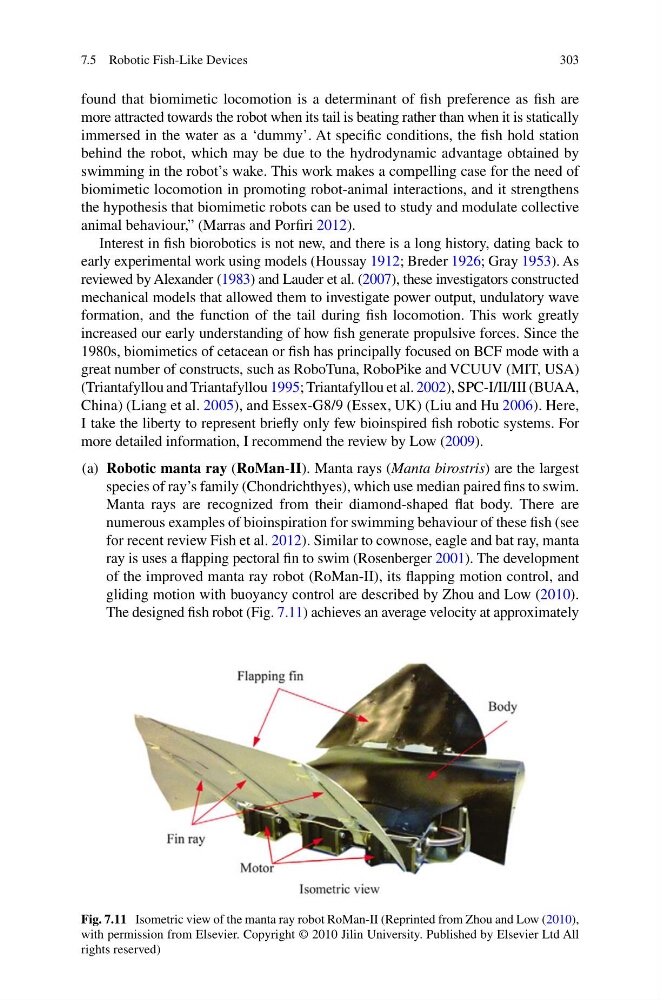
The designed fi sh robot (Fig. 7.11 ) achieves an average velocity at approximately
Fig. 7.11 Isometric view of the manta ray robot RoMan-II (Reprinted from Zhou and Low ( 2010 ),
with permission from Elsevier. Copyright © 2010 Jilin University. Published by Elsevier Ltd All
rights reserved)
7.5 Robotic Fish-Like Devices
found that biomimetic locomotion is a determinant of fi sh preference as fi sh are
more attracted towards the robot when its tail is beating rather than when it is statically
immersed in the water as a ‘dummy’. At specifi c conditions, the fi sh hold station
behind the robot, which may be due to the hydrodynamic advantage obtained by
swimming in the robot’s wake. This work makes a compelling case for the need of
biomimetic locomotion in promoting robot-animal interactions, and it strengthens
the hypothesis that biomimetic robots can be used to study and modulate collective
animal behaviour,” (Marras and Porfi ri 2012 ).
Interest in fi sh biorobotics is not new, and there is a long history, dating back to
early experimental work using models (Houssay 1912 ; Breder 1926 ; Gray 1953 ). As
reviewed by Alexander ( 1983 ) and Lauder et al. ( 2007 ), these investigators constructed
mechanical models that allowed them to investigate power output, undulatory wave
formation, and the function of the tail during fi sh locomotion. This work greatly
increased our early understanding of how fi sh generate propulsive forces. Since the
1980s, biomimetics of cetacean or fi sh has principally focused on BCF mode with a
great number of constructs, such as RoboTuna, RoboPike and VCUUV (MIT, USA)
(Triantafyllou and Triantafyllou 1995 ; Triantafyllou et al. 2002 ), SPC-I/II/III (BUAA,
China) (Liang et al. 2005 ), and Essex-G8/9 (Essex, UK) (Liu and Hu 2006 ). Here,
I take the liberty to represent briefl y only few bioinspired fi sh robotic systems. For
more detailed information, I recommend the review by Low ( 2009 ).
(a) Robotic manta ray ( RoMan - II ). Manta rays ( Manta birostris ) are the largest
species of ray’s family (Chondrichthyes), which use median paired fi ns to swim.
Manta rays are recognized from their diamond-shaped fl at body. There are
numerous examples of bioinspiration for swimming behaviour of these fi sh (see
for recent review Fish et al. 2012 ). Similar to cownose, eagle and bat ray, manta
ray is uses a fl apping pectoral fi n to swim (Rosenberger 2001 ). The development
of the improved manta ray robot (RoMan-II), its fl apping motion control, and
gliding motion with buoyancy control are described by Zhou and Low ( 2010 ).
The designed fi sh robot (Fig. 7.11 ) achieves an average velocity at approximately
Fig. 7.11 Isometric view of the manta ray robot RoMan-II (Reprinted from Zhou and Low ( 2010 ),
with permission from Elsevier. Copyright © 2010 Jilin University. Published by Elsevier Ltd All
rights reserved)
7.5 Robotic Fish-Like Devices