

290
The wing-like process of the fi n rays (lepidotrichia) could help in stiffening the fi ns
when spread through it. Each lepidotrichium gave support to the previous one.
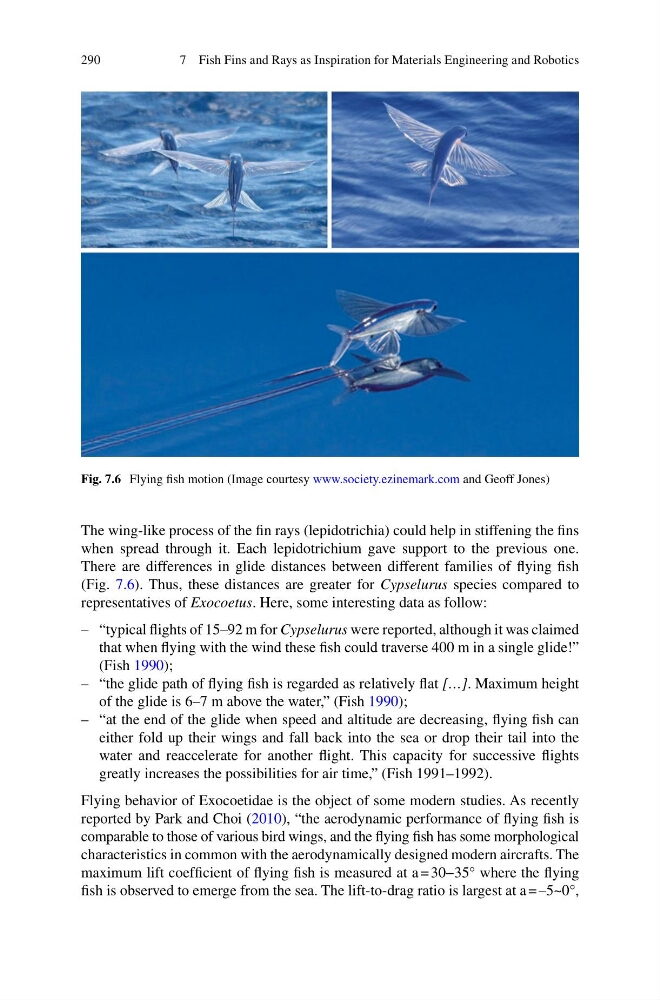
There are differences in glide distances between different families of fl ying fi sh
(Fig. 7.6 ). Thus, these distances are greater for Cypselurus species compared to
representatives of Exocoetus . Here, some interesting data as follow:
– “typical fl ights of 15–92 m for Cypselurus were reported, although it was claimed
that when fl ying with the wind these fi sh could traverse 400 m in a single glide!”
(Fish 1990 );
– “the glide path of fl ying fi sh is regarded as relatively fl at […] . Maximum height
of the glide is 6–7 m above the water,” (Fish 1990 );
– “at the end of the glide when speed and altitude are decreasing, fl ying fi sh can
either fold up their wings and fall back into the sea or drop their tail into the
water and reaccelerate for another fl ight. This capacity for successive fl ights
greatly increases the possibilities for air time,” (Fish 1991–1992).
Flying behavior of Exocoetidae is the object of some modern studies. As recently
reported by Park and Choi ( 2010 ), “the aerodynamic performance of fl ying fi sh is
comparable to those of various bird wings, and the fl ying fi sh has some morphological
characteristics in common with the aerodynamically designed modern aircrafts. The
maximum lift coeffi cient of fl ying fi sh is measured at a = 30−35° where the fl ying
fi sh is observed to emerge from the sea. The lift-to-drag ratio is largest at a = –5~0°,
Fig. 7.6 Flying fi sh motion (Image courtesy www.society.ezinemark.com and Geoff Jones)
7 Fish Fins and Rays as Inspiration for Materials Engineering and Robotics
The wing-like process of the fi n rays (lepidotrichia) could help in stiffening the fi ns
when spread through it. Each lepidotrichium gave support to the previous one.
There are differences in glide distances between different families of fl ying fi sh
(Fig. 7.6 ). Thus, these distances are greater for Cypselurus species compared to
representatives of Exocoetus . Here, some interesting data as follow:
– “typical fl ights of 15–92 m for Cypselurus were reported, although it was claimed
that when fl ying with the wind these fi sh could traverse 400 m in a single glide!”
(Fish 1990 );
– “the glide path of fl ying fi sh is regarded as relatively fl at […] . Maximum height
of the glide is 6–7 m above the water,” (Fish 1990 );
– “at the end of the glide when speed and altitude are decreasing, fl ying fi sh can
either fold up their wings and fall back into the sea or drop their tail into the
water and reaccelerate for another fl ight. This capacity for successive fl ights
greatly increases the possibilities for air time,” (Fish 1991–1992).
Flying behavior of Exocoetidae is the object of some modern studies. As recently
reported by Park and Choi ( 2010 ), “the aerodynamic performance of fl ying fi sh is
comparable to those of various bird wings, and the fl ying fi sh has some morphological
characteristics in common with the aerodynamically designed modern aircrafts. The
maximum lift coeffi cient of fl ying fi sh is measured at a = 30−35° where the fl ying
fi sh is observed to emerge from the sea. The lift-to-drag ratio is largest at a = –5~0°,
Fig. 7.6 Flying fi sh motion (Image courtesy www.society.ezinemark.com and Geoff Jones)
7 Fish Fins and Rays as Inspiration for Materials Engineering and Robotics