

289
punters than in the augmented punters. This concordance of musculature with punting
ability provides predictive power regarding the punting kinematics of other elasmobranchs based upon gross muscular examinations,” (Macesic and Kajiura 2010 ).
7.1.1 Fish Wings: Fins of Flying Fish
The Exocoetidae (fl ying fi sh) are fi rst appearing in the Eocene (Müller 1985 ). Their
specifi c aerodynamic designs affect the maximum distance travelled in fl ight, which
is considered to be a major factor in the evolution of these marine vertebrates as to
decrease the energetic expenditure of locomotion, or as a response to predation
(Fish 2010 ). Correspondingly, fl ying fi sh has been classifi ed into two distinct
aerodynamic designs due to distribution of their wing area (Breder 1930 ) as well as
to lift, speed and stability, based on the wing loading and aspect ratio of the fi ns:
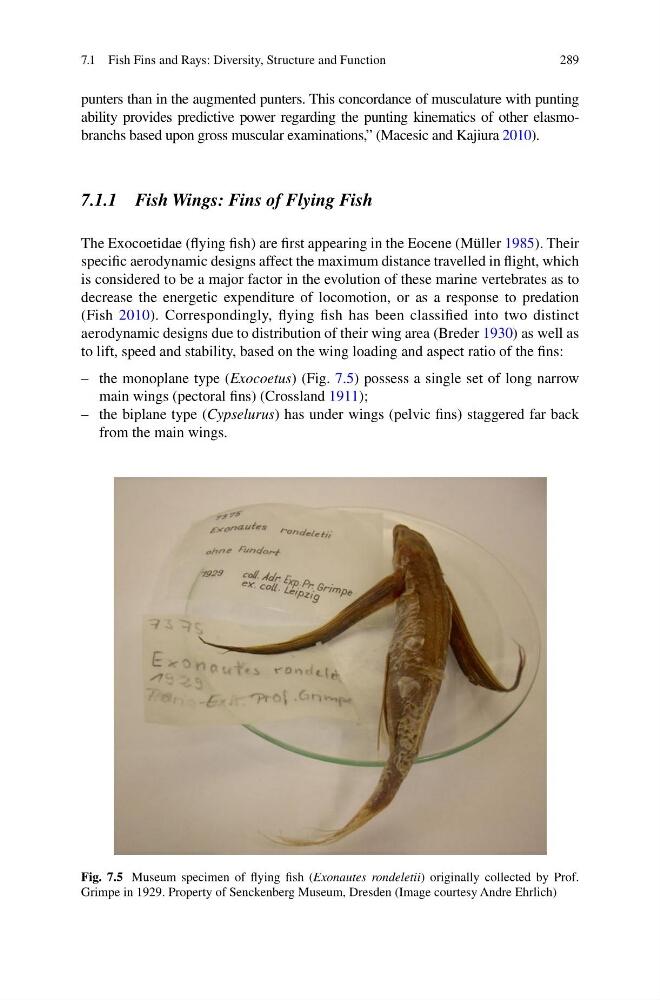
– the monoplane type ( Exocoetus ) (Fig. 7.5 ) possess a single set of long narrow
main wings (pectoral fi ns) (Crossland 1911 );
– the biplane type ( Cypselurus ) has under wings (pelvic fi ns) staggered far back
from the main wings.
Fig. 7.5 Museum specimen of fl ying fi sh ( Exonautes rondeletii ) originally collected by Prof.
Grimpe in 1929. Property of Senckenberg Museum, Dresden (Image courtesy Andre Ehrlich)
7.1 Fish Fins and Rays: Diversity, Structure and Function
punters than in the augmented punters. This concordance of musculature with punting
ability provides predictive power regarding the punting kinematics of other elasmobranchs based upon gross muscular examinations,” (Macesic and Kajiura 2010 ).
7.1.1 Fish Wings: Fins of Flying Fish
The Exocoetidae (fl ying fi sh) are fi rst appearing in the Eocene (Müller 1985 ). Their
specifi c aerodynamic designs affect the maximum distance travelled in fl ight, which
is considered to be a major factor in the evolution of these marine vertebrates as to
decrease the energetic expenditure of locomotion, or as a response to predation
(Fish 2010 ). Correspondingly, fl ying fi sh has been classifi ed into two distinct
aerodynamic designs due to distribution of their wing area (Breder 1930 ) as well as
to lift, speed and stability, based on the wing loading and aspect ratio of the fi ns:
– the monoplane type ( Exocoetus ) (Fig. 7.5 ) possess a single set of long narrow
main wings (pectoral fi ns) (Crossland 1911 );
– the biplane type ( Cypselurus ) has under wings (pelvic fi ns) staggered far back
from the main wings.
Fig. 7.5 Museum specimen of fl ying fi sh ( Exonautes rondeletii ) originally collected by Prof.
Grimpe in 1929. Property of Senckenberg Museum, Dresden (Image courtesy Andre Ehrlich)
7.1 Fish Fins and Rays: Diversity, Structure and Function