

271
Today, the representatives of Dasyatidae family of rays are used as source for
modern shagreen. For example, such species as Dasyatis stephan and D. bleekeri
carry no restrictions including CITES. Their skins are a by-product of the fi shing
industry as well as an important foodstuff in South East Asia.
6.3 Fish Scales and Skin as Scaffolds for Tissue Engineering
Both epidermis and dermis are the basic layers localized within skin of vertebrates
including the skin of all fi sh species. Rakers and co-workers ( 2011 ) described the
organization of skin in the following way:
“The stratifi ed squamous epithelium is composed of three strata with cell – cell
junctions providing the only epithelial coherence. Undifferentiated epidermal progenitor cells emerging from the intermediate and probably from the basal layer are
induced to proliferate and/or differentiate into various specialized cell types
(mucus cells, club cells, sensory cells) on demand and subsequently recruited to the
outermost epidermal layer. Dermal cells however, are mostly fi broblasts, interspersed with different chromatophores. The dermis further houses the scales, which
are formed and anchored in the superfi cial region of the dermis, the stratum laxum.
Underneath, the dermal stratum compactum is located, with a densely packed
collagenous matrix,” (Rakers et al. 2011 ). From materials science point of view,
design principles, which can be observed within hierarchically organized fi sh scales
as naturally occurring scaffolds may be useful in the broad variety of practical
applications in biomedicine and modern technologies. Following features of fi sh
scales have been reported as advantageous:
– “fi sh scales, which are usually considered as marine wastes, were acellularized,
decalcifi ed and fabricated into collagen scaffolds;
– these treatments did not affect the naturally three dimensional, highly centrallyoriented micropatterned structure of the material,” (Lin et al. 2010 ).
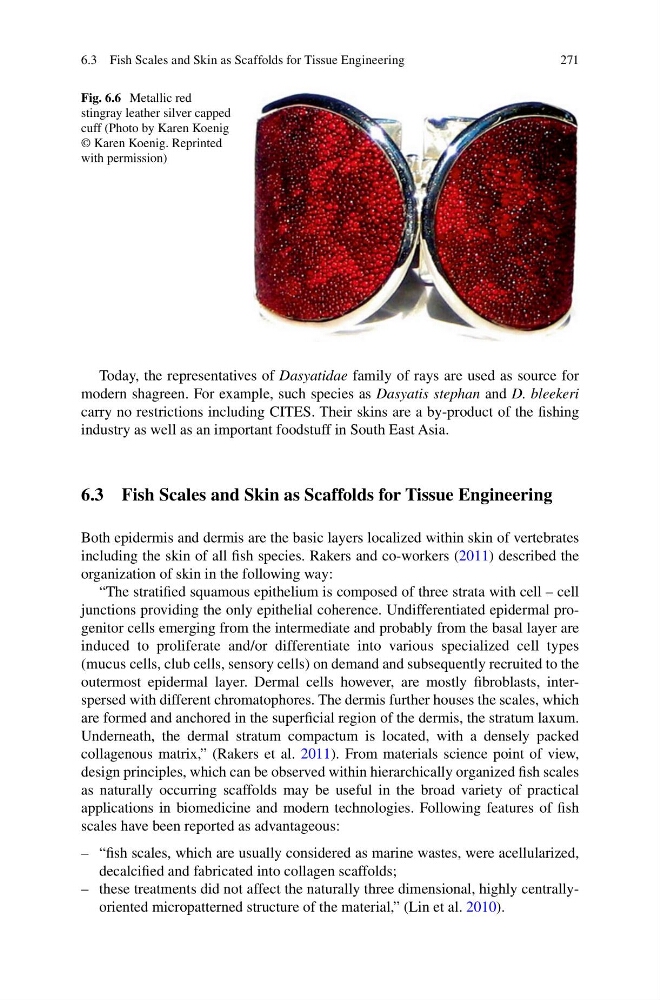
Fig. 6.6 Metallic red
stingray leather silver capped
cuff (Photo by Karen Koenig
© Karen Koenig. Reprinted
with permission)
6.3 Fish Scales and Skin as Scaffolds for Tissue Engineering
Today, the representatives of Dasyatidae family of rays are used as source for
modern shagreen. For example, such species as Dasyatis stephan and D. bleekeri
carry no restrictions including CITES. Their skins are a by-product of the fi shing
industry as well as an important foodstuff in South East Asia.
6.3 Fish Scales and Skin as Scaffolds for Tissue Engineering
Both epidermis and dermis are the basic layers localized within skin of vertebrates
including the skin of all fi sh species. Rakers and co-workers ( 2011 ) described the
organization of skin in the following way:
“The stratifi ed squamous epithelium is composed of three strata with cell – cell
junctions providing the only epithelial coherence. Undifferentiated epidermal progenitor cells emerging from the intermediate and probably from the basal layer are
induced to proliferate and/or differentiate into various specialized cell types
(mucus cells, club cells, sensory cells) on demand and subsequently recruited to the
outermost epidermal layer. Dermal cells however, are mostly fi broblasts, interspersed with different chromatophores. The dermis further houses the scales, which
are formed and anchored in the superfi cial region of the dermis, the stratum laxum.
Underneath, the dermal stratum compactum is located, with a densely packed
collagenous matrix,” (Rakers et al. 2011 ). From materials science point of view,
design principles, which can be observed within hierarchically organized fi sh scales
as naturally occurring scaffolds may be useful in the broad variety of practical
applications in biomedicine and modern technologies. Following features of fi sh
scales have been reported as advantageous:
– “fi sh scales, which are usually considered as marine wastes, were acellularized,
decalcifi ed and fabricated into collagen scaffolds;
– these treatments did not affect the naturally three dimensional, highly centrallyoriented micropatterned structure of the material,” (Lin et al. 2010 ).
Fig. 6.6 Metallic red
stingray leather silver capped
cuff (Photo by Karen Koenig
© Karen Koenig. Reprinted
with permission)
6.3 Fish Scales and Skin as Scaffolds for Tissue Engineering