

270
into galuchat, the French word for shagreen. Louis XV’s most famous mistress,
Madame de Pompadour, was the dominant patron of Monsieur Galluchat, and it was
said that a week didn’t go by when she didn’t buy some new object, often in
shagreen.”
Nearly 1,000 shagreen made artefacts including candlesticks and frames,
handbags and belts, vases and elaborate boxes, wallets and briefcases has been produced in London from 1899 to 1933 by English artisan John Paul Cooper. Shagreen
saw its hey-day in the twentieth century when its use by makers such as Clément
Rousseau, Jacques-Émile Ruhlman, Jean-Michel Frank, André Groult and Jules
Leleu made it the height of chic. Caunes and Perfettini wrote a defi nitive book on
the material in 1994 with the same publishers. The exhibition and catalogue were
the consequences of the popularity and importance of this earlier work (see for
review De Caunes and Perfettini 1995 ; Lefranc 2004 ; Perfettini 2005 ).
Throughout history, shagreen has been revered for its mesmerizing beauty, durability and functionality (Fig. 6.6 ). It was also frequently used in furniture and accessories during the Art Deco period.
There are some debates concerning shagreen as “environmentally correct material” because of animal protection policy. Probably, due to this situation such prominent companies that use shagreen as Ironies and R&Y Augousti, confi rm that they
use only sustainably-sourced remnants from the fi shing industry.
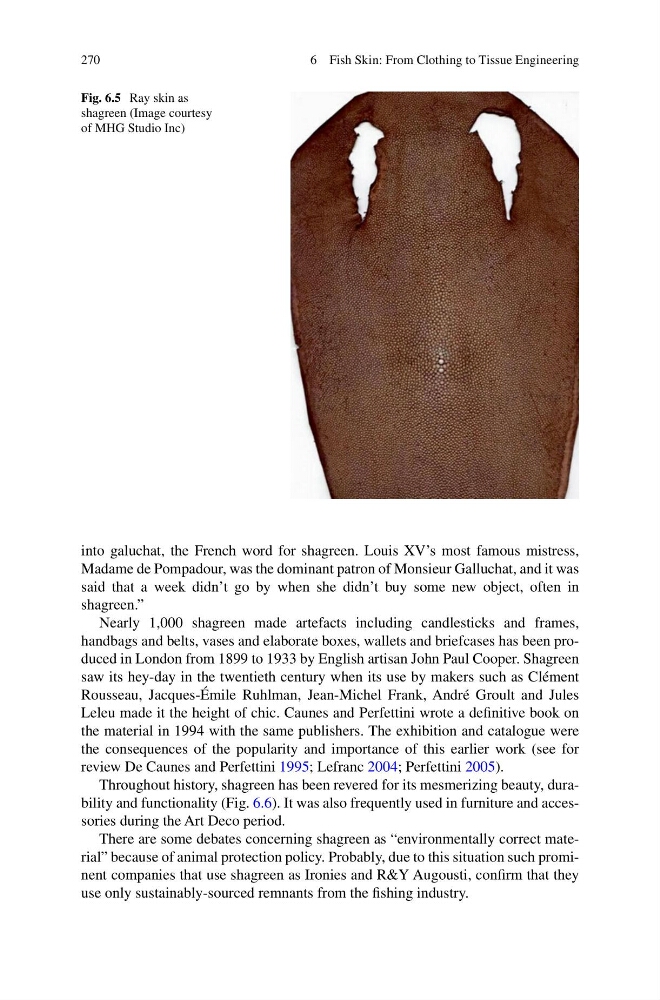
Fig. 6.5 Ray skin as
shagreen (Image courtesy
of MHG Studio Inc)
6 Fish Skin: From Clothing to Tissue Engineering
into galuchat, the French word for shagreen. Louis XV’s most famous mistress,
Madame de Pompadour, was the dominant patron of Monsieur Galluchat, and it was
said that a week didn’t go by when she didn’t buy some new object, often in
shagreen.”
Nearly 1,000 shagreen made artefacts including candlesticks and frames,
handbags and belts, vases and elaborate boxes, wallets and briefcases has been produced in London from 1899 to 1933 by English artisan John Paul Cooper. Shagreen
saw its hey-day in the twentieth century when its use by makers such as Clément
Rousseau, Jacques-Émile Ruhlman, Jean-Michel Frank, André Groult and Jules
Leleu made it the height of chic. Caunes and Perfettini wrote a defi nitive book on
the material in 1994 with the same publishers. The exhibition and catalogue were
the consequences of the popularity and importance of this earlier work (see for
review De Caunes and Perfettini 1995 ; Lefranc 2004 ; Perfettini 2005 ).
Throughout history, shagreen has been revered for its mesmerizing beauty, durability and functionality (Fig. 6.6 ). It was also frequently used in furniture and accessories during the Art Deco period.
There are some debates concerning shagreen as “environmentally correct material” because of animal protection policy. Probably, due to this situation such prominent companies that use shagreen as Ironies and R&Y Augousti, confi rm that they
use only sustainably-sourced remnants from the fi shing industry.
Fig. 6.5 Ray skin as
shagreen (Image courtesy
of MHG Studio Inc)
6 Fish Skin: From Clothing to Tissue Engineering