

264
6.1 Fish Skin Clothing and Leather
The earliest records of wide scale use of fi sh skins appear to have been used by the
Japanese Ainu culture in the fi fth century (Price 2005 ). Inuit and some southern
maritime cultures have used fi sh skins, especially salmon, since the Middle Ages for
their clothing accessories such as jackets and outer lining of shoes. For example,
broad variety of fi sh skin-made leather goods is known from the Nanai culture.
French Jesuit geographers travelling on the Ussury and the Amur in 1709 described
Nanai people for the fi rst time. They were also known as fi sh - skin tartars or Yupi
Tartars (Du Halde 1735 ). Their settlements were distributed in the region of the
Ussury River and on the Amur above the mouth of the Dondon River (which falls
into the Amur between today’s Khabarovsk and Komsomolsk-on-Amur in Russia).
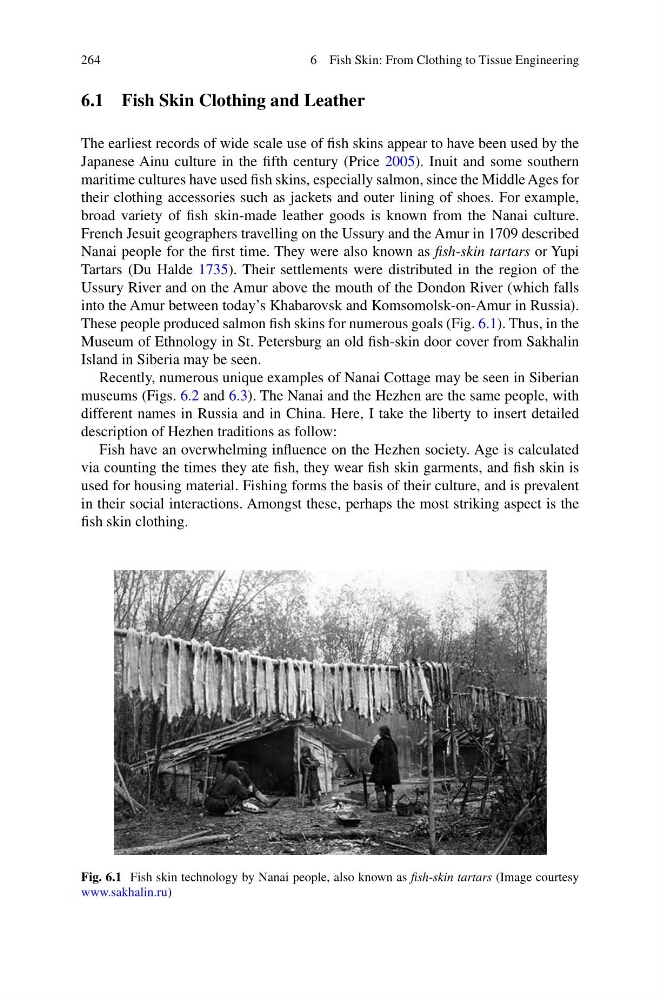
These people produced salmon fi sh skins for numerous goals (Fig. 6.1 ). Thus, in the
Museum of Ethnology in St. Petersburg an old fi sh-skin door cover from Sakhalin
Island in Siberia may be seen.
Recently, numerous unique examples of Nanai Cottage may be seen in Siberian
museums (Figs. 6.2 and 6.3 ). The Nanai and the Hezhen are the same people, with
different names in Russia and in China. Here, I take the liberty to insert detailed
description of Hezhen traditions as follow:
Fish have an overwhelming infl uence on the Hezhen society. Age is calculated
via counting the times they ate fi sh, they wear fi sh skin garments, and fi sh skin is
used for housing material. Fishing forms the basis of their culture, and is prevalent
in their social interactions. Amongst these, perhaps the most striking aspect is the
fi sh skin clothing.
Fig. 6.1 Fish skin technology by Nanai people, also known as fi sh - skin tartars (Image courtesy
www.sakhalin.ru )
6 Fish Skin: From Clothing to Tissue Engineering
6.1 Fish Skin Clothing and Leather
The earliest records of wide scale use of fi sh skins appear to have been used by the
Japanese Ainu culture in the fi fth century (Price 2005 ). Inuit and some southern
maritime cultures have used fi sh skins, especially salmon, since the Middle Ages for
their clothing accessories such as jackets and outer lining of shoes. For example,
broad variety of fi sh skin-made leather goods is known from the Nanai culture.
French Jesuit geographers travelling on the Ussury and the Amur in 1709 described
Nanai people for the fi rst time. They were also known as fi sh - skin tartars or Yupi
Tartars (Du Halde 1735 ). Their settlements were distributed in the region of the
Ussury River and on the Amur above the mouth of the Dondon River (which falls
into the Amur between today’s Khabarovsk and Komsomolsk-on-Amur in Russia).
These people produced salmon fi sh skins for numerous goals (Fig. 6.1 ). Thus, in the
Museum of Ethnology in St. Petersburg an old fi sh-skin door cover from Sakhalin
Island in Siberia may be seen.
Recently, numerous unique examples of Nanai Cottage may be seen in Siberian
museums (Figs. 6.2 and 6.3 ). The Nanai and the Hezhen are the same people, with
different names in Russia and in China. Here, I take the liberty to insert detailed
description of Hezhen traditions as follow:
Fish have an overwhelming infl uence on the Hezhen society. Age is calculated
via counting the times they ate fi sh, they wear fi sh skin garments, and fi sh skin is
used for housing material. Fishing forms the basis of their culture, and is prevalent
in their social interactions. Amongst these, perhaps the most striking aspect is the
fi sh skin clothing.
Fig. 6.1 Fish skin technology by Nanai people, also known as fi sh - skin tartars (Image courtesy
www.sakhalin.ru )
6 Fish Skin: From Clothing to Tissue Engineering