

258
on the vehicle surface creating a negatively charged, highly repellant surface. The
treated surface repels water, dirt and other pollutants. It is UV stable and increases
resistance to scratches. The surface is also easier to clean and keeps the vehicle
looking like new,” ( http://sym-tech.ca/programs-products/sharkskin/ ).
Recently, Han and Wang ( 2011 ) proposed a novel method for fabrication of the
biomimetic shark skin coating. Using hot embossing technology, the direct micro
replication of the microstructure on shark skin was investigated for the fi rst time.
Modeled after the shark skin sample, the negative structure was directly replicated
and printed on PMMA fl at plate in the hot embossing process, which relied on the
bionic shark-skin coating made of silica gel that was fabricated in the end. The preliminary experiment results indicate that this method is a high precision, high
throughput, high effi ciency and low cost way to fabricate bionic microstructure in
micron and submicron scale with good repeatability and availability.
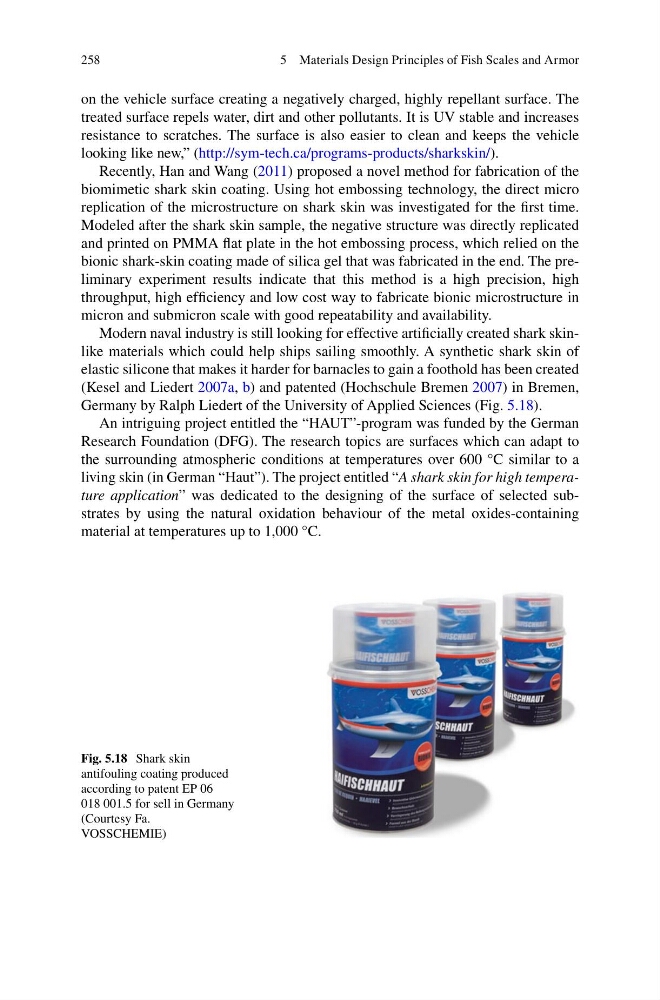
Modern naval industry is still looking for effective artifi cially created shark skinlike materials which could help ships sailing smoothly. A synthetic shark skin of
elastic silicone that makes it harder for barnacles to gain a foothold has been created
(Kesel and Liedert 2007a , b ) and patented (Hochschule Bremen 2007 ) in Bremen,
Germany by Ralph Liedert of the University of Applied Sciences (Fig. 5.18 ).
An intriguing project entitled the “HAUT”-program was funded by the German
Research Foundation (DFG). The research topics are surfaces which can adapt to
the surrounding atmospheric conditions at temperatures over 600 °C similar to a
living skin (in German “Haut”). The project entitled “ A shark skin for high temperature application ” was dedicated to the designing of the surface of selected substrates by using the natural oxidation behaviour of the metal oxides-containing
material at temperatures up to 1,000 °C.
Fig. 5.18 Shark skin
antifouling coating produced
according to patent EP 06
018 001.5 for sell in Germany
(Courtesy Fa.
VOSSCHEMIE)
5 Materials Design Principles of Fish Scales and Armor
on the vehicle surface creating a negatively charged, highly repellant surface. The
treated surface repels water, dirt and other pollutants. It is UV stable and increases
resistance to scratches. The surface is also easier to clean and keeps the vehicle
looking like new,” ( http://sym-tech.ca/programs-products/sharkskin/ ).
Recently, Han and Wang ( 2011 ) proposed a novel method for fabrication of the
biomimetic shark skin coating. Using hot embossing technology, the direct micro
replication of the microstructure on shark skin was investigated for the fi rst time.
Modeled after the shark skin sample, the negative structure was directly replicated
and printed on PMMA fl at plate in the hot embossing process, which relied on the
bionic shark-skin coating made of silica gel that was fabricated in the end. The preliminary experiment results indicate that this method is a high precision, high
throughput, high effi ciency and low cost way to fabricate bionic microstructure in
micron and submicron scale with good repeatability and availability.
Modern naval industry is still looking for effective artifi cially created shark skinlike materials which could help ships sailing smoothly. A synthetic shark skin of
elastic silicone that makes it harder for barnacles to gain a foothold has been created
(Kesel and Liedert 2007a , b ) and patented (Hochschule Bremen 2007 ) in Bremen,
Germany by Ralph Liedert of the University of Applied Sciences (Fig. 5.18 ).
An intriguing project entitled the “HAUT”-program was funded by the German
Research Foundation (DFG). The research topics are surfaces which can adapt to
the surrounding atmospheric conditions at temperatures over 600 °C similar to a
living skin (in German “Haut”). The project entitled “ A shark skin for high temperature application ” was dedicated to the designing of the surface of selected substrates by using the natural oxidation behaviour of the metal oxides-containing
material at temperatures up to 1,000 °C.
Fig. 5.18 Shark skin
antifouling coating produced
according to patent EP 06
018 001.5 for sell in Germany
(Courtesy Fa.
VOSSCHEMIE)
5 Materials Design Principles of Fish Scales and Armor