

255
Interestingly, sharks can even bristle their scales at higher swimming speeds. The
phenomenon of the scale erection may be determined by the change the helical
orientation of the collagen bundles to which the scales are attached. Probably it
accomplished through increased overall skin tension at higher swimming speeds, as
the subcutaneous pressure has been demonstrated to increase from 7 to 14 Pa in a
resting lemon shark Negaprion brevirostris to 200 kPa (29 psi) during fast swimming (Wainwright et al. 1978 ). In their Water Tunnel Experiments with bristle shark
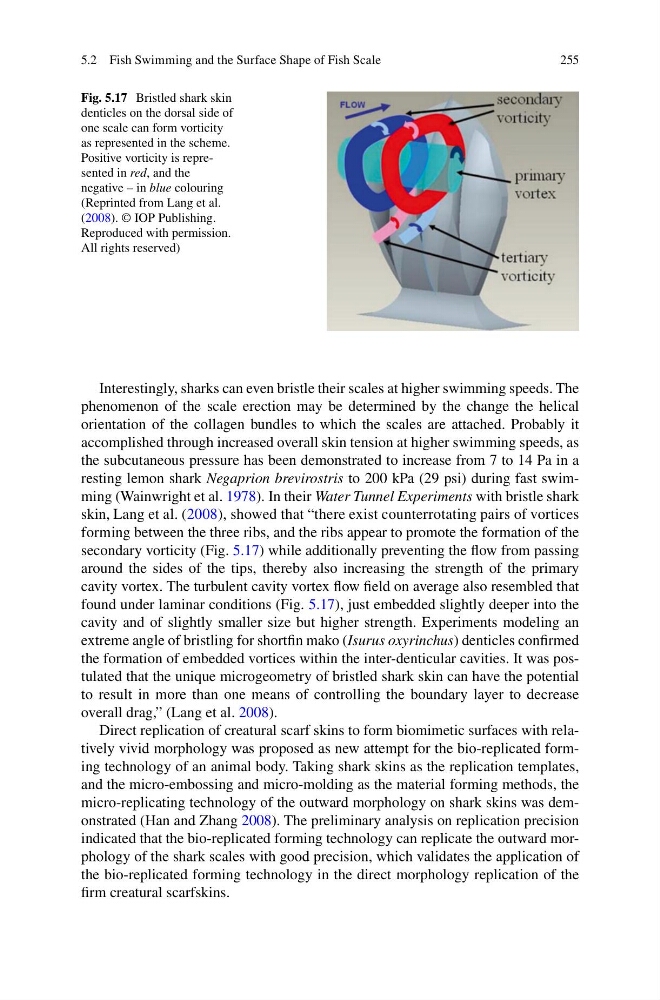
skin, Lang et al. ( 2008 ), showed that “there exist counterrotating pairs of vortices
forming between the three ribs, and the ribs appear to promote the formation of the
secondary vorticity (Fig. 5.17 ) while additionally preventing the fl ow from passing
around the sides of the tips, thereby also increasing the strength of the primary
cavity vortex. The turbulent cavity vortex fl ow fi eld on average also resembled that
found under laminar conditions (Fig. 5.17 ), just embedded slightly deeper into the
cavity and of slightly smaller size but higher strength. Experiments modeling an
extreme angle of bristling for shortfi n mako ( Isurus oxyrinchus ) denticles confi rmed
the formation of embedded vortices within the inter-denticular cavities. It was postulated that the unique microgeometry of bristled shark skin can have the potential
to result in more than one means of controlling the boundary layer to decrease
overall drag,” (Lang et al. 2008 ).
Direct replication of creatural scarf skins to form biomimetic surfaces with relatively vivid morphology was proposed as new attempt for the bio-replicated forming technology of an animal body. Taking shark skins as the replication templates,
and the micro-embossing and micro-molding as the material forming methods, the
micro-replicating technology of the outward morphology on shark skins was demonstrated (Han and Zhang 2008 ). The preliminary analysis on replication precision
indicated that the bio-replicated forming technology can replicate the outward morphology of the shark scales with good precision, which validates the application of
the bio-replicated forming technology in the direct morphology replication of the
fi rm creatural scarfskins.
Fig. 5.17 Bristled shark skin
denticles on the dorsal side of
one scale can form vorticity
as represented in the scheme.
Positive vorticity is represented in red , and the
negative – in blue colouring
(Reprinted from Lang et al.
( 2008 ). © IOP Publishing.
Reproduced with permission.
All rights reserved)
5.2 Fish Swimming and the Surface Shape of Fish Scale
Interestingly, sharks can even bristle their scales at higher swimming speeds. The
phenomenon of the scale erection may be determined by the change the helical
orientation of the collagen bundles to which the scales are attached. Probably it
accomplished through increased overall skin tension at higher swimming speeds, as
the subcutaneous pressure has been demonstrated to increase from 7 to 14 Pa in a
resting lemon shark Negaprion brevirostris to 200 kPa (29 psi) during fast swimming (Wainwright et al. 1978 ). In their Water Tunnel Experiments with bristle shark
skin, Lang et al. ( 2008 ), showed that “there exist counterrotating pairs of vortices
forming between the three ribs, and the ribs appear to promote the formation of the
secondary vorticity (Fig. 5.17 ) while additionally preventing the fl ow from passing
around the sides of the tips, thereby also increasing the strength of the primary
cavity vortex. The turbulent cavity vortex fl ow fi eld on average also resembled that
found under laminar conditions (Fig. 5.17 ), just embedded slightly deeper into the
cavity and of slightly smaller size but higher strength. Experiments modeling an
extreme angle of bristling for shortfi n mako ( Isurus oxyrinchus ) denticles confi rmed
the formation of embedded vortices within the inter-denticular cavities. It was postulated that the unique microgeometry of bristled shark skin can have the potential
to result in more than one means of controlling the boundary layer to decrease
overall drag,” (Lang et al. 2008 ).
Direct replication of creatural scarf skins to form biomimetic surfaces with relatively vivid morphology was proposed as new attempt for the bio-replicated forming technology of an animal body. Taking shark skins as the replication templates,
and the micro-embossing and micro-molding as the material forming methods, the
micro-replicating technology of the outward morphology on shark skins was demonstrated (Han and Zhang 2008 ). The preliminary analysis on replication precision
indicated that the bio-replicated forming technology can replicate the outward morphology of the shark scales with good precision, which validates the application of
the bio-replicated forming technology in the direct morphology replication of the
fi rm creatural scarfskins.
Fig. 5.17 Bristled shark skin
denticles on the dorsal side of
one scale can form vorticity
as represented in the scheme.
Positive vorticity is represented in red , and the
negative – in blue colouring
(Reprinted from Lang et al.
( 2008 ). © IOP Publishing.
Reproduced with permission.
All rights reserved)
5.2 Fish Swimming and the Surface Shape of Fish Scale