

239
therefore broad variety of scales with respect to their size, thickness, and shapes
are to be found up today. For examples, there are scales with bottoms which are
rounded, or fl at, or pointed. It is thought that the Romans developed lamellar armor,
that didn’t require a backing. In this type of scaled armor the main principle to
manufacture the construct was wiring each scale to each of its neighbours, making
it more resilient (see for review Robinson 1975 ).
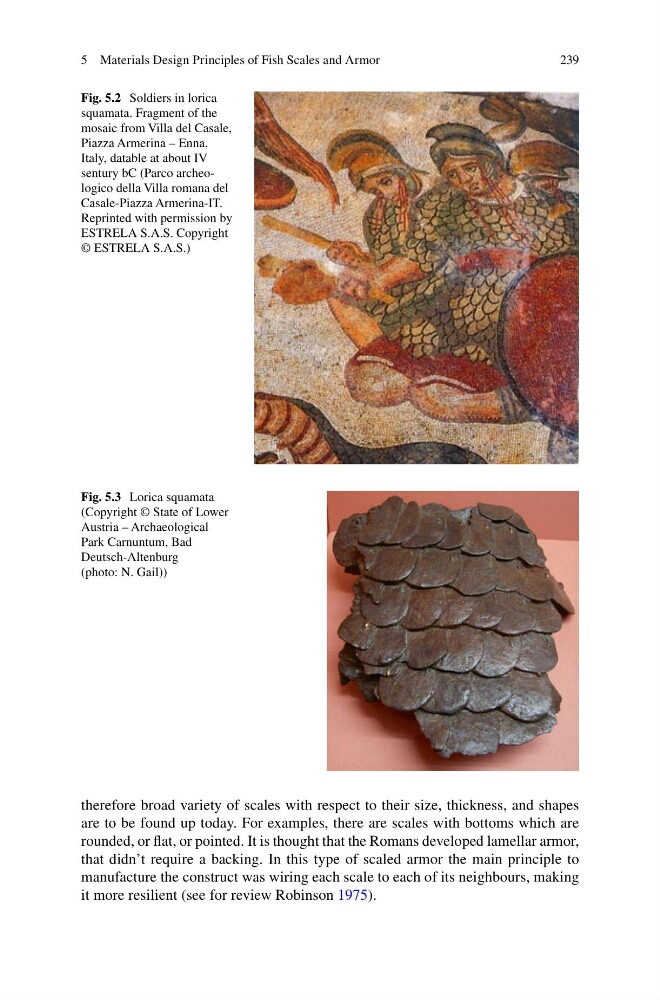
Fig. 5.2 Soldiers in lorica
squamata. Fragment of the
mosaic from Villa del Casale,
Piazza Armerina – Enna,
Italy, datable at about IV
sentury bC (Parco archeologico della Villa romana del
Casale-Piazza Armerina-IT.
Reprinted with permission by
ESTRELA S.A.S. Copyright
© ESTRELA S.A.S.)
Fig. 5.3 Lorica squamata
(Copyright © State of Lower
Austria – Archaeological
Park Carnuntum, Bad
Deutsch-Altenburg
(photo: N. Gail))
5 Materials Design Principles of Fish Scales and Armor
therefore broad variety of scales with respect to their size, thickness, and shapes
are to be found up today. For examples, there are scales with bottoms which are
rounded, or fl at, or pointed. It is thought that the Romans developed lamellar armor,
that didn’t require a backing. In this type of scaled armor the main principle to
manufacture the construct was wiring each scale to each of its neighbours, making
it more resilient (see for review Robinson 1975 ).
Fig. 5.2 Soldiers in lorica
squamata. Fragment of the
mosaic from Villa del Casale,
Piazza Armerina – Enna,
Italy, datable at about IV
sentury bC (Parco archeologico della Villa romana del
Casale-Piazza Armerina-IT.
Reprinted with permission by
ESTRELA S.A.S. Copyright
© ESTRELA S.A.S.)
Fig. 5.3 Lorica squamata
(Copyright © State of Lower
Austria – Archaeological
Park Carnuntum, Bad
Deutsch-Altenburg
(photo: N. Gail))
5 Materials Design Principles of Fish Scales and Armor