

238
As scales form a natural layer of armor for fi sh and reptilians, it is unsurprising
that they prove useful in designing military armor since ancient times in human
communities. Armor covered in scales bends to conform to the body of a soldier,
defl ecting attacks without sacrifi cing mobility. The selfsimilar, tileable nature of
scales also simplifi es manufacture of the armor, as scales can be mass produced and
fi tted to any underlying shape. The individual scales are produced separately, then
typically woven together and attached to an underlying armor (Landreneau 2011 ).
While segmented scale armor is inherently more fl exible than a solid plate of the
same thickness, both engineers, the Nature in the case of fi sh armor, and human in
the case of military armor, used the same physical principles.
The use of scales in protective armor dates back at least to the ancient Persians.
Herodotus also makes mention of Persian scaled armor, describing colored tunics
covered in iron fi sh scales (Laufer 1914 ; Herodotus 1954 ). Persian Elamite artwork
as early as the third millennium BCE depicts people wearing armor covered in
scales. Scale armor remained prominent throughout the reign of the Roman Empire,
where two types of fi sh scale mimicking lorica’s has been developed. The fi rst one,
Lorica Squamata , was a type of scaled armor used in Rome as equipment for
soldiers (Fig. 5.2 ). Manufacture of such scale armors was cheap. Their protective
properties for the tasks in the battlefi eld were acceptable. Even after more advanced
armors were invented, this version was used for a long time. Here, the description
of this construct according to http://www.history-of-armor.com/LoricaSquamata.
html : the “squamae”, or individual scales, were either brass or iron, or other alternating metals on the same shirt. The multiple layers gave satisfactory protection due
to the multidirectional overlapping scales. These were wired together in horizontal
rows which were in special manner laced to the backing. Correspondingly between
4 and 12 holes, which were necessary for wiring of each scale to the next in the row,
can be observed on examples of this kind of lorica.
The armor consisted of innumerable metal scales arranged in overlapping horizontal rows (Fig. 5.3 ). The leather was the commonest strong backing material to
that metal scales has been attached. Scaled armors were produced individual,
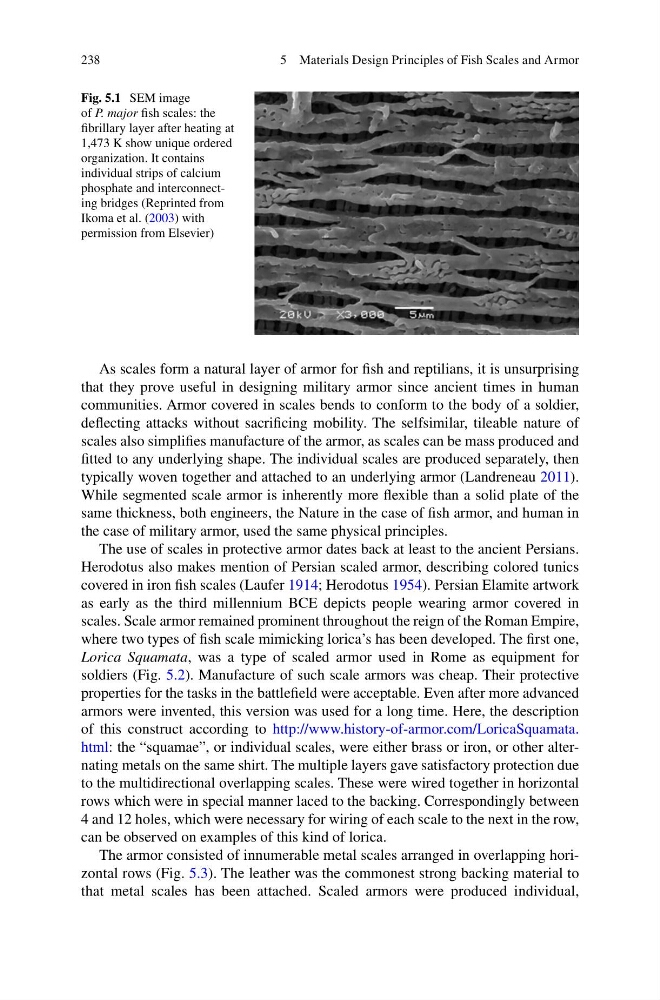
Fig. 5.1 SEM image
of P. major fi sh scales: the
fi brillary layer after heating at
1,473 K show unique ordered
organization. It contains
individual strips of calcium
phosphate and interconnecting bridges (Reprinted from
Ikoma et al. ( 2003 ) with
permission from Elsevier)
5 Materials Design Principles of Fish Scales and Armor
As scales form a natural layer of armor for fi sh and reptilians, it is unsurprising
that they prove useful in designing military armor since ancient times in human
communities. Armor covered in scales bends to conform to the body of a soldier,
defl ecting attacks without sacrifi cing mobility. The selfsimilar, tileable nature of
scales also simplifi es manufacture of the armor, as scales can be mass produced and
fi tted to any underlying shape. The individual scales are produced separately, then
typically woven together and attached to an underlying armor (Landreneau 2011 ).
While segmented scale armor is inherently more fl exible than a solid plate of the
same thickness, both engineers, the Nature in the case of fi sh armor, and human in
the case of military armor, used the same physical principles.
The use of scales in protective armor dates back at least to the ancient Persians.
Herodotus also makes mention of Persian scaled armor, describing colored tunics
covered in iron fi sh scales (Laufer 1914 ; Herodotus 1954 ). Persian Elamite artwork
as early as the third millennium BCE depicts people wearing armor covered in
scales. Scale armor remained prominent throughout the reign of the Roman Empire,
where two types of fi sh scale mimicking lorica’s has been developed. The fi rst one,
Lorica Squamata , was a type of scaled armor used in Rome as equipment for
soldiers (Fig. 5.2 ). Manufacture of such scale armors was cheap. Their protective
properties for the tasks in the battlefi eld were acceptable. Even after more advanced
armors were invented, this version was used for a long time. Here, the description
of this construct according to http://www.history-of-armor.com/LoricaSquamata.
html : the “squamae”, or individual scales, were either brass or iron, or other alternating metals on the same shirt. The multiple layers gave satisfactory protection due
to the multidirectional overlapping scales. These were wired together in horizontal
rows which were in special manner laced to the backing. Correspondingly between
4 and 12 holes, which were necessary for wiring of each scale to the next in the row,
can be observed on examples of this kind of lorica.
The armor consisted of innumerable metal scales arranged in overlapping horizontal rows (Fig. 5.3 ). The leather was the commonest strong backing material to
that metal scales has been attached. Scaled armors were produced individual,
Fig. 5.1 SEM image
of P. major fi sh scales: the
fi brillary layer after heating at
1,473 K show unique ordered
organization. It contains
individual strips of calcium
phosphate and interconnecting bridges (Reprinted from
Ikoma et al. ( 2003 ) with
permission from Elsevier)
5 Materials Design Principles of Fish Scales and Armor