

229
Ctenoid Scales Crappie and bass are representatives of fi sh with spiny fi n rays and
ctenoid sales, which have a toothed outer edge. The characteristic rough texture of
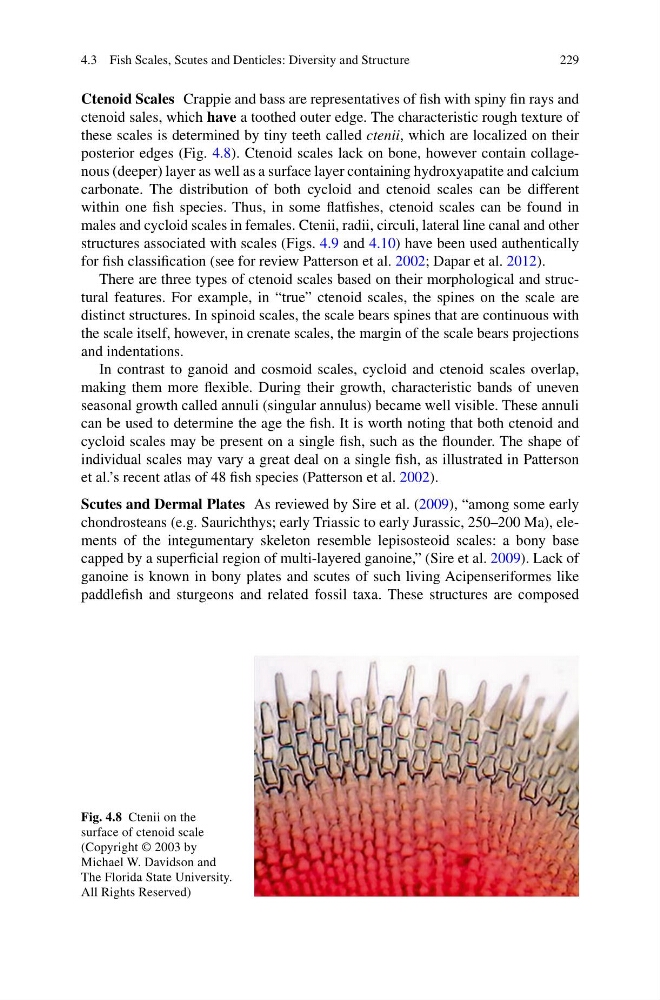
these scales is determined by tiny teeth called ctenii , which are localized on their
posterior edges (Fig. 4.8 ). Ctenoid scales lack on bone, however contain collagenous (deeper) layer as well as a surface layer containing hydroxyapatite and calcium
carbonate. The distribution of both cycloid and ctenoid scales can be different
within one fi sh species. Thus, in some fl atfi shes, ctenoid scales can be found in
males and cycloid scales in females. Ctenii, radii, circuli, lateral line canal and other
structures associated with scales (Figs. 4.9 and 4.10 ) have been used authentically
for fi sh classifi cation (see for review Patterson et al. 2002 ; Dapar et al. 2012 ).
There are three types of ctenoid scales based on their morphological and structural features. For example, in “true” ctenoid scales, the spines on the scale are
distinct structures. In spinoid scales, the scale bears spines that are continuous with
the scale itself, however, in crenate scales, the margin of the scale bears projections
and indentations.
In contrast to ganoid and cosmoid scales, cycloid and ctenoid scales overlap,
making them more fl exible. During their growth, characteristic bands of uneven
seasonal growth called annuli (singular annulus) became well visible. These annuli
can be used to determine the age the fi sh. It is worth noting that both ctenoid and
cycloid scales may be present on a single fi sh, such as the fl ounder. The shape of
individual scales may vary a great deal on a single fi sh, as illustrated in Patterson
et al.’s recent atlas of 48 fi sh species (Patterson et al. 2002 ).
Scutes and Dermal Plates As reviewed by Sire et al. ( 2009 ), “among some early
chondrosteans (e.g. Saurichthys; early Triassic to early Jurassic, 250–200 Ma), elements of the integumentary skeleton resemble lepisosteoid scales: a bony base
capped by a superfi cial region of multi-layered ganoine,” (Sire et al. 2009 ). Lack of
ganoine is known in bony plates and scutes of such living Acipenseriformes like
paddlefi sh and sturgeons and related fossil taxa. These structures are composed
Fig. 4.8 Ctenii on the
surface of ctenoid scale
(Copyright © 2003 by
Michael W. Davidson and
The Florida State University.
All Rights Reserved)
4.3 Fish Scales, Scutes and Denticles: Diversity and Structure
Ctenoid Scales Crappie and bass are representatives of fi sh with spiny fi n rays and
ctenoid sales, which have a toothed outer edge. The characteristic rough texture of
these scales is determined by tiny teeth called ctenii , which are localized on their
posterior edges (Fig. 4.8 ). Ctenoid scales lack on bone, however contain collagenous (deeper) layer as well as a surface layer containing hydroxyapatite and calcium
carbonate. The distribution of both cycloid and ctenoid scales can be different
within one fi sh species. Thus, in some fl atfi shes, ctenoid scales can be found in
males and cycloid scales in females. Ctenii, radii, circuli, lateral line canal and other
structures associated with scales (Figs. 4.9 and 4.10 ) have been used authentically
for fi sh classifi cation (see for review Patterson et al. 2002 ; Dapar et al. 2012 ).
There are three types of ctenoid scales based on their morphological and structural features. For example, in “true” ctenoid scales, the spines on the scale are
distinct structures. In spinoid scales, the scale bears spines that are continuous with
the scale itself, however, in crenate scales, the margin of the scale bears projections
and indentations.
In contrast to ganoid and cosmoid scales, cycloid and ctenoid scales overlap,
making them more fl exible. During their growth, characteristic bands of uneven
seasonal growth called annuli (singular annulus) became well visible. These annuli
can be used to determine the age the fi sh. It is worth noting that both ctenoid and
cycloid scales may be present on a single fi sh, such as the fl ounder. The shape of
individual scales may vary a great deal on a single fi sh, as illustrated in Patterson
et al.’s recent atlas of 48 fi sh species (Patterson et al. 2002 ).
Scutes and Dermal Plates As reviewed by Sire et al. ( 2009 ), “among some early
chondrosteans (e.g. Saurichthys; early Triassic to early Jurassic, 250–200 Ma), elements of the integumentary skeleton resemble lepisosteoid scales: a bony base
capped by a superfi cial region of multi-layered ganoine,” (Sire et al. 2009 ). Lack of
ganoine is known in bony plates and scutes of such living Acipenseriformes like
paddlefi sh and sturgeons and related fossil taxa. These structures are composed
Fig. 4.8 Ctenii on the
surface of ctenoid scale
(Copyright © 2003 by
Michael W. Davidson and
The Florida State University.
All Rights Reserved)
4.3 Fish Scales, Scutes and Denticles: Diversity and Structure