

181
3.8.1 Conclusion
To my best knowledge, there are no reports on examples of pathological
bio mineralization of marine vertebrates with respect to silica. Probably, this situation
is determined by the non-siliceous diet of these animals in contrast to herbivorous
animals such as sheep and cattle where siliceous urinary calculi have been observed.
The consumption of forage with a high content of plant silica seems to be the reason
for development of silica calculi with urethral obstruction in about 4 % of range
steers wintered in the northwestern plains of North America (Ehrlich et al. 2010 ).
Although one report on a silica eating marine animal exists, there is no information
about fi nding of some siliceous bodies within the organism. Sponges, and especially
demosponges, associated with coral reef are the components of the feeding diet of
the Hawksbill turtles ( Eretmochelys imbricata ). Demosponges possess horny, proteinaceous skeletons with huge amounts of siliceous spicules. There are no doubts
that these sponges are some kind of protein rich diet for turtles. As reported by
Meylan ( 1988 ) in her Science publication: “dissociated siliceous spicules were found
embedded in the intestinal epithelia of hawksbills. No morphological adaptations
were identifi ed that might facilitate the handling of spicules. In other spongivores,
spicule-compacting organs, modifi cations of masticatory structures, and copious
mucus production are thought to serve this purpose,” (Meylan 1988 ).
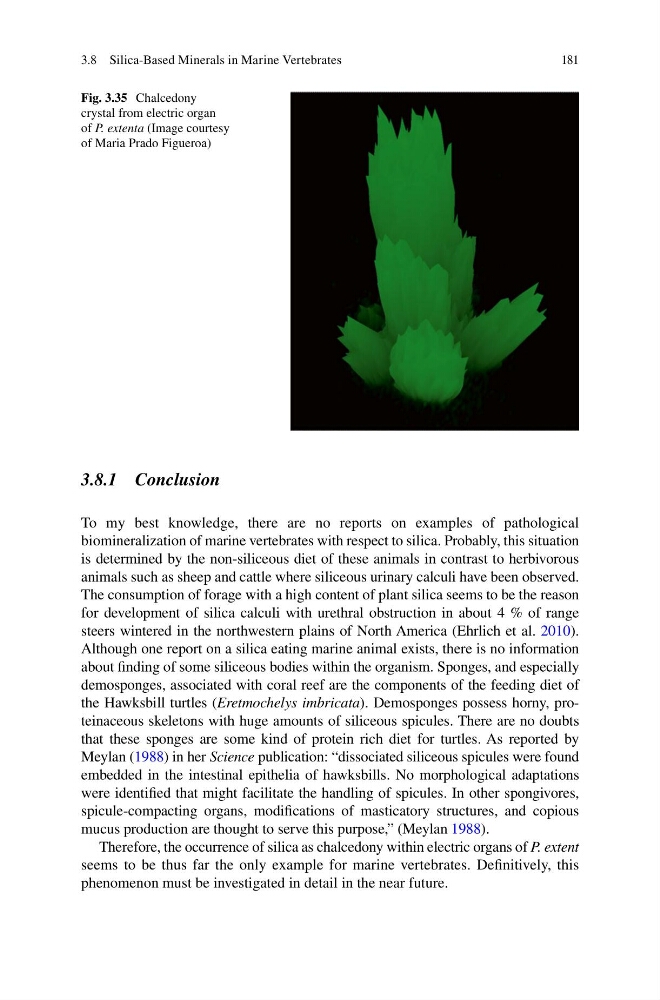
Therefore, the occurrence of silica as chalcedony within electric organs of P. extent
seems to be thus far the only example for marine vertebrates. Defi nitively, this
phenomenon must be investigated in detail in the near future.
Fig. 3.35 Chalcedony
crystal from electric organ
of P. extenta (Image courtesy
of Maria Prado Figueroa)
3.8 Silica-Based Minerals in Marine Vertebrates
3.8.1 Conclusion
To my best knowledge, there are no reports on examples of pathological
bio mineralization of marine vertebrates with respect to silica. Probably, this situation
is determined by the non-siliceous diet of these animals in contrast to herbivorous
animals such as sheep and cattle where siliceous urinary calculi have been observed.
The consumption of forage with a high content of plant silica seems to be the reason
for development of silica calculi with urethral obstruction in about 4 % of range
steers wintered in the northwestern plains of North America (Ehrlich et al. 2010 ).
Although one report on a silica eating marine animal exists, there is no information
about fi nding of some siliceous bodies within the organism. Sponges, and especially
demosponges, associated with coral reef are the components of the feeding diet of
the Hawksbill turtles ( Eretmochelys imbricata ). Demosponges possess horny, proteinaceous skeletons with huge amounts of siliceous spicules. There are no doubts
that these sponges are some kind of protein rich diet for turtles. As reported by
Meylan ( 1988 ) in her Science publication: “dissociated siliceous spicules were found
embedded in the intestinal epithelia of hawksbills. No morphological adaptations
were identifi ed that might facilitate the handling of spicules. In other spongivores,
spicule-compacting organs, modifi cations of masticatory structures, and copious
mucus production are thought to serve this purpose,” (Meylan 1988 ).
Therefore, the occurrence of silica as chalcedony within electric organs of P. extent
seems to be thus far the only example for marine vertebrates. Defi nitively, this
phenomenon must be investigated in detail in the near future.
Fig. 3.35 Chalcedony
crystal from electric organ
of P. extenta (Image courtesy
of Maria Prado Figueroa)
3.8 Silica-Based Minerals in Marine Vertebrates